KAMPALA.
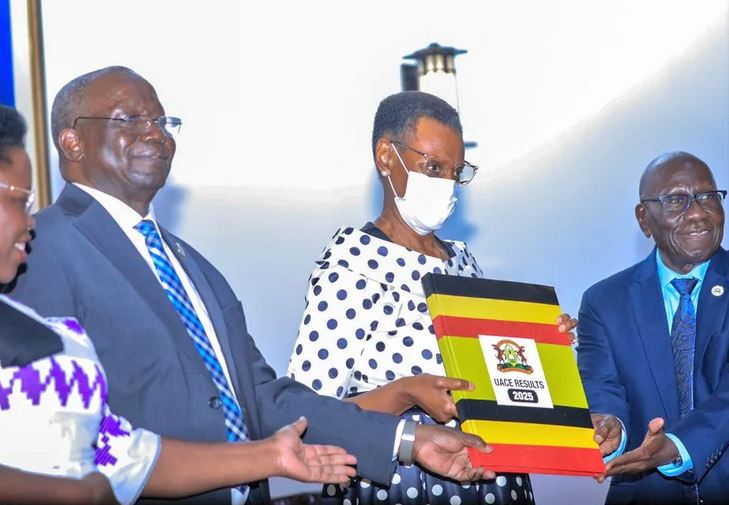
A record 68.6 percent of candidates who sat the 2025 Uganda Advanced Certificate of Education (UACE) qualify for university admission, according to the results released by Uganda National Examinations Board (Uneb) Friday.
According to the results , a total of 113,291 candidates out of 165,172 who sat the examinations qualified for university, representing 68.6 percent.
The figures indicate a 3.1 percentage point increase in the proportion of students meeting the minimum requirements for degree programmes, reflecting an overall improvement in academic performance year-on-year.
In the 2024 UACE examinations, a total of 92,273 candidates qualified for university admission out of 140,888 who sat the exams, representing 65.5 percent of the cohort.
A total of 166,400 candidates registered for the 2025 UACE examinations, an increase of 17.2 percent from 141,996 candidates in 2024. Of these, 72,764 (43.7 percent) were female and 93,636 (56.3 percent) male.
The number of examination centres also rose, from 2,255 in 2024 to 2,452 in 2025, ensuring more candidates could access the examinations closer to their schools.
Out of the registered candidates, 165,172 actually sat the exams, representing a slight decrease in absenteeism from 0.8 percent in 2024 to 0.7 percent this year.
“In the post-COVID period, the rate of increase in candidature sitting the exam has been quite rapid, rising from 96,557 in 2022 to 165,172 in 2025 — a 71 percent increase,” Uneb executive director Dan Odongo said.
Overall Performance
The 2025 results indicate an overall improvement across multiple subjects, particularly in Mathematics, Chemistry, Agriculture, Geography, Economics, Biology, and Literature in English.
According to Uneb’s statistics, 41.7 percent of candidates achieved a 3 Principal pass (3P), while 26.9 percent attained a 2 Principal pass (2P), and 19.3 percent secured a 1 Principal pass (1P).
An additional 11 percent achieved a Subsidiary pass (1S), leaving only 1.1 percent of candidates failing to qualify for the UACE certificate.
These figures suggest that more candidates than ever before are now eligible for higher education opportunities.
“University admissions to degree courses have historically required two Principal level passes. Based on this criterion, 113,291 candidates (68.6%) qualify for degree programmes, up from 92,273 (65.5%) in 2024,” Odongo said.
For other tertiary institutions, including TVET colleges, the requirement of one Principal and two Subsidiary passes means that 145,129 candidates (87.9%) qualify.
Gender Performance
Proportionally, female candidates outperformed their male counterparts at most levels and in most subjects, especially in Humanities, Mathematics, General Paper, and Information and Communication Technology (ICT).
At the top level of A passes, however, male candidates scored higher in Mathematics and Sciences, a reflection of the continued gender imbalance in entries for STEM subjects.
Female participation in Science and Mathematics is increasing but still lags behind male representation.

The 2025 examinations also included candidates from special interest groups. A total of 540 Special Needs Education (SNE) candidates sat the exams, with males and females almost evenly represented.
The SNE candidates’ performance was commendable, with most securing Principal and Subsidiary passes.
Notably, 70 inmates from Uganda Government Upper Prison, Luzira, participated in the exams, of whom 68 sat for the papers.
More than 90 percent of these candidates qualified for the UACE certificate, demonstrating the transformative power of education even in challenging circumstances.
While the results show improvements in several subjects, Uneb highlighted persistent challenges in both Humanities and Sciences.
Students continue to struggle with practical applications in Science subjects, analytical and evaluative skills in Humanities, and the ability to relate classroom knowledge to real-life scenarios.
The Board also reported low levels of examination malpractice, with only 351 cases (0.2 percent of total candidates) recorded across 47 centres.
Investigations into these cases are ongoing, and results for implicated candidates will be withheld until the completion of the review process.
The results have been uploaded to examination centre portals, allowing schools to download them immediately.
Hard copies will be available at Uneb Kyambogo offices next week. Candidates and parents can also access individual results via SMS on MTN and Airtel networks by sending “UACE” followed by the candidate’s index number to 6600.
As the country celebrates the release of UACE results, education stakeholders are encouraged to continue supporting learners through career guidance, university placement, and professional development opportunities.
Uneb has assured that detailed reports on candidates’ performance will be sent to schools to guide teaching and learning strategies for future cohorts.
