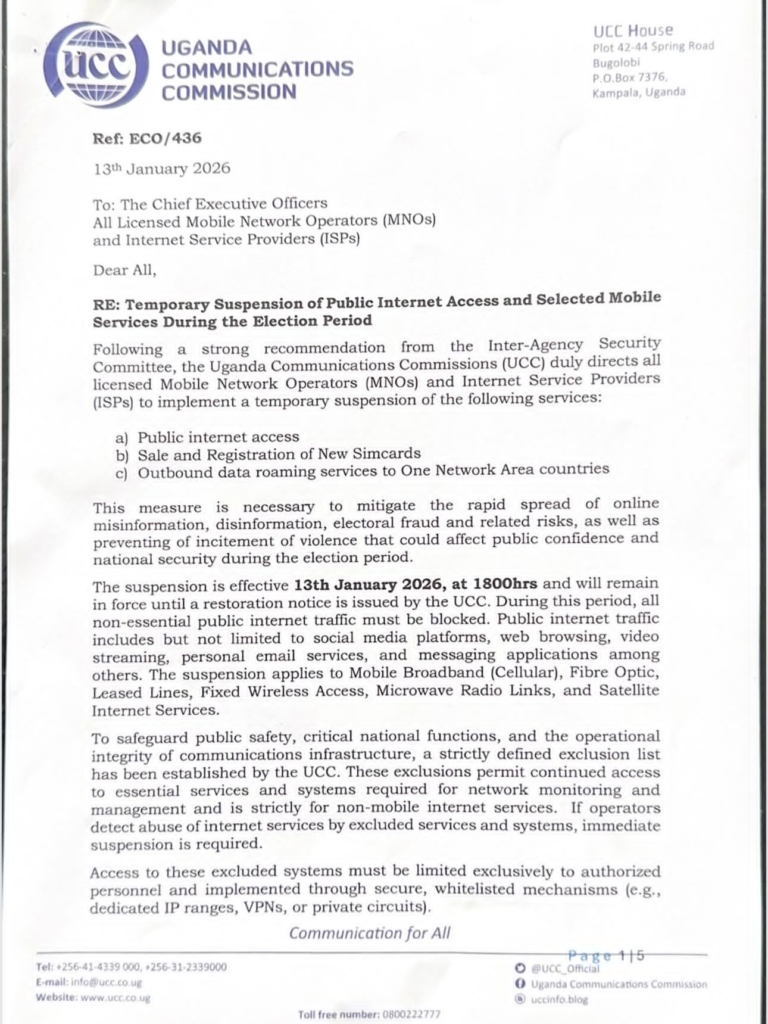
KAMPALA.The government has directed all mobile network operators and internet service providers to temporarily suspend public internet access and selected mobile services during the ongoing election period, citing national security concerns.
In a directive issued on January 13, 2026, and addressed to chief executive officers of licensed mobile network operators (MNOs) and internet service providers (ISPs), the regulator said the suspension takes effect at 6pm on Tuesday and will remain in force until further notice.
The Uganda Communications Commission (UCC), the regulators, said the decision followed a “strong recommendation” from the Inter-Agency Security Committee and is intended to mitigate the rapid spread of online misinformation and disinformation, prevent electoral fraud, and curb incitement to violence that could undermine public confidence and national security during the polls.
Under the directive, operators are required to suspend public internet access, halt the sale and registration of new SIM cards, and disable outbound data roaming services to countries within the One Network Area framework.
The commission said the suspension applies across multiple access technologies, including mobile broadband, fibre optic connections, leased lines, fixed wireless access, microwave radio links and satellite internet services.
“The UCC acknowledges the operational challenges this directive may impose and appreciates your full cooperation in upholding national stability during this sensitive period,” the directive, signed by Executive Director Nyombi Thembo, states.
During the period, all non-essential public internet traffic must be blocked, including access to social media platforms, web browsing, video streaming, personal email services and messaging applications.
However, UCC outlined a strictly controlled exclusion list allowing continued access to essential services, limited to non-mobile internet connections and accessible only to authorised personnel through secure, whitelisted mechanisms such as dedicated IP ranges, virtual private networks or private circuits.
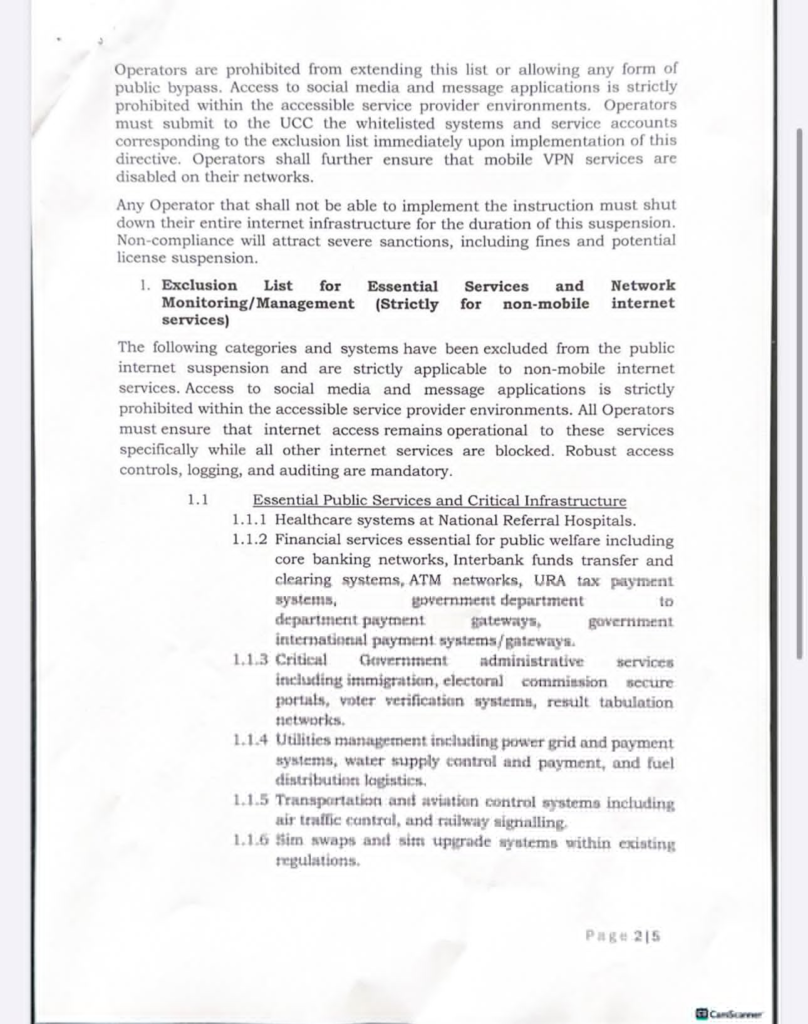
Mr Nyombi did not name the exempted entities but indicated that they include healthcare systems at national referral hospitals; core financial and payment infrastructure such as banking networks, interbank transfer and clearing systems, ATM networks, Uganda Revenue Authority tax payment platforms and government payment gateways; and critical government administrative systems, including immigration services, Electoral Commission secure portals, voter verification tools and result tabulation networks.
Also excluded are utilities management systems covering electricity, water and fuel distribution; transportation and aviation control systems such as air traffic control and railway signalling; and regulated SIM swap and upgrade systems.
Network management and cybersecurity tools, including network operations centres, routing diagnostics, fault detection systems, intrusion detection platforms and regulatory reporting portals, are also permitted to remain operational.
UCC warned that operators are prohibited from extending the exclusion list or allowing any form of public bypass.
Access to social media and messaging applications is strictly barred within exempted environments, while mobile VPN services must be disabled across all networks.
Operators have been instructed to submit details of all whitelisted systems to the regulator immediately, establish 24-hour incident response teams and maintain detailed traffic logs, which must be made available for inspection upon request.
“Any technical issues, suspected breaches or compliance challenges must be reported to the commission within 30 minutes,” Nyombi said.
The regulator cautioned that any operator unable to fully implement the directive must shut down its entire internet infrastructure for the duration of the suspension. Non-compliance, UCC said, will attract severe sanctions, including fines and potential suspension of operating licences.
The directive, signed by Executive Director Nyombi Thembo, adds that internet services will only be restored upon receipt of explicit written notice from the commission, with restoration expected to be carried out in phases.
The shutdown is not unprecedented in Uganda. Similar restrictions were imposed during the 2016 and 2021 general elections, when authorities blocked access to social media platforms and, in 2021, ordered a near-total internet blackout that lasted several days through polling and vote tallying.
At the time, government officials cited security concerns and the need to prevent unrest, while critics argued the measures curtailed access to information and impeded independent election monitoring.
Uganda’s move mirrors a broader pattern across several African countries where internet disruptions have increasingly been used during elections, protests and periods of political tension.
In recent years, countries such as Tanzania, Niger, Zambia, the Republic of Congo and Togo have experienced partial or full internet shutdowns around disputed polls or mass demonstrations, often justified by authorities as necessary to maintain public order.