TEHERAN.
The Islamic Republic of Iran has announced a conditional ceasefire proposal, saying it will halt its defensive operations if attacks against it stop, in what appears to be a significant step toward easing tensions in a rapidly escalating regional conflict involving the United States and its allies.
In a statement issued on behalf of Iran’s Supreme National Security Council, Foreign Minister Seyed Abbas Araghchi said Tehran was responding to mediation efforts led by Pakistan and ongoing diplomatic overtures from Washington.
“On behalf of the Islamic Republic of Iran, I express gratitude and appreciation for my dear brothers HE Prime Minister of Pakistan Sharif and HE Field Marshal Munir for their tireless efforts to end the war in the region,” Araghchi said.
He added that Iran’s position was contingent on a halt to hostilities. “If attacks against Iran are halted, our powerful armed forces will cease their defensive operations.”
As part of the proposed de-escalation, Iran said it would allow limited maritime access through the Strait of Hormuz for two weeks under coordinated conditions.
“For a period of two weeks, safe passage through the Strait of Hormuz will be possible via coordination with Iran’s Armed Forces and with due consideration of technical limitations,” the statement said.
The announcement comes as US President Donald Trump confirmed that Iran had submitted a ten-point proposal, describing it as a “workable basis on which to negotiate.”
“Almost all of the various points of past contention have been agreed to between the United States and Iran, but a two-week period will allow the agreement to be finalized and consummated,” Trump said, adding that “it is an honour to have this long-term problem close to resolution.”
Trump also revealed that Pakistan played a central role in brokering the current pause, naming Prime Minister Shehbaz Sharif and Field Marshal Asim Munir as key interlocutors.
“They requested that I hold off the destructive force being sent tonight to Iran,” Trump said, announcing that he would suspend attacks temporarily.
“I agree to suspend the bombing and attack of Iran for a period of two weeks. This will be a double-sided ceasefire.”
However, he made the ceasefire conditional on Iran’s cooperation.
“I will agree to the two-week ceasefire subject to the Islamic Republic of Iran agreeing to the complete, immediate, and safe opening of the Strait of Hormuz,” he said.
According to Iranian state media, Tehran’s ten-point plan calls for a complete cessation of hostilities across the region, including in Iraq, Lebanon, and Yemen, as well as a permanent end to attacks on Iran.
It also demands the lifting of sanctions, release of frozen Iranian assets held by the United States, and full compensation for reconstruction costs.
The plan further commits Iran to not seeking nuclear weapons and calls for guarantees on freedom and security of navigation through the Strait of Hormuz, alongside its reopening.
Despite the apparent diplomatic progress, Trump has faced mounting criticism both domestically and internationally over his rhetoric and handling of the crisis.
Georgia Congressman Austin Scott described the president’s comments as “counter-productive,” saying, “I do not agree with them.”
Texas Republican Nathaniel Moran also distanced himself from Trump’s stance, writing: “I do not support the destruction of a ‘whole civilization.’ That is not who we are, and it is not consistent with the principles that have long guided America.”
Former Congresswoman Marjorie Taylor Greene went further, calling Trump’s remarks “insane” and warning: “We cannot kill an entire civilization. This is evil and madness.”
Criticism has also come from conservative media figures and former national security officials, with warnings that targeting Iranian civilian infrastructure could damage America’s global standing.
Joe Kent, a former national security official, cautioned: “If he attempts to eradicate Iranian civilization, the United States will no longer be viewed as a stabilizing force in the world, but as an agent of chaos.”
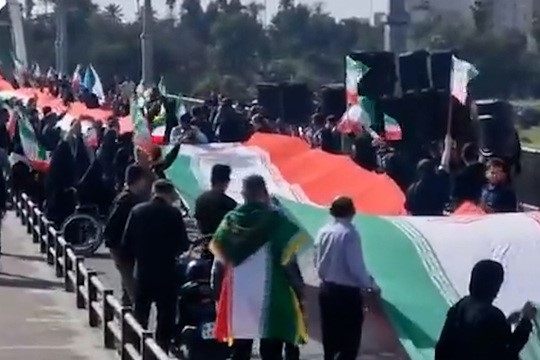
Meanwhile, tensions remain high on the ground. Iranian state media reported that thousands of civilians formed human chains around key infrastructure sites, including power plants and bridges, in a show of defiance following threats of US strikes.
As diplomatic efforts intensify, the proposed two-week window is now seen as critical to determining whether a broader agreement can be reached—or whether the region risks sliding back into full-scale conflict.