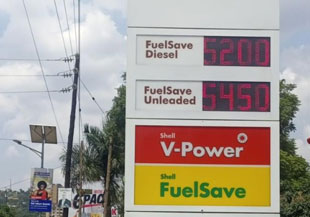
KAMPALA.Uganda’s continued incoming fuel shipments are expected to reinforce national reserves and sustain one of the most competitive pump price regimes globally.
In a statement released Tuesday, the Ministry of Energy and Mineral Development and the Uganda National Oil Company said the vessels, currently en route via Port of Mombasa and Tanzanian ports, are part of a forward supply strategy aimed at shielding the country from global market shocks.
The shipments include 183 million litres of petrol, 258 million litres of diesel and 23 million litres of jet fuel expected between May and June, significantly boosting Uganda’s fuel cover.
“These projections demonstrate strong forward supply planning and provide assurance of the continued availability of petroleum products nationwide,” the statement said.
The Ministry said existing stock levels remain stable, with petrol at 70.5 million litres representing about 19 days of cover, diesel at 43.7 million litres equivalent to 12 days, and jet fuel at 32 million litres providing up to 53 days of cover.
Uganda’s fuel supply is largely secured through a government arrangement with global energy trader Vitol acting as the principal supplier.
Energy Minister Ruth Nankabirwa recently said Vitol’s diversified sourcing network has helped Uganda maintain stable supply flows even during global disruptions.
The government’s assurance comes as new global comparisons show Uganda maintaining relatively lower fuel prices than many countries despite ongoing volatility in international oil markets.
According to global pricing data, petrol in Uganda averages between Shs 5,290 per litre to Shs 5,400, below the global average of roughly Shs 5,521 per litre.
Across Africa and emerging markets, Uganda remains competitive. In Kenya petrol averages about Shs 5,600 per litre, Tanzania about Shs 5,430, Rwanda roughly Shs 7,450, and Malawi significantly higher at about Shs 14,200 per litre. Prices in Zimbabwe stand at around Shs 8,250 per litre.
In advanced economies, the gap is even wider. Petrol prices average about Shs 8,600 per litre in France, Shs 8,900 in Germany, Shs 10,050 in the Netherlands, and approximately Shs 9,800 in Denmark. Other high-cost markets include Israel at about Shs 10,230 per litre and Hong Kong at over Shs 15,300 per litre.
Even in parts of Asia and Latin America, prices remain higher or comparable, with Singapore at about Shs 8,960 per litre and United Kingdom at around Shs 7,880 per litre.
This pricing advantage is particularly notable given that Uganda is a landlocked country that imports all its refined petroleum products over long distances, primarily through Kenya’s coastal infrastructure before trucking or piping them inland, a supply chain that typically adds significant transport, insurance and handling costs.
Despite these structural disadvantages, Uganda still posts lower pump prices than several coastal and developed economies, underscoring the impact of its centralized procurement system and relatively lower tax regime.
Countries that post significantly lower prices than Uganda are predominantly major oil producers with subsidised domestic markets.
In Libya petrol costs as little as about Shs 88 per litre, while in Iran it is around Shs 106 and Venezuela about Shs 130 per litre.
Other oil-rich nations also maintain relatively low prices, including Angola at roughly Shs 1,210 per litre, Kuwait at about Shs 1,260, Algeria at around Shs 1,317, and Saudi Arabia and Oman both at about Shs 2,300 per litre. Prices in Qatar average about Shs 2,080, United Arab Emirates about Shs 3,300, and Russia roughly Shs 3,010 per litre.
These lower prices are largely driven by domestic crude production, state subsidies and minimal import costs, in stark contrast to Uganda and other East African economies that import nearly all their fuel through regional corridors and are exposed to global price shocks, freight charges and currency .