By Johannah Nantongo
KAMPALA — Uganda needs to increase annual housing construction fivefold if it is to make meaningful progress in reducing a national deficit estimated at 2.4 million housing units, Lands, Housing and Urban Development Minister Judith Nabakooba has said.
Nabakooba said Uganda requires approximately 300,000 new housing units every year to begin closing the gap, yet current output stands at only about 60,000 units annually.
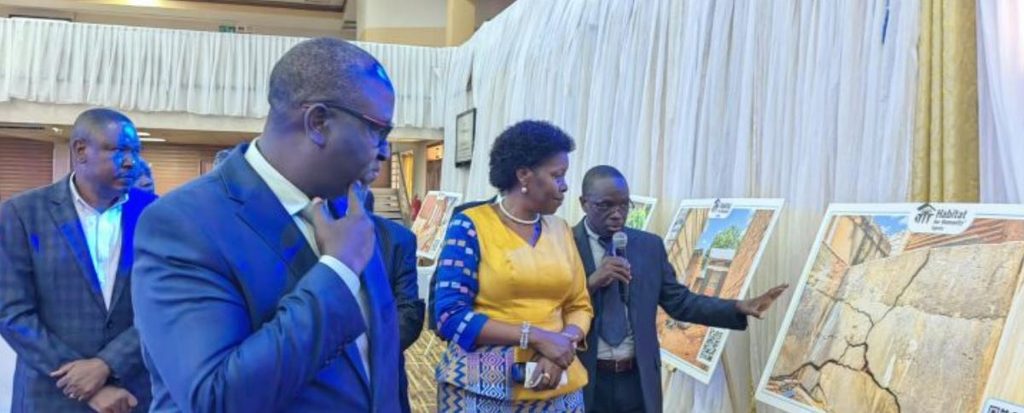
She made the remarks in Kampala on Monday while officiating at the national housing dialogue held to mark World Habitat Day 2026.
The minister warned that the current pace of construction is insufficient to meet demand, particularly as Uganda’s population continues to grow and more people migrate to urban areas in search of employment, education and other opportunities.
At an annual output of 60,000 units, Uganda is falling short of its estimated requirement by about 240,000 houses each year. Nabakooba said the situation risks prolonging the housing crisis unless construction is significantly accelerated.
The pressure is being compounded by rapid urbanisation, which she said is occurring at an estimated annual rate of 5.4 percent. Data from the 2024 national census by the Uganda Bureau of Statistics indicates that about six in every 10 Ugandans live in informal settlements or inadequate housing.
Nabakooba said the housing challenge goes beyond the number of buildings being constructed, arguing that planning, affordability and access to secure land must also be addressed.
She attributed part of the problem to development taking place ahead of proper physical planning, a situation she said has contributed to unplanned urban expansion, growth of informal settlements, expensive infrastructure and inefficient use of available land.
The minister said government has expanded the national land information system through 22 zonal offices and has continued supporting the acquisition of land titles and certificates of customary ownership. It has also provided prototype house plans for communities and is working towards completing legislation governing the real estate sector.
She said the National Land Policy also needs to be fully implemented, while government is developing a framework for implementing the national land-use plan.
Nabakooba identified access to affordable housing finance as another major obstacle, particularly for young people seeking to acquire their first homes.
She said mortgage interest rates in Uganda remain largely in double digits, while repayment periods can make home ownership difficult for many households. She called for more affordable and longer-term financing, including financial products designed for workers and entrepreneurs with irregular incomes.
The minister said discussions are ongoing with the Ministry of Finance and financial institutions on ways of reducing the cost of housing finance.
She also appealed to banks and other lenders to consider products that allow borrowers with non-traditional incomes to make repayments on a daily or weekly basis.
Nabakooba said government alone cannot bridge the housing deficit and urged private developers, banks, development partners, universities and civil society organisations to join efforts to expand access to decent and affordable housing.
“Government cannot close Uganda’s housing gap alone. We need a new and a stronger housing partnership,” she said.
Robert Waggwa Nsibirwa, the Buganda Kingdom Second Deputy Prime Minister and chairman of the board of Habitat for Humanity Uganda, challenged stakeholders to move beyond discussions about the scale of the housing crisis and focus on practical interventions.
He said housing programmes should respond to the needs of young people, growing families and vulnerable communities by providing shelter that is affordable, sustainable and capable of preserving human dignity.
The discussions are expected to shape efforts to improve housing supply, strengthen urban planning and expand access to affordable housing finance as Uganda grapples with a rapidly growing demand for decent shelter.