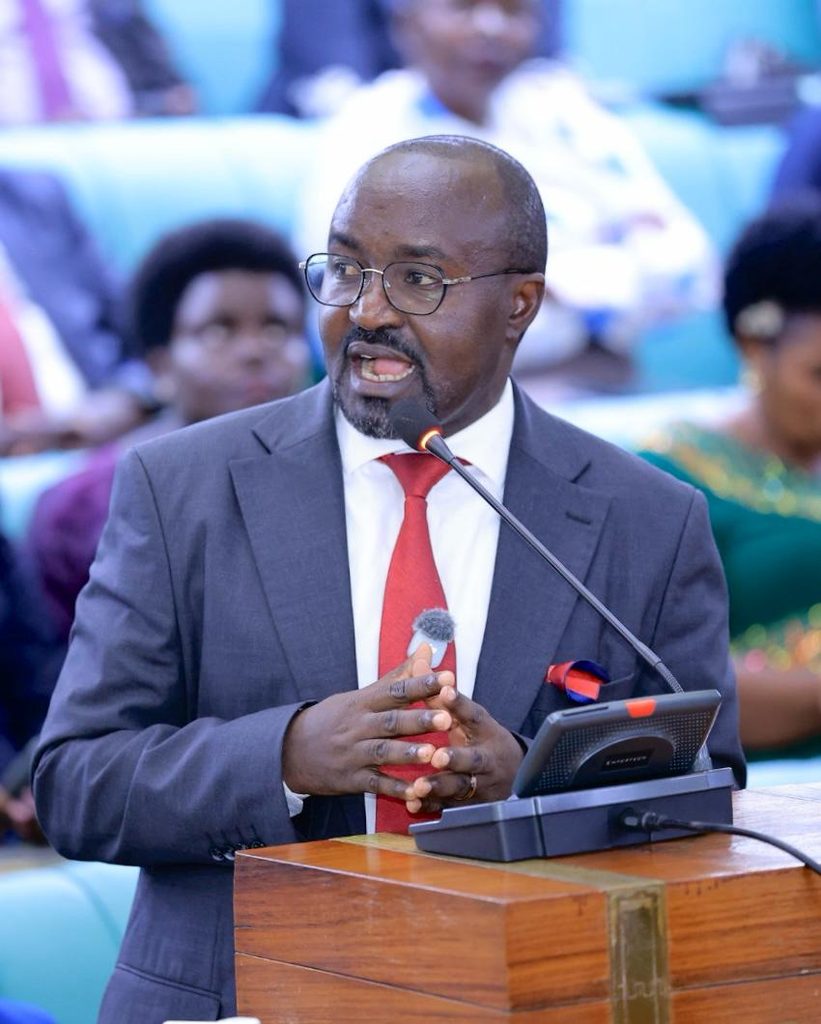
Hon. Patrick Nsamba speaking during a House session on Wednesday, 21 October 2026
By Maria Mariam Namala
The Public Accounts Committee (Central Government) has faulted the Ministry of Justice and Constitutional Affairs and the Office of the Director of Public Prosecutions (ODPP) for spending Shs41.6 billion on activities outside their approved work plans without authorisation from the Minister of Finance, Planning and Economic Development.
The committee said the expenditure, comprising Shs40.7 billion spent by the Justice Ministry and Shs900 million by the ODPP, contravened the Public Finance Management Act because there was no evidence of the required ministerial approval.
The findings are contained in the committee’s report on the Auditor General’s audit for the year ended December 2025. The report was presented during a plenary sitting chaired by Deputy Speaker Thomas Tayebwa on Wednesday, October 21, 2026.
Committee chairperson Patrick Nsamba, the MP for Kassanda North, said the two institutions had spent public funds on items that Parliament had not appropriated.
“The two entities applied a combined Shs41.6 billion to items that Parliament had not appropriated, without evidence of the Minister’s authorisation,” Nsamba said.
The committee found that the ODPP spent Shs900 million constructing Resident State Attorney offices in Katakwi and Yumbe outside its approved work plan, while the Justice Ministry redirected Shs40.7 billion to other activities, including court awards and compensation.
Nsamba warned that savings realised on one budget line did not give an accounting officer the authority to finance activities outside an approved work plan without the necessary approval.
“Savings on a budget line do not confer authority to spend on activities outside the approved work plan,” he said.
The report also highlighted staffing gaps at the ODPP, which had filled only 600 of its 1,704 approved positions. The committee said the understaffing had placed pressure on prosecutors, with 399 prosecutors serving 149 field stations.
Of the 40,501 new cases received, only 23,184 had been committed for trial before the High Court, raising concerns about the institution’s capacity to manage its caseload effectively.
The committee further questioned the procurement of works worth Shs457.68 million for the ODPP’s Yumbe office outside the electronic government procurement system.
Concerns were also raised over the performance of the Prosecution Case Management Information System (PROCAMIS), which the committee said had remained problematic despite expenditure of Shs42 billion since 2017.
According to Nsamba, the ODPP paid M/s Graphics Systems Shs2.95 billion for system maintenance and support during the 2024/2025 financial year, but key contractual obligations were not fulfilled.
These included integrating the system with other criminal justice institutions and establishing an off-site disaster recovery facility.
“Shillings 2.95 billion was paid under a contract whose two principal deliverables were not provided and the liability clause was not invoked against the provider,” Nsamba said.
The committee recommended enforcing the contract’s liability provisions, recovering funds where justified, establishing disaster recovery arrangements and conducting an audit of the system to establish its performance and value for money.
It also found that infrastructure in Arua and Lira had remained idle since November 2022, raising questions about the utilisation of public resources invested in the facilities.
On the Justice Ministry’s financial obligations, the committee reported contingent liabilities amounting to Shs3.492 trillion, largely arising from lawsuits against government entities.
To address the growing exposure, the committee recommended developing a litigation management strategy to improve the tracking, monitoring and handling of claims against government.
The committee called for stronger financial accountability, improved staffing levels, functional digital prosecution systems and tighter oversight of public expenditure to ensure that public funds are used for their approved purposes and deliver value to taxpayers.