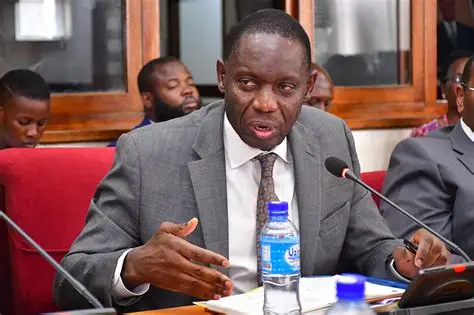
Bank of Uganda Governor Michael Atingi-Ego apearing before parlaiment recetly.
By Johannah Nantongo
The Bank of Uganda (BoU) has disclosed that it injected approximately $68 million (about Shs278 billion) into the foreign exchange market to support the shilling after the local currency weakened significantly against the US dollar.
The intervention came as the demand for dollars increased, pushing the exchange rate close to Shs4,500 per dollar in October 2026.
Bank of Uganda Governor Michael Atingi-Ego said the central bank deliberately restricted the amount of foreign currency it released onto the market, warning that repeatedly using national reserves to support the shilling would not provide a lasting solution.
He made the disclosure during the Monetary Policy Committee meeting held on November 9, explaining that the intervention was intended to moderate excessive exchange rate fluctuations rather than permanently determine the value of the currency.
Foreign exchange reserves are funds held by a country’s central bank in foreign currencies, particularly the US dollar. They help governments meet international payment obligations and provide a financial buffer when the economy faces external shocks.
When demand for dollars rises above the available supply, their value increases against the shilling, forcing importers and other buyers to spend more local currency to obtain foreign exchange.
To ease the pressure, BoU supplied additional dollars to the market, making foreign currency more readily available to commercial banks and businesses that require it to settle international transactions.
Atingi-Ego said the central bank had released about $68 million since the depreciation pressures emerged but cautioned that a larger intervention would not address the economic factors driving demand for foreign currency.
“We have intervened to the tune of about $68m to be precise since this challenge began. We could have intervened more, but we were mindful of the fact that intervention does not solve the problem that we are facing today,” he said.
What Triggered the Shilling’s Decline?
The weakening of the shilling was largely driven by increased demand for dollars at a time when some important sources of foreign exchange earnings were experiencing pressure.
One of the contributing factors was the movement of foreign investors out of Uganda’s government securities market.
Some international investors disposed of their holdings in government bonds and treasury bills before converting the proceeds into dollars for transfer outside the country.
The movement was partly influenced by changes in interest rates in the United States, which increased the attractiveness of dollar-denominated investments.
This created additional demand for foreign currency and intensified pressure on the shilling.
Uganda’s tourism sector also faced challenges following the Ebola outbreak, which prompted some countries to issue travel advisories against the country.
Atingi-Ego told Parliament that tourist arrivals had dropped by more than 30 per cent, threatening an important source of foreign exchange earnings.
Meanwhile, geopolitical tensions in the Middle East contributed to higher international shipping and insurance costs, increasing the cost of importing goods, including petroleum products.
Consequently, Ugandan importers required more dollars to meet their international payment obligations, adding further pressure to the local foreign exchange market.
BoU Tightens Monetary Policy
In addition to supplying dollars to the market, the central bank introduced tighter monetary measures aimed at reducing excess liquidity and strengthening the attractiveness of domestic financial investments.
On October 14, 2026, BoU increased its Central Bank Rate (CBR) from 9.75 per cent to 12 per cent, representing an increase of 2.25 percentage points.
The CBR is the benchmark interest rate used by the central bank to influence interest rates across the economy.
An increase generally raises the cost of borrowing, helping to moderate demand and contain inflationary pressures. It can also improve returns on government securities, potentially attracting investors seeking better yields.
The central bank also raised the Cash Reserve Requirement (CRR) for commercial banks from 11 per cent to 13.5 per cent.
The CRR represents the proportion of customer deposits that commercial banks are required to maintain as reserves rather than make available for lending.
According to Atingi-Ego, the increase helped withdraw approximately Shs1.3 trillion from circulation, reducing excess liquidity within the banking system.
The tighter monetary conditions subsequently improved the attractiveness of Uganda’s government securities to foreign investors.
At a subsequent government securities auction, where Shs1.4 trillion was offered, offshore investors purchased securities worth more than Shs200 billion, bringing additional foreign currency into the domestic market.
Atingi-Ego told Parliament that the increased inflows contributed to the shilling’s recovery from nearly Shs4,500 to approximately Shs4,050 against the dollar.
Why BoU Cannot Keep Selling Dollars
Despite having foreign exchange reserves, the central bank says it cannot continuously release dollars into the market every time the shilling experiences depreciation pressures.
The reserves serve several important national purposes, including supporting international payments, meeting external debt obligations and financing essential government imports.
A prolonged intervention programme could significantly deplete these reserves, leaving the country more vulnerable to future external economic shocks.
Atingi-Ego therefore cautioned businesses and other market participants against expecting the central bank to permanently protect the shilling through direct foreign exchange interventions.
“People should not look at the central bank as the institution that can fix the currency. No, we can only try to stabilise the currency in the short term,” he said.
He explained that although selling dollars can help reduce sudden exchange rate fluctuations, sustainable currency stability requires addressing the economic conditions responsible for the persistent demand for foreign exchange.
Government Urged to Strengthen Export Capacity
The Governor emphasised that Uganda’s long-term currency stability will largely depend on its ability to earn sufficient foreign exchange through exports, tourism and other productive economic activities.
He called for increased domestic production, industrial development and value addition to reduce dependence on imported goods while expanding the country’s export earnings.
Atingi-Ego identified agro-industrialisation, tourism, mineral development, and science, technology and innovation as key areas that Government should prioritise under its tenfold growth strategy.
He argued that strengthening these sectors would improve Uganda’s current account position by increasing the value of goods and services sold internationally.
The Governor maintained that the country needs to address the underlying supply-side weaknesses in its economy rather than relying mainly on measures that temporarily reduce demand for dollars.
“But long-term stability of the currency depends on how strong our current account balance is. We need to upgrade the supply side rather than the demand side,” he said.