KAMPALA.
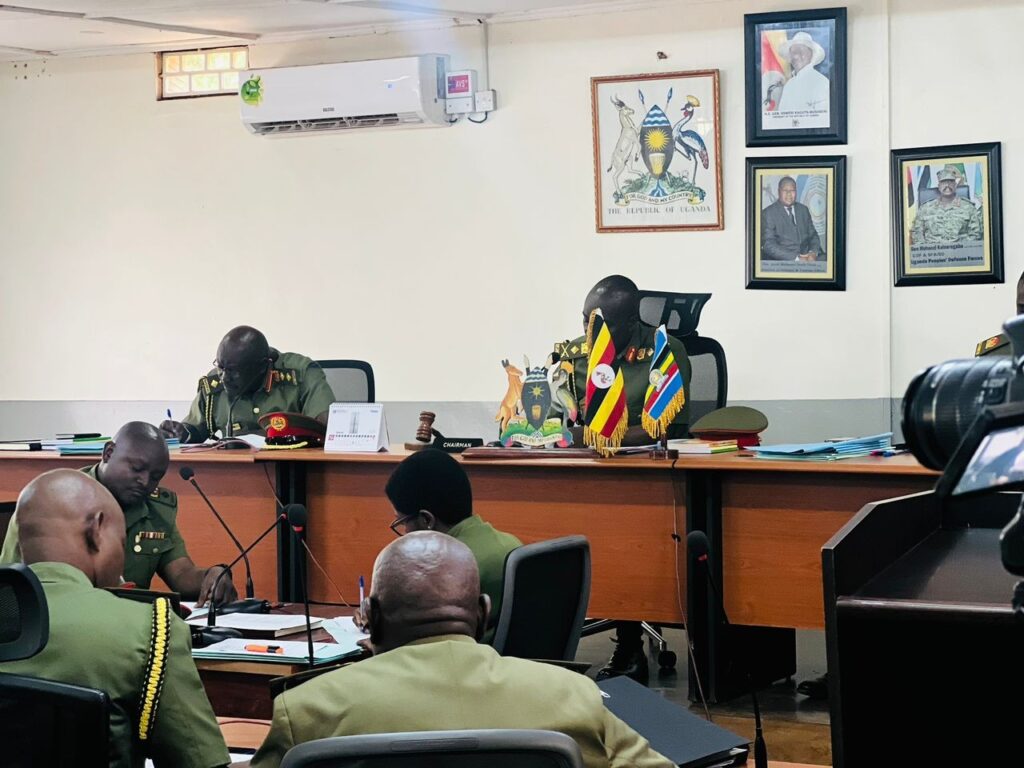
The Army General Court Martial has today , Thursday officially resumed work after a comprehensive restructuring of the military justice system anchored in amendments to the Uganda Peoples’ Defence Forces (UPDF) Act.
The reforms followed the January 2025 Supreme Court decision in Attorney General v Michael Kabaziguruka, in which the court addressed key questions regarding the mandate and jurisdiction of the General Court Martial, particularly its powers to try civilians.
In response, Parliament amended the UPDF Act to align it with aspects of the Supreme Court ruling, especially concerning the locus of mandate and jurisdiction of the military court.
However, lawmakers went further and used the amendment process to restructure the entire Court Martial system to bring it in line with standards applicable to courts within the mainstream judiciary.
One of the major reforms targeted the appointment of officers of the Court Martial. Under Section 195(2) of the amended UPDF Act, all officers of the General Court Martial are now appointed by the Commander-in-Chief on the advice of the Judicial Service Commission.
The officers are also required to take a judicial oath in accordance with Section 202A of the Act.
The amendments further introduced the Directorate of Military Prosecutions under Section 202B of the Act. The Directorate is mandated to prosecute persons before the Court Martial, a function comparable to that of the Office of the Director of Public Prosecutions in the civilian justice system.
Following the restructuring, 10 members of the General Court Martial were appointed, led by Brigadier General Richard Tukachungurwa as head of the court.
Brig. Gen. Tukachungurwa previously served as Judge Advocate of the General Court Martial. He replaces Brigadier General Robert Freeman Mugabe, who had been heading the court.
After taking the required judicial oath, the newly appointed officers formally resumed the court’s work.
On its first day back in session, the General Court Martial is hearing a matter involving 12 accused persons — one UPDF officer and 11 civilians — who are alleged to have acted together in committing the offences of murder, aggravated robbery, and kidnap with intent to murder. All the charges are brought under the Penal Code Act.
The matter is currently before court for plea taking.
The 11 civilians are being tried under military law pursuant to Section 117(1)(a) of the UPDF Act, which provides that civilians who voluntarily act as accomplices in offences committed by UPDF officers fall within the ambit of military law. However , on Wednesday , Kampala Lord Mayor Erias Lukwago and lawyer of jailed veteran politician Dr Kizza Besigye and his aide Obeid Lutale , filed a petition challenging Parliament’s decision to allow civilians to be tried in military courts, arguing that the law was passed irregularly and in defiance of an earlier court ruling.
Lukwago contends that the legislation was rushed through Parliament within two days- a timeframe he says was insufficient for proper scrutiny and public participation.
“The law was passed in a period of two days, and that time was not enough,” Lukwago stated. “It was wrongly passed.” that due process was not followed and that the move undermines constitutional safeguards.
He further argued that Parliament reintroduced provisions that had previously been declared illegal by the High Court.
“Parliament returned almost the same thing that the High Court declared illegal,” he said. “We appeal to court to nullify Parliament’s decision.”
The petition sets the stage for another legal battle over the jurisdiction of military courts and whether civilians can constitutionally be subjected to military justice.
Legal experts say the outcome of the case could have significant implications for the separation of powers and the protection of civil liberties in Uganda.