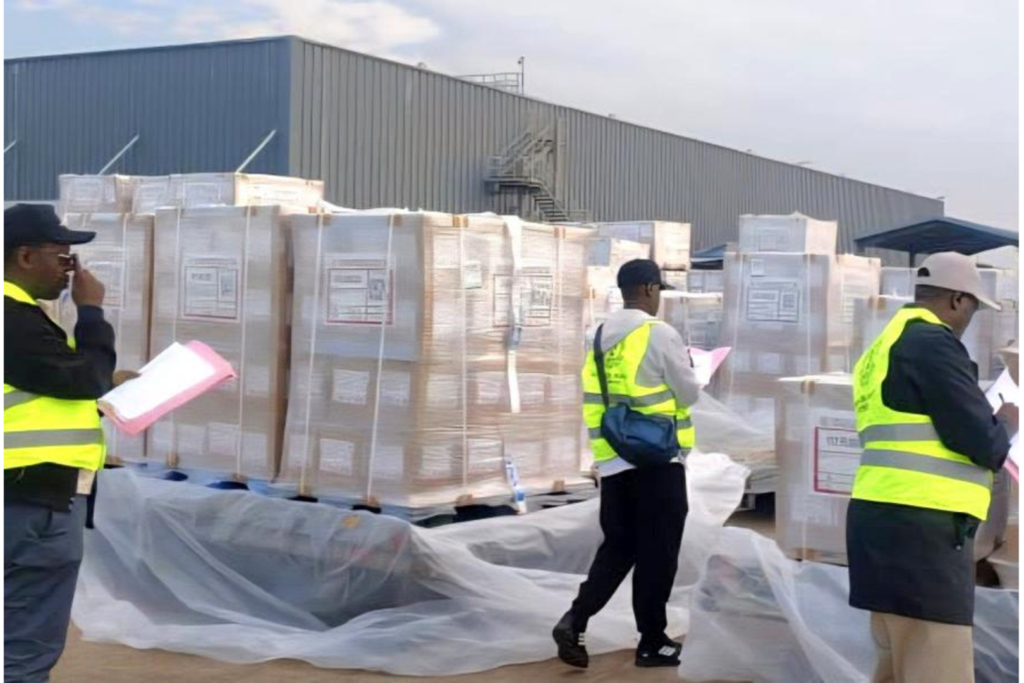
KAMPALA.The Electoral Commission(EC) has received the third consignment of ballot papers at Entebbe International Airport ahead of the January 15 General election.
The shipment which arrived on Sunday includes ballot papers for District and City Chairpersons and District Women Councillors.
Under tight security, the pallets, sealed and wrapped, were offloaded from a cargo aircraft in the presence of EC officials, representatives of political parties, security agencies, and the media, a gesture aimed at reinforcing transparency amid lingering public mistrust rooted in disputed past elections.
The latest delivery follows two earlier consignments received in late December 2025, signaling that the bulk of sensitive voting materials are now in-country as the election clock ticks down.
The EC has adopted a phased importation strategy for ballot papers, a practice it says reduces logistical risks and enhances oversight.
The first consignment, presidential ballot papers for more than 21.6 million registered voters, arrived on December 24, 2025, Christmas Eve, and was formally received the following day under the supervision of EC Chairperson Justice Simon Byabakama, senior commissioners, political party agents, and observers.
Just hours later, on December 25, a second batch comprising ballot papers for Directly Elected Members of Parliament was delivered. By December 29, the EC had begun packing presidential ballots at its warehouses, again in the presence of political stakeholders.
Speaking to journalists at Entebbe on Sunday, EC spokesperson Julius Musinguzi said the Commission was on track to complete receipt of all externally printed ballot papers within the week.
“Today, January 4, 2026, the Commission received ballot papers for district and city chairpersons and district women councillors,” Musinguzi said.
“Ballot papers for district women councillors have arrived in full, while about 90 percent of those for district and city chairpersons have been delivered.” Uganda currently has 146 districts and cities, each requiring tailored ballot quantities based on registered voter numbers.
“In total, we received 247 pallets, 144 for district and city chairpersons and 103 for district women councillors,” he added. “These materials have been safely offloaded and will be packed according to their destinations before dispatch.”
Musinguzi emphasized that the Commission’s legal obligation is to ensure timely delivery of all election materials.
“Our duty under the law is to ensure that by polling day, all materials are at polling stations so that voting starts on time,” he said. “That process is ongoing, and we remain on schedule.”
Legal Framework and Printing Arrangements
The preparation, custody, and distribution of ballot papers are governed by Article 61 of the Constitution, the Electoral Commission Act (Cap. 140), the Parliamentary Elections Act, and the Local Governments Act, which collectively mandate the EC to conduct elections in a free, fair, and timely manner.
In line with past electoral cycles, the EC outsourced ballot printing to a mix of international and domestic firms, citing limited local capacity to meet the scale and security requirements of national elections.
The ballot papers received on Sunday were printed in Dubai, with companies involved including Al Ghurair Printing and Publishing, Pictorial, and Graphics Systems. Transportation was handled by Network Aviation Group.
Overall, ballot printing for the 2026 elections has been shared among firms in the United Arab Emirates, South Africa, Greece, Kenya, and Uganda, including Uniprint, Inform Lycos, Sintel Security, Graphics Systems, and Peak Fair.
The EC says the materials are meant to serve 50,739 polling stations nationwide.