By Nasser Kayanja
The Global Fund has committed at least $521 million (about Shs1.9 trillion) to Uganda to fight Aids, Tuberculosis and Malaria from 2026 to 2028.
The Director General of Health Services at the Ministry of Health Dr. Charles Olaro, said that although there was a reduction in funding, according to the previous finding, the funds are substantial enough to address the handling of the three diseases in question.
“We received a letter from the Global Fund confirming to us that Uganda has been allocated 521 million dollars. Definitely, this is a reduction from the previous grant, which was about 80 million dollars. But I must say that this still remains a very substantial one,” he said.
He made the remarks at a National Dialogue on priorities for HIV, TB, Malaria and Resilient and Sustainable Systems (RSSH) for Health under the Global Fund Grant cycle 8 in Kampala.
He is optimistic that the funding will strengthen health systems, expand antiretroviral therapy (ART) access, and reduce new HIV infections.
“In terms of HIV, it means that we also need to be able to reduce new infections,” he said.
‘’In terms of TB, we think that we need to be able to look for the 10,000 cases which are missing, because at the moment they remain in the community, they will continue to go on.
“So, we think that with the money available, we’ll be able to use our community health system, the community extension workers, but also our health system to be able to track these cases. And they are put into treatment early,” he added.
The Director General of Uganda AIDS Commission Dr.Nelson Musoba said there is a slight increase in the new infections in HIV.
“As we speak now, HIV prevalence has reduced from double-digit figures of 18% to now 4.9%, translating that, if we look at the other data in terms of new HIV infections, looking at the last report that we analyzed, we had 37,000 new infections in one year,” he said.
“So that’s still quite high because we would like by 2030 for that figure to reduce to less than 10,000,” he added.
He said, currently they are targeting to reduce HIV related death to 5000 by 2030.
The Technical Advisor at the Ministry of Health, Dr. Raymond Byaruhanga, said in terms of tuberculosis in the country, the prevalence is about 197 people with TB per 100,000 population. And on average, about 99,000 new TB patients are registered every year.
“This is quite a very big number, especially on a disease, an old disease that has a cure, we are also seeing that there are more men infected with TB than women, for every one woman that has TB, there are about three men that have TB,” he stressed.
“We are also noticing that our children less than 15 years are also reporting to have tuberculosis and for a child to have tuberculosis, it tells you that within the home there is someone who is transmitting that TB. So if you are already seeing 11% of our children having tuberculosis then that is bad enough,” he added.
According to experts, TB is transmitted mainly by coughing and sneezing. If someone has tuberculosis, especially in the lungs, and is talking or sneezing in a congested population, they tend to get tuberculosis.
This new commitment follows a previous US$602 million commitment for 2021-2023, demonstrating consistent support for health system strengthening and disease prevention in Uganda.
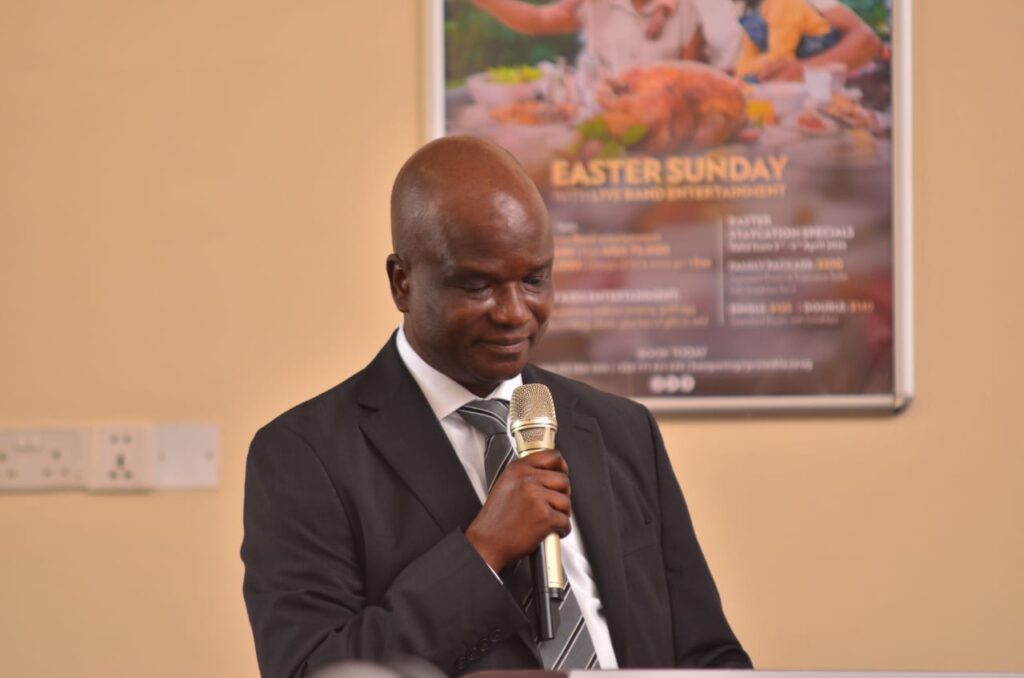
Dr. Nelson Musoba the Director General of Uganda AIDS Commission addressing stakeholders during a National Dialogue on priorities for HIV, TB, Malaria and Resilient and Sustainable Systems for Health under the Global Fund Grant cycle 8 in Kampala.
