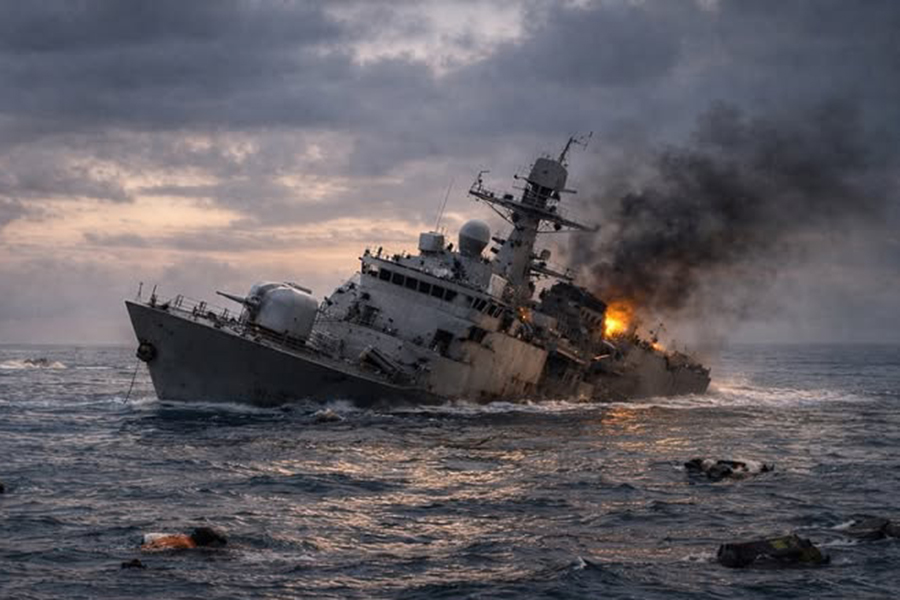
At least 104 Iranian naval personnel were killed and 32 wounded when a United States Navy submarine torpedoed and sank the Iranian warship Iris Dena in the Indian Ocean last week, according to Iran’s army.
The incident occurred on March 4, 2026, when the frigate was struck by a torpedo fired from a US submarine while sailing in international waters near Sri Lanka’s southern coast.
The ship sank within minutes of the explosion, leaving dozens of sailors trapped or thrown into the sea.
Iranian authorities said the casualty toll rose to 104 dead after additional bodies were recovered in the days following the attack, while 32 survivors were treated for injuries and exposure.
The Iris Dena, a domestically built Moudge-class frigate commissioned into Iran’s navy in 2021, was returning home after participating in a naval exercise in India when it was targeted.
According to the Pentagon, the attack was carried out by a US Navy submarine using torpedoes during ongoing hostilities between the United States and Iran.
US Defense Secretary Pete Hegseth confirmed the strike, saying the Iranian vessel “thought it was safe in international waters,” but was destroyed by a torpedo in what he described as a “quiet death.”
But Iran said the vessel was unarmed having been attending a ceremony in India at which arms were not allowed.
Discover more
HEALTH
Political commentary subscriptions
Opinion writing guides
The sinking marked the first time an American submarine had destroyed an enemy surface warship in combat since World War II, highlighting the escalating scope of the conflict between Washington and Tehran.
US President Donald Trump has framed the broader campaign as part of a strategy to cripple Iran’s military capabilities, including its navy, as fighting spreads beyond the Persian Gulf into other strategic waterways.
Rescue efforts were not carried out by the United States. Instead, the Sri Lanka Navy launched search-and-rescue operations after receiving a distress signal from the stricken vessel.
Patrol ships and aircraft were dispatched to the area, where rescuers found survivors clinging to life rafts and floating in oil-covered waters.
Sri Lankan authorities said the vessel had around 180 people on board at the time of the strike. By the time rescue teams arrived, the ship had already disappeared beneath the surface, leaving only debris, oil slicks and scattered life rafts.
Survivors were taken to hospital in the coastal city of Galle for treatment.
The incident has also raised questions about the laws of naval warfare and rules of engagement at sea. Under international maritime law and customary naval warfare rules, attacking warships of an enemy state during armed conflict is generally considered lawful.
However, legal experts note that belligerents are expected, when possible, to assist shipwrecked survivors once combat operations have ended.
Critics of the operation have argued that the failure of US forces to participate in rescue operations after the strike raises humanitarian concerns, while supporters say submarines are often unable to safely surface in hostile waters after an attack.
The sinking has intensified diplomatic tensions in the region. Reports indicate that Washington has been pressuring Sri Lanka regarding the handling and potential repatriation of Iranian sailors rescued after the attack.
Iran has condemned the strike as a “hostile act,” while governments and analysts worldwide warn that the incident risks widening the already volatile conflict in the Middle East and beyond.