KAMPALA.
Government is to set up a railway training institute to provide the necessary manpower and human resource to run the Malaba-Kampala Standard Gauge Railway (SGR).
The Malaba-Kampala SGR is a crucial national investment and strategic infrastructure project aimed at revolutionising the Northern Corridor trade route.
Contracted by Turkish firm Yapi Merkezi, the project is part of the 273-kilometre Northern Corridor Integrated Projects Railway Network, which will connect Uganda to neighbours Kenya, Rwanda, DR Congo, and South Sudan.
It aims to significantly reduce transport and logistics costs, support industrialisation and trade, create over 150,000 direct and indirect job opportunities, and strengthen interoperability across the Northern Corridor. It is expected to be completed within 48 months, starting from November 2024.
The Minister of State for Works and Transport, Mr Musa Ecweru, said the decision to establish a railway training institute follows a trip he and other government officials took to Kenya to benchmark its SGR.
“It is not that the Kenyans are 100 percent perfect, but there are a number of things we were able to pick. For example, initially, they had almost 55 percent Chinese manning their SGR, but they selected young people with Higher Diplomas in Civil Engineering, Electrical Engineering, and Mechanical Engineering,” Mr Ecweru noted on Wednesday.
“The Government of Kenya sent them to the people who helped manufacture this (in China). They were there for three years, and by the time they came back, we were privileged to meet some of them. Extremely brilliant indigenous Kenyans had taken over the management.” he added.
Mr Ecweru explained that as the institute is being fine-tuned, discussions will be held with partners from Turkey to send some young Ugandans on an exchange programme to train in managing modern SGR equipment, ensuring the country does not face human resource challenges.
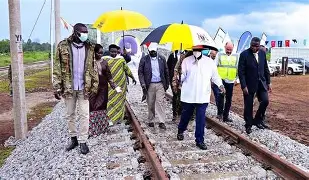
Mr Ecweru, who was meeting officials from the Islamic Development Bank (IsDB) on an appraisal mission of the SGR in Kampala, described the Malaba-Kampala SGR as a “complex mega project” which requires almost €2.7 billion in financing.
According to him, Cabinet approved a financing framework that combines government counterpart financing (15 percent ), ECA financing (60 percent ), and DFI financing (25 percent ).
However, the government prefers to increase the proportion of DFI financing to reduce the overall cost of borrowing and improve long-term affordability.
He further noted that Uganda is ready to move into full-scale construction and that the government has progressed from concept to construction readiness, making substantial progress in key preparatory areas required for bankability and smooth execution.
For now, Mr Ecweru said the government’s priority is to close the project financing early, preferably by June 2026, and encourage the IsDB to consider increasing its financing beyond Euro405 million.
IsDB commits Shs1.7t for SGR
The appraisal meeting was the last stage of the engagement and followed a preparatory mission held in July last year.
The Regional Hub Manager in charge of the IsDB Group Regional Hub in Uganda, Dr Issahaqq Umar Iddrisu, said they would not be in Kampala for an appraisal meeting if they were not convinced the project was worth supporting, adding that their return demonstrates their commitment to seeing the SGR become a reality.
“When my team visited the site on Tuesday, we saw the urgency of the matter and had to do something about it. Tentatively, we are looking at supporting the project to the tune of Euro410m (about Shs7 trillion),” Dr Iddrisu said.
He said they are mobilising other partners under the “Arab Coordination Group”, who are reportedly coming on board with between £100m (about Shs416.2b) and £150m (about Shs624b), while others, including Badia, are also expected to contribute between £80m and £100m.
The Kuwait Fund, he added, has also expressed interest in coming on board.
Conditions
For this funding to happen, Dr Iddrisu said donors require IsDB to send an official request or government undertaking asking them to get involved. Secondly, financial closure is required to enable funders to understand how the project will be concluded.
“The other issue is that we are going to approve this project, and as a development bank, the last thing we want to see is projects approved and money sitting at headquarters. Development only happens if money is transferred to the country and work is being done.
“In most forums at the bank, the question always comes up: we have given Uganda a lot of money so far, but it is not being used — why are you asking for more? So we are calling on you to help us with what we already have on the plate,” he explained.
The incoming Uganda IsDB Country Operations Manager, Mr Davis E. Omar, said that as the partner on the ground, they have worked over the past few days to convince partners to consider the project seriously.
“We really need their support in terms of development finance,” he said.