KIGALI.
Rwandan President Paul Kagame has defended his country’s security policies and warned that Rwanda will not compromise its national defence, as Western governments impose sanctions and visa restrictions on senior Rwandan military officials over the conflict in neighbouring eastern Democratic Republic of the Congo.
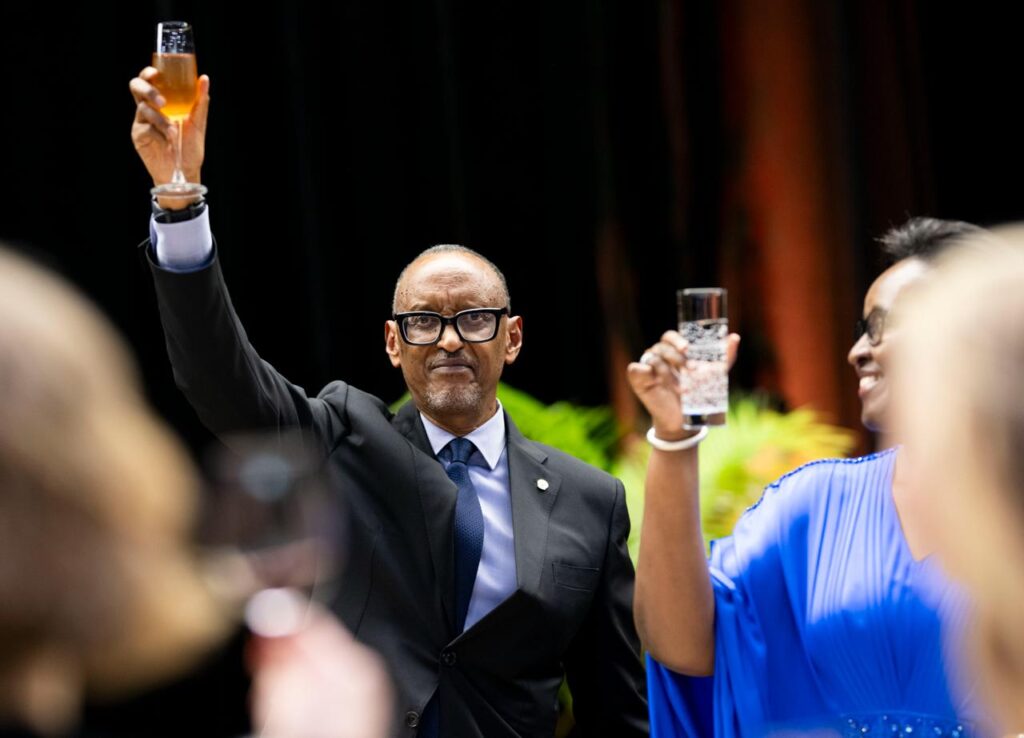
On March 6, 2026 Kagame hosted members of the diplomatic corps at the Kigali Convention Centre, where he used the occasion to strongly defend his country’s security posture amid escalating international pressure linked to the conflict in eastern Democratic Republic of the Congo.
The dinner followed the presentation of letters of credence by 20 newly accredited ambassadors and high commissioners to Rwanda.
Kagame told diplomats that Rwanda would remain steadfast in protecting its sovereignty despite mounting criticism and sanctions from Western governments.
“We will have our shoulders burdened and remain dignified,” Kagame said during the address.
The remarks come days after the United States announced visa restrictions targeting senior Rwandan officials accused of fueling instability in eastern DRC through alleged support to the March 23 Movement (M23) rebel group.
In a statement issued on March 6, US Secretary of State Marco Rubio said the restrictions apply to individuals “responsible for, complicit in, or directly or indirectly engaged in undermining or impeding a sustainable peace in the Great Lakes region.”
The visa policy may also extend to immediate family members of the targeted officials and is enacted under Section 212(a)(3)(C) of the U.S. Immigration and Nationality Act.
The measures followed earlier sanctions by the U.S. Treasury Department against the Rwanda Defence Force (RDF) and four of its senior commanders, including Chief of Defence Staff General Mubarakh Muganga, Army Chief of Staff Major General Vincent Nyakarundi, 5th Infantry Division Commander Major General Ruki Karusisi, and Special Operations Commander Brigadier General Stanislas Gashugi.
Washington accuses the RDF of providing operational support to M23 rebels in eastern Congo, including troop deployments, advanced military equipment such as drones and GPS jamming technology, and training.
Speaking to diplomats in Kigali, Kagame said Rwanda’s actions are guided by a duty to safeguard its people and borders, insisting that no country should be expected to ignore threats to its security.
“Nowadays, none of us can afford to be indifferent to geopolitical trends,” Kagame said.
“Whether or not you believe that there was a rules-based international order, it is clear that changes are underway, which will affect all of us.”
He stressed that the fundamental responsibility of any government is to protect its citizens.
“One thing that has not changed, however, is the right and duty of every nation to ensure the safety of its borders and its people. It is that duty that never changes. Rwanda is no exception.”
Kagame argued that Rwanda’s security concerns are driven by the continued presence in eastern Congo of the Democratic Forces for the Liberation of Rwanda (FDLR), a militia group linked to perpetrators of the 1994 genocide against the Tutsi.
“Rwanda’s security concerns stem from the continued presence of the FDLR and its violent extremist ideology, which is the ideology of genocide,” he said.
“Unfortunately, that seems to have some backers in the region and beyond, under all kinds of guises.”
The Rwandan leader also criticised what he described as unequal expectations in the implementation of peace agreements aimed at stabilising eastern Congo.
“By definition, a signed peace agreement should bind all parties equally and implementation should follow the text. However, this has not been our experience,” Kagame said.
“What we see instead is that one party is expected to carry almost the whole burden.”
The current tensions follow the signing of the Washington Accords on December 4, 2025, an agreement intended to halt hostilities and create a framework for cooperation and economic integration in the Great Lakes region.
Under the accord, the DRC committed to neutralising the FDLR armed group, while Rwanda agreed to withdraw its troops and military equipment from Congolese territory.
However, the situation deteriorated shortly after the agreement when M23 rebels captured the strategic town of Uvira before later withdrawing.
U.S. officials argue that continued RDF support to the rebel group risks escalating the conflict and undermining the peace process.
“Only then will the immense economic potential of the Great Lakes region be realized,” Rubio said, referring to the full implementation of the accords.
Rwanda has rejected the accusations and described the sanctions as one-sided.
In a statement earlier this month, the Rwandan government said the measures “unjustly target only one party to the peace process” while ignoring alleged ceasefire violations by the Congolese government.
Kagame told diplomats that Rwanda faces a stark security dilemma as the conflict persists along its western frontier.
“As things stand, Rwanda faces an impossible choice: to either tolerate the continued presence of the FDLR and its growing network of militias and allow them to grow closer to our border, or to defend ourselves and be condemned for it,” he said.
“The choice is therefore very clear. In our position, would any other country make a different choice?”
He concluded by reaffirming Rwanda’s determination to avoid the instability that once engulfed the country.
“We have made a promise to ourselves to never go back to the dark days, to that darkness. We can’t go back and that is not something we will waver from.”