LIRA .
Muslims across the world on Friday, March 13, 2026, observed the last congregational Friday prayers (Juma) of the holy month of Ramadhan, with the Mufti of Uganda using the occasion to address leadership disputes within the Lango Muslim community.
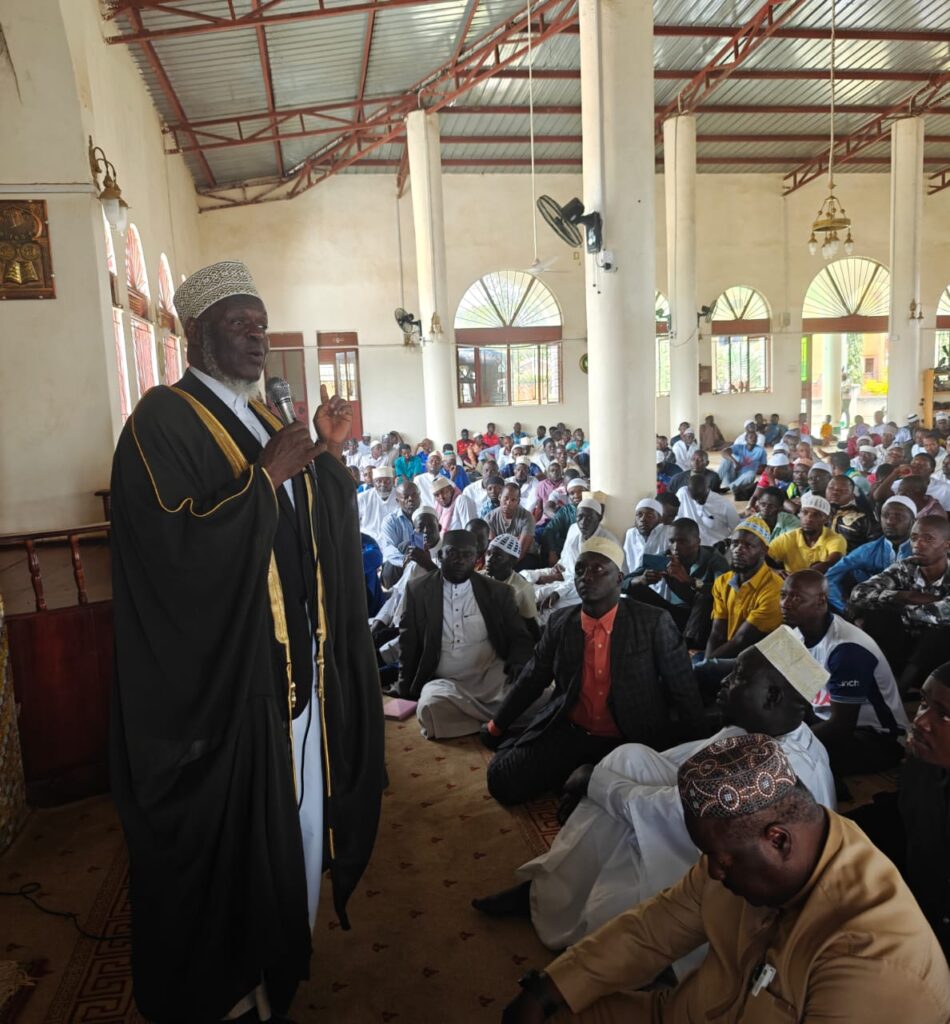
His Eminence Sheikh Shaban Ramadhan Mubajje led the prayers at the Idi Amin Dada Memorial Mosque in Lira City, where he was accompanied by senior officials from the Uganda Muslim Supreme Council (UMSC). The delegation included Secretary General Hadji Abbas Muluubya Ssekyanzi, Deputy Secretary General in charge of Finance and Administration Hon. Counsel Haj Muhammad Ali Aluma, and Deputy Secretary General for Planning and Development Hon. Arinda Abdu-Razaq, Sheikh Twaha Uthuman, the Mufti Special Envoy to South Sudan among others.
The visit had earlier been planned to enable the Mufti to assess the causes of the prolonged leadership disputes in Lango Muslim District.
Upon arrival, the Mufti was received by his Northern Regional Assistant, Sheikh Musa Khalil, alongside Kadhis from four Muslim districts and members of their respective committees.
Before the prayers, the Mufti and his delegation toured prime mosque land located in the centre of Lira City. During the inspection, it was observed that part of the land had allegedly been encroached upon, while another portion was reportedly being illegally rented out by unidentified individuals for activities including vehicle washing, market vending, and kiosk operations.
As the Mufti entered the mosque, a group of women and youths staged a peaceful protest, holding placards calling for an audit of funds collected and the reinstatement of some leaders—an indication of the prevailing misunderstandings within the district.
Calm was later restored as Muslims of all ages gathered for the Juma prayers and listened to the sermon delivered by UMSC Education Secretary Sheikh Juma Bakhit Cucu.
Quoting verses from the Holy Qur’an and sayings of Prophet Muhammad while translating in English, Swahili, and the local dialect, Sheikh Cucu reminded the faithful about the values of unity and righteousness in Islam.
“whoever strives to do good deeds, your legacy will never fed away long departing earthly life while those who live ungodly, their names will be forgotten long after their death,” he preached.
He added that every society experiences challenges but solutions can only be found when problems are clearly identified.
After the prayers, the Mufti urged Muslims to intensify acts of worship during the final days of Ramadhan and to strengthen unity and brotherhood within the community. He also called on believers to maintain peace and stability, recalling the painful history of insurgency in Northern Uganda that claimed many lives.
The Mufti further informed the congregation that following amendments to the UMSC constitution, a new structure—the Muslim Arbitration and Reconciliation Council (MAC)—had been introduced to handle disputes within the Muslim community.
Earlier, Secretary General Muluubya and other officials greeted the congregation, while Sheikh Kheliri presented a brief overview of the state of Muslim affairs in the Northern region.
After the prayers, the Mufti held a closed-door meeting with Muslim leaders from Lango that lasted several hours at a venue provided by Adam Makmot Kibwanga, an executive member and chairperson of MAC.
The discussions involved scrutiny of leadership structures, methods of appointment, and qualifications of office bearers. It was reportedly established that some leaders lacked the required qualifications while others were holding positions contrary to provisions of the UMSC constitution.
Before concluding the meeting, the Mufti directed the Northern Regional Assistant to compile a comprehensive report on UMSC properties in the region, particularly land and schools.
As an interim measure, a committee supervised by Sheikh Musa Kheliri was appointed to manage the affairs of Lango Muslim District until a mandated committee of Sheikhs is constituted in line with the UMSC constitution. The committee will subsequently nominate candidates for appointment of a substantive Kadhi.
Other members include Sheikh Saidi Hussein Ongu, Sheikh Ibrahim Okello, Sheikh Abdu-Karim Omara, Sheikh Ali Yakub Okwir and Sheikh Swaibu Uthuman Lubega Kato.
