KYANKWANZI.
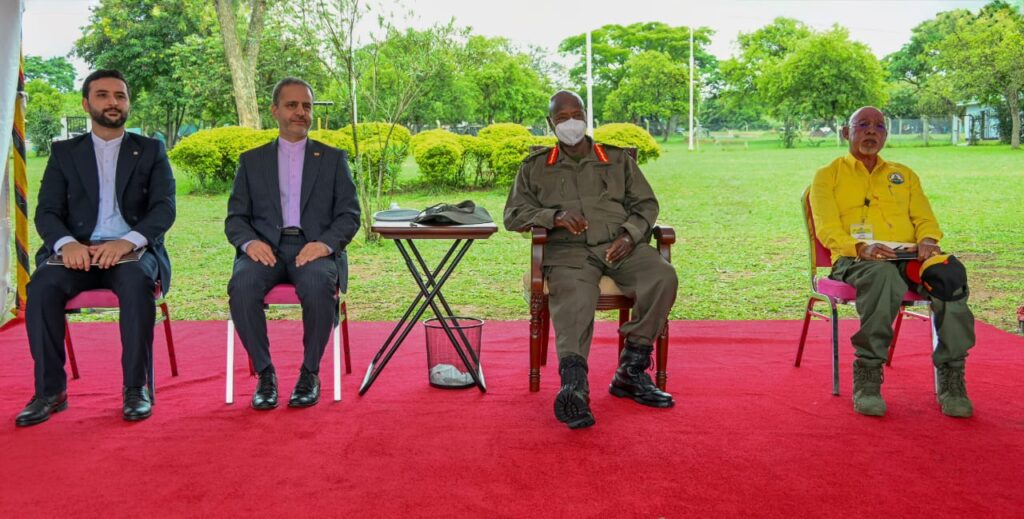
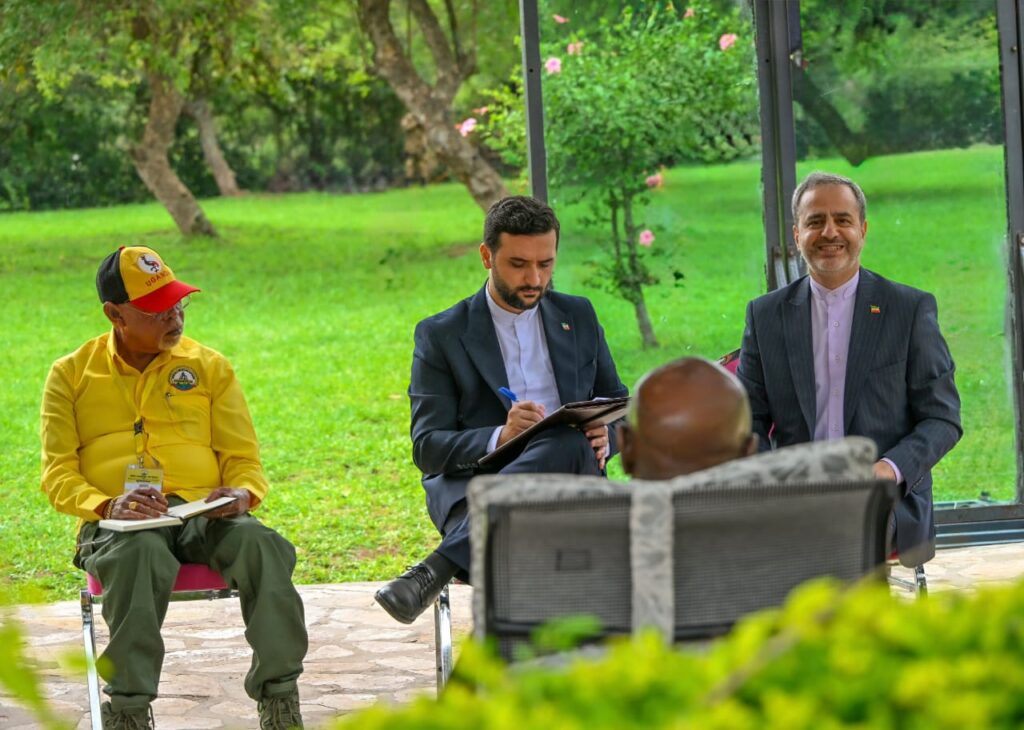
President Museveni has discussed with Iranian Ambassador to Uganda, Majid Saffar “issues of mutual interest and cooperation between Uganda and Iran” amid the ongoing US/ Israel war on Tehran.
“I welcomed His Excellency Majid Saffar, the Iranian Ambassador to Uganda, who called on me this afternoon in Kyankwanzi. We discussed issues of mutual interest and cooperation between Uganda and Iran,” Mr Museveni posted on his X formerly Twitter.
The Sunday morning meeting comes days after Mr Museveni’s son, Gen Muhoozi Kainerugaba, who serves as the Chief of Defence Forces in late March and early April 2026, made a series of controversial social media statements regarding Iran and its conflict with Israel.
The meeting was also attended by Uganda’s Foreign Affairs Minister, Gen (rtd) Abubaker Jeje Odongo.
The tweeting General pledged that Uganda would enter the war on Israel’s side if Israel’s survival were threatened.
“I have about 500,000 war hungry young men. All they want is money. They’ll eat that Tehran for free….. I’m ready to deploy 100,000 Ugandan soldiers in Israel. Under my command. To protect the Holy Land. The land of Jesus Christ our God!,” Gen Muhoozi posted on April 10, 2026.
Known for triggering significant diplomatic tensions through a series of provocative statements on social media, Gen Muhoozi posted on X on Saturday that: “But when it comes to men (soldiers), I only respect UPDF, RDF, United Kingdom, USA, Russia, Ethiopia, Israel, China, Vietnam and Afghanistan.”
Uganda’s Ministry of Foreign Affairs has frequently found itself managing these “diplomatic ripples,” often emphasising that official policy remains non-aligned despite the CDF’s vocal and personal interventions on global conflicts.
Mr Museveni’s meeting with Ambassador Saffar in Kyankwazi came on the heels of reports indicating that the U.S. and Iran failed to reach an agreement to end their war despite marathon talks that concluded on Sunday in the Pakistani capital, Islamabad, jeopardising a fragile ceasefire.
Each side blamed the other for the failure of the 21-hour negotiations to end fighting that has killed thousands, roiled the global economy and sent oil prices soaring since it began more than six weeks ago.
“The bad news is that we have not reached an agreement, and I think that’s bad news for Iran much more than it’s bad news for the United States of America,” said Vice President JD Vance, the head of the U.S. delegation.
“So we go back to the United States, having not come to an agreement. We’ve made very clear what our red lines are.”
Iran’s Parliamentary Speaker Mohammad Baqer Qalibaf, who led his country’s delegation along with Foreign Minister Abbas Araqchi, blamed the U.S. for not winning Iran’s trust despite his team offering “forward-looking initiatives”.
“The U.S. has understood Iran’s logic and principles and it’s time for them to decide whether they can earn our trust or not,” Qalibaf said on X.
Both the U.S. and Iranian delegations have now left Islamabad to return home, Pakistani sources told Reuters.
The talks, after a ceasefire earlier in the week, were the first direct U.S.-Iranian meeting in more than a decade and the highest-level discussions since the 1979 Islamic Revolution.
Vance said Iran had chosen not to accept American terms, including not to build nuclear weapons.
Tehran is demanding control of the Strait of Hormuz, payment of war reparations and a ceasefire across the region, including in Lebanon, according to Iranian state TV and officials, as well as the release of its frozen assets abroad.
Tehran also wants to collect transit fees in the Strait of Hormuz.
Despite the differences in Islamabad, three supertankers fully laden with oil passed through the Strait of Hormuz on Saturday, shipping data showed, in what appeared to be the first vessels to exit the Gulf since the ceasefire deal.
Hundreds of tankers are still stuck in the Gulf, waiting to exit during the two-week ceasefire period.
Trump’s stated goals have shifted, but as a minimum, he wants free passage for global shipping through the strait and the crippling of Iran’s nuclear enrichment programme to ensure it cannot produce an atomic bomb.
Tehran has long denied seeking to build a nuclear weapon.