ENTEBBE.
By Joseph Kiggundu
President Yoweri Kaguta Museveni has rallied political actors to rise above party labels and embrace principle-driven politics, saying national progress depends on shared programmes and ideology rather than partisan identity.
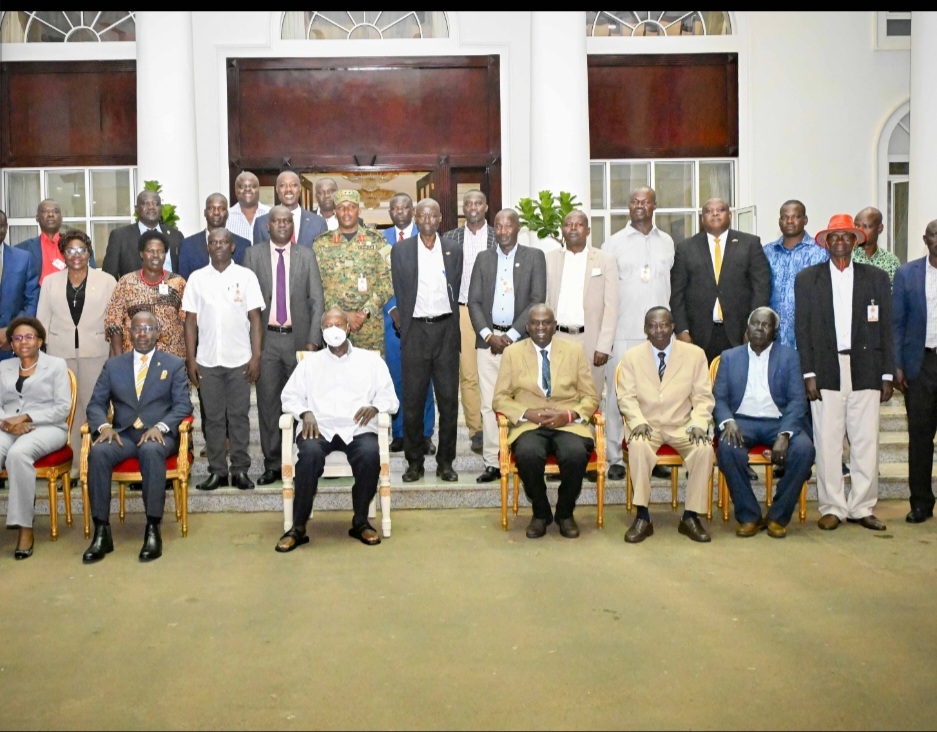
The President made the remarks while meeting a group of leaders and elders affiliated to the Uganda People’s Congress (UPC) and the Forum for Democratic Change (FDC) from across 10 districts of Lango sub-region.
The group that met the President at State House, Entebbe on Thursday, 19th February, 2026, was led by the Commander of the 5th Infantry Division, Maj. Gen. Keith Katungi.
President Museveni, who is also the National chairman of the National Resistance Movement (NRM), said political cooperation should be anchored on ideas and national interests.
“The label of the party is secondary. What is crucial is what you support and the programmes you stand for,” he said.
“It is not about NRM, UPC or DP. It is about patriotism, Pan-Africanism and the principles that shape Uganda.”
He described the engagement as a step toward “real politics,” arguing that politics, like religion, should be centred on beliefs and values.
“Politics should be based on clear principles. For us, it is patriotism; loving Uganda because your prosperity depends on Pan-Africanism, socio-economic transformation and democracy,” he said.
Drawing from personal experience as a farmer, the President underscored the importance of national unity in economic growth.
“My prosperity does not depend only on my neighbours. The people who buy my milk and beef come from different parts of Uganda. That is why unity and stability are critical.”
He urged leaders to focus on solving people’s real challenges.
“Hunger and disease have no tribe or religion. Look at people’s needs, not their identities,” he added.
President Museveni also acknowledged that political actors must do more ideological work to explain policies and programmes to citizens.
“We should not just tell people to support a party without explaining why. People must understand the principles and the programmes,” he noted.
On their part, the leaders pledged to work collectively with the ruling National Resistance Movement for the social and economic transformation of their region and the country.
The NRM Vice Chairperson for Northern Uganda, Hon. Hamson Obua welcomed the group’s decision, saying it aligns with the President’s long-standing message on unity and supporting what is right for national development.
“Your Excellency, you have always emphasized unity and supporting the right things for Uganda,” Hon. Obua said.
“This step of sitting together; UPC, FDC and NRM to discuss Lango’s future is historic.”
He noted that political maturity in the region had translated into stronger collaboration and growing support for government programmes.
“We have moved forward because of unity and clear messaging on transformation,” he said, urging leaders to sustain the momentum.
Gen. Katungi, who oversees operations in Northern Uganda, thanked the President for hosting the group and commended leaders in Lango for choosing cooperation over division.
He noted that various political actors in the sub-region had increasingly embraced dialogue and peaceful mobilisation.
“Lango is peaceful and ready to work together,” he said, adding that the growing collaboration among leaders reflects a shift from sectarian politics to issue-based engagement.
Gen. Katungi also highlighted the role of security agencies in maintaining stability during previous electoral periods, saying peace had created space for constructive political participation.
Mr. Charles Ogwal who presented a Memorandum of Understanding on behalf of the group, congratulated the President on his electoral victory and pledged continued mobilisation for peace and stability.
“We voted for peace and protecting the gains made. Lango got 84% in the last General Elections. We are ready to work with the government to address the needs of our people,” he said.
He also highlighted infrastructure priorities, including key road projects such as the Dokolo–Namasagali road, saying improved connectivity would boost trade and livelihoods.