TEHERAN.
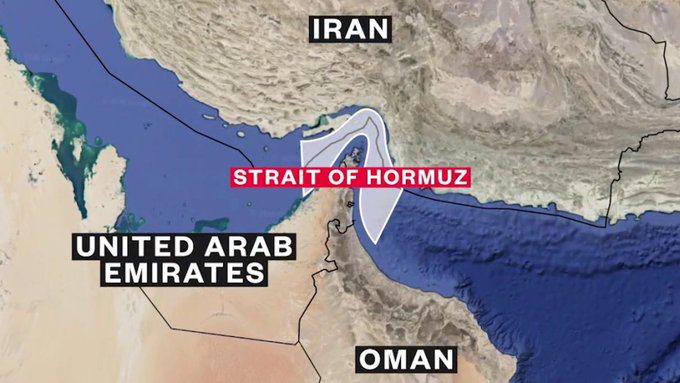
Iran’s powerful Islamic Revolutionary Guard Corps (IRGC) has declared the Strait of Hormuz “closed”, warning that any vessel attempting to pass through the strategic waterway will be attacked, in a dramatic escalation of the ongoing conflict involving the United States and Israel.
An IRGC commander on Monday announced that ships attempting to transit the strait would be set “ablaze”, signalling that Tehran is prepared to enforce the closure of one of the world’s most critical energy routes.
The move has rattled global markets. Oil prices rose for a third consecutive day on Tuesday, with Brent crude futures nearing $80 per barrel. Analysts warn that prices could climb to $100 in the coming days if the conflict intensifies or if shipping through the waterway remains disrupted.
The Strait of Hormuz, which lies between Iran and Oman, is one of the most important oil transit chokepoints in the world. Roughly 20 percent of global oil consumption passes through the narrow corridor, making it a vital artery for energy exports from major Gulf producers.
Any disruption to traffic in the strait has immediate global consequences. Higher crude prices quickly translate into rising fuel costs, increased transport expenses, and renewed inflationary pressures worldwide.
The majority of oil transported through the strait is destined for Asian markets. China, India, Japan and South Korea account for nearly 70 percent of shipments, according to data from the US Energy Information Administration.
A sustained closure could therefore significantly affect Asian economies, many of which rely heavily on Gulf crude.
Beyond oil, the strait is also crucial for other energy supplies. Approximately one-fifth of global liquefied natural gas (LNG) passes through the waterway, while around 30 percent of Europe’s jet fuel supply either originates from or transits via the route.
Disruptions could therefore ripple through aviation, power generation and industrial sectors.
The declaration marks a significant widening of the conflict, which had largely been characterised by air and missile exchanges.
By targeting maritime traffic, Iran appears to be leveraging one of its most powerful strategic tools — its geographic position along the narrow shipping lane.
The US has previously warned that any attempt to block the strait would cross a red line, given its centrality to global trade and energy security.
Military analysts caution that efforts to reopen the waterway could draw in regional and international forces, raising the risk of a broader Gulf confrontation.
Shipping companies are now closely monitoring developments, with some expected to reroute vessels or suspend operations until security conditions become clearer. Insurance premiums for tankers operating in the Gulf region are also likely to rise sharply.
While it remains unclear whether commercial traffic has fully halted, the announcement alone has injected fresh volatility into global markets and heightened fears of a prolonged regional crisis.
As tensions mount, the Strait of Hormuz has once again become the focal point of a conflict whose consequences extend far beyond the Middle East, threatening global energy stability and economic growth.