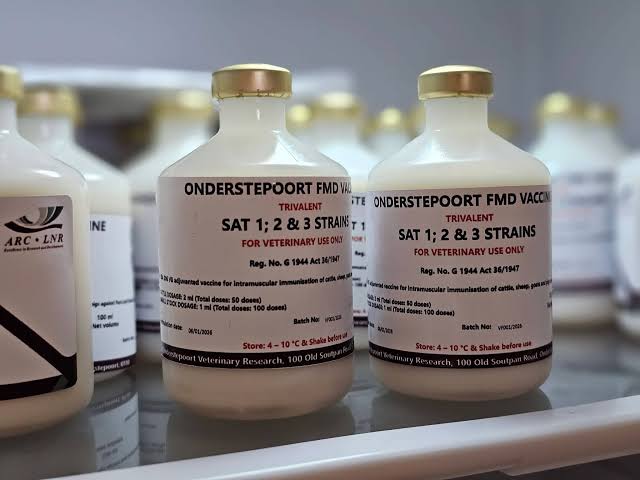
The government has announced that the first nationwide mass vaccination campaign against Foot and Mouth Disease (FMD) will begin next month in July and end in August this year.
This will follow the completion of the ongoing farmer registration, on-boarding, and vaccine distribution activities across different districts under the National FMD cost recovery scheme that was launched early this year.
Under the new policy shift, the government supplies the vaccines and covers logistical costs, cold chain storage, vaccine distribution, surveillance, and veterinary supervision, while farmers pay a subsidized user fee per dose during compulsory biannual mass vaccination cycles.
According to the guidelines, farmers will contribute Shs8,000 per dose for cattle and pigs, and Shs4,000 per dose for goats and sheep.
The nationwide mass vaccination is structured to occur twice a year to fully protect the national herd and restore international livestock trade.
Under the same arrangement, farmers must be registered in the national FMD vaccination database, and authorities warn that non-compliance could limit a farmer’s access to lucrative dairy and livestock markets.
While giving an update on the new measures at the Uganda Media Centre yesterday, the Minister of State for Animal Industry, Col. (Rtd) Bright Rwamirama, said veterinary teams across the country are currently developing micro plans for vaccination mobilization of farmers and preparing logistic support for implementation.
“This campaign will target Uganda’s estimated 45.5 million susceptible animals, comprising approximately 16.5 million cattle, 17.4 million goats, 4.5 million sheep, and approximately eight million pigs,” he said.
He added that the government’s long-term objective is to ensure progressive and sustainable vaccination coverage of at least 80% of all susceptible animals during every vaccination cycle.
“The fight against Foot and Mouth Disease (FMD) cannot be won by the government alone, it requires corrective effort, it therefore requires corrective effort from all stakeholders,” he added.
As of last Friday, June 2026, 20,000 farmers had been successfully on-boarded into the national FMD vaccination system, and approximately 3.5 million susceptible animals have been registered for vaccination.
The registration exercise has so far been conducted in districts with high livestock production, including Nakaseke, Lyantonde, Kiruhura, Rukungiri, Kasese, Kazo, Isingiro, Rakai, Kayunga, Mbarara, Ibanda, Kyegegwa, Mubende, Kasanda, Gomba, Kyankwazi, Kiboga, Mpigi, and Ntungamo. Other districts are expected on board soon.
About FMD
Foot and Mouth Disease is a highly contagious viral disease that affects cloven-hoofed animals, including cattle, goats, sheep, pigs, and wild animals.
It is regarded as one of the most economically devastating livestock diseases in the world and remains the single biggest disease-related barrier to trade in animals and animal products, both locally, regionally, and internationally.
The disease spreads rapidly through direct contact between infected animals and contaminated equipment, feeds, vehicles, animal products, and people moving between farms. The virus can also spread through small liquid particles expelled by an infected animal.
While FMD rarely causes high mortality in adult animals, its economic consequences are enormous. Farmers lose milk production, meat production, breeding potential, and market opportunities, especially as livestock markets are closed, animal movements are restricted, and trade opportunities are lost.
Livestock contribution to economy
Uganda’s livestock sector is increasingly a significant contributor to foreign exchange earnings and national economic growth.
In 2024, Uganda generated approximately over Shs1 trillion, about $285 million, from dairy product exports. This year the figure has risen to over Shs1.4 trillion, about $385 million, driven by increased milk production, which stands at 5.3 billion litres, value addition, and expansion into regional and international markets.
The country also earned about Shs48 billion, roughly $12.9 million, from the export of hides and skins, while exports of gelatin and its derivatives yielded approximately Shs24 billion, about $6.5 million.