BBC – The US and Saudi Arabia have signed a landmark deal that will reportedly allow the Gulf kingdom to develop a civilian nuclear programme.
The deal is described as a “peaceful nuclear co-operation agreement” that will provide “great access for American companies in the Saudi nuclear energy program”, according to the US energy department.
Text from the deal was not made public, but US media have reported that it could allow Saudi Arabia to enrich uranium in the future – which can be used as fuel for power plants, but also to make nuclear bombs.
Experts say that would mark a first for the US and could run the risk of future nuclear proliferation in an already unstable region.
The US Department of Energy noted that along with the co-operation deal, a “bilateral safeguards agreement” was also signed.
“Together, these two agreements lay the legal foundation for a decades-long, multi-billion-dollar partnership that advances several priority economic and strategic objectives, including nuclear nonproliferation,” the statement reads.
The Saudi government also released a statement, saying the deal “represents an extension of existing co-operation between the two countries in the energy sector”, and noted that it comes after the Saudi leader visited Washington last November.
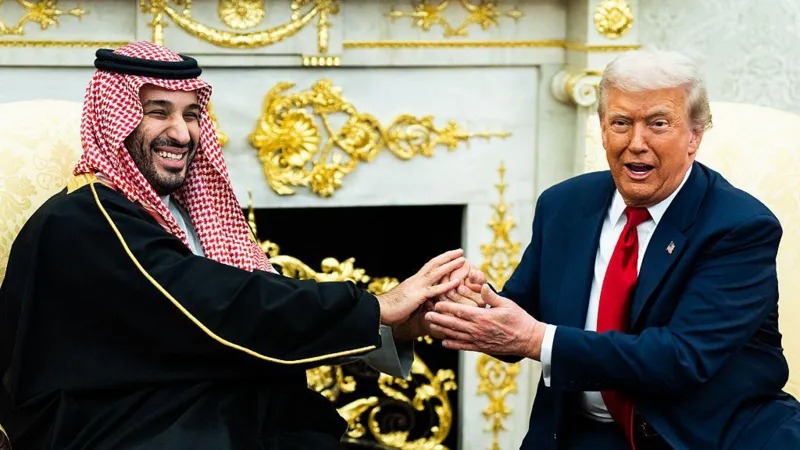
Getty Images A file image of Saudi Crown Prince Mohammed bin Salman holding an extended handshake in the White House Oval Office with US President Donald TrumpGetty Images
Under the deal, US President Donald Trump has reportedly not required his Saudi counterpart Mohammed bin Salman to give diplomatic recognition to Israel
The announcement comes as fighting escalates between the US and Iran. Saudi Arabia, a longtime US ally, hosts several US bases, which have been targeted by Iranian attacks. It also comes two days after Iran’s allies in Yemen, the Houthis, announced a “maritime blockade” against the kingdom.
Specific details of the nuclear deal were not given but earlier media reports suggested that, after undertaking a joint study with the US, Saudi Arabia may be allowed to enrich uranium on its soil to produce fuel at a US-built enrichment facility, instead of relying on imported fuel.
This could be worth billions of dollars to the US, whose companies could be involved in building a facility to produce enriched uranium, which can be used as fuel for power plants but also to make nuclear bombs.
“Rest assured, these agreements uphold the highest standards of nuclear safety and nonproliferation, while relying on the world’s best nuclear technology and scientists, designed right here in the United States,” US Secretary of Energy Chris Wright said in a statement.
The energy department said the deal advances both “US and regional security” and will uphold “high standards of nuclear safety, security, and nonproliferation and strengthening the United States’ competitive edge in civil nuclear technology”.
Nuclear experts and former officials in Israel – the US’s top ally in the Middle East – voiced concern the plan could ultimately lead to Saudi Arabia being able to develop a nuclear weapon – though many experts say that path would likely take decades and lead to pushback from the international community.
Rosemary Kelanic, the director of the Middle East programme at the US-based Defense Priorities think tank, said it would be “quite shocking” if the deal includes the US allowing Saudi Arabia to have facilities to enrich uranium.
“The US has never done that before, we have never helped another country enrich on their own soil,” she said, adding the reason for that is because “if you can produce your own nuclear fuel, you become a much bigger risk” for building nuclear weapons.
The agreement will now be sent to Congress for review.
Some lawmakers on both sides of the political aisle are expected to oppose the deal, though Trump’s Republican Party currently controls both the upper and lower chambers.
US Secretary of State Marco Rubio pushed back against critics who may be concerned about Saudi Arabia’s ability to develop a nuclear weapon in the future.
“The US is not going to reach any agreement with any country in the world that leads to the risk of proliferation,” Rubio told reporters while travelling in the Philippines.
Several Democrats who voiced opposition to the deal noted that during his time as a senator, Rubio had endorsed a law – the “No Nuclear Weapons for Saudi Arabia Act” – which required Congress to sign off on a nuclear deal with the Saudis.
Massachusetts Democratic Senator Edward Markey issued a statement condemning Rubio and Trump, and saying that their “hypocrisy is matched only by their recklessness”.
“They are allowing Saudi Arabia, a belligerent and authoritarian nation, to develop nuclear weapons technologies while starting a war with Iran under the guise of preventing an Iranian nuclear bomb,” said Markey.
If an enrichment provision is included, it would distinguish this agreement from another one that was struck by the US in 2009 with Saudi Arabia’s neighbour, the United Arab Emirates, under which the UAE does not produce its own fuel and accepts a host of other restrictions.
For that reason, the agreement is also expected to attract the concern of nuclear non-proliferation campaigners, whose ultimate aim is to prevent an increase in the number of nuclear weapons worldwide.