By Joseph Kiggundu
Uganda is targeting exports of about 3,500 tonnes of coffee a year to South Korea.
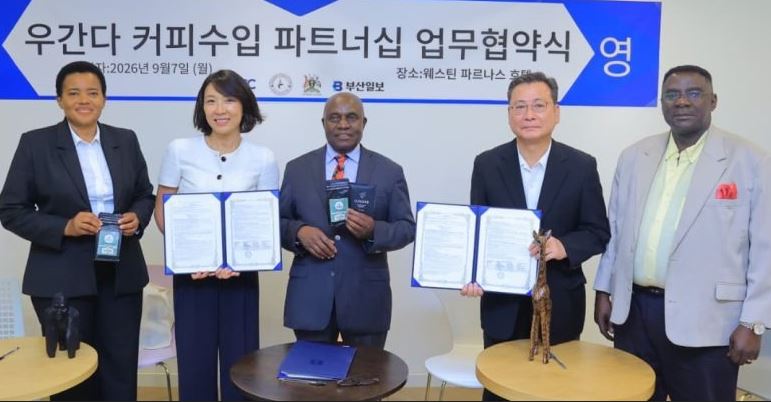
This is under a new distribution agreement signed with Busan-based GVCC Co. Ltd, as the country seeks to expand its presence in Asian markets.
The agreement, signed on Monday between Ugandan coffee company Besmark Coffee Company Ltd and GVCC, provides for Besmark to act as Uganda’s exclusive coffee supplier and GVCC as the exclusive distributor in South Korea.
A first consignment of two containers is already being shipped to South Korea, the Ugandan delegation said.
GVCC Chief Executive Soo-jung Lim said the company had developed a strong interest in Ugandan coffee after initial discussions with the Ugandan delegation at a coffee exhibition in Busan.
Lim said GVCC was ready to do business with Uganda.
Uganda’s Ambassador to Japan, Tophace Kaahwa, whose mission is accredited to South Korea, said Lim was targeting imports of one 20-tonne container of Ugandan coffee each day, which would amount to about 3,500 tonnes annually.
Kaahwa appealed to Ugandan farmers to increase production to help Uganda meet the potential demand.
The agreement goes beyond the South Korean market, with the partners seeking to establish Busan as a regional hub for Ugandan coffee. The coffee could be processed and undergo value addition in Busan before being re-exported to other Asian markets, including Japan and Southeast Asia.
Import volumes and pricing will be determined through separate commercial agreements.
Uganda’s Second Deputy Prime Minister, Dr Crispus Kiyonga, who led the Ugandan delegation, said the government wanted the partnership to help Uganda expand its market in Asia while moving towards greater domestic value addition.
“Uganda wanted, in time, to add value to its coffee at home rather than ship raw beans,” Kiyonga said.
He said Uganda was looking to expand into Japan and other Asian markets and that the government would provide the support needed for the partnership.
Kiyonga said President Museveni had set a target of producing 20 million bags of coffee annually, compared with current production levels.
The deal comes as Uganda’s coffee exports reach record levels. In the 12 months to May 2026, Uganda exported 8.6 million 60-kg bags worth about $2.3 billion (8.3 trillion Ugandan shillings), up from 7.4 million bags a year earlier, according to the Ministry of Agriculture, Animal Industry and Fisheries.
Uganda overtook Ethiopia as Africa’s largest coffee exporter in 2025 and is among the world’s leading Robusta suppliers. By volume, it ranks around sixth to eighth globally, behind Brazil and Vietnam.
Robusta accounts for about 80% of Uganda’s coffee exports, while Arabica represents a smaller share but is growing faster in value.
Despite its growing production, Asia accounted for only 13% of Uganda’s coffee exports in the 2024/25 coffee year. Europe took about 62%, while Africa accounted for 23%, according to the ministry.
The South Korean deal therefore gives Uganda an opportunity to increase its share of the Asian market.
Kiyonga said the partnership could also help address the trade imbalance between Uganda and South Korea.
Uganda exported about $10 million worth of goods to South Korea while importing about $100 million, Kiyonga said. Official data put Uganda’s total exports to South Korea at about $7.18 million in 2023, with coffee, tea and spices accounting for about $2.6 million.
“We want to balance the trade,” Kiyonga said.
The agreement was coordinated by Uganda’s embassy in Tokyo and is being presented as an early outcome of the Economic and Commercial Diplomacy strategy launched in 2025.
The strategy encourages Ugandan diplomatic missions to promote value-added products rather than raw commodities and is linked to the country’s ambition to grow its economy to $500 billion by 2040.
Ambassador Henry Mayega described the agreement as a significant step for Uganda’s coffee exports and highlighted the role of coffee in Ugandan society.
“Coffee features in Ugandan custom, including marriage and bride-price rites,” Mayega said.
The partners will also work with The Busan media on promotion, including coverage and events intended to increase awareness of Ugandan coffee.
South Korea has a population of about 51.6 million people. Uganda does not have a resident embassy in Seoul; its embassy in Tokyo is accredited to South Korea.
The Korea International Trade Association, a co-organiser of the Uganda-Korea Trade and Investment Meeting, has urged Kampala to open a resident diplomatic mission in Seoul.Why this is stronger: it leads with the 3,500-tonne target, brings in the two-container first shipment immediately, then uses Uganda’s $2.3 billion coffee exports, 8.6 million bags and Asia’s 13% share to establish the wider significance. It also avoids making the story sound like a press release.