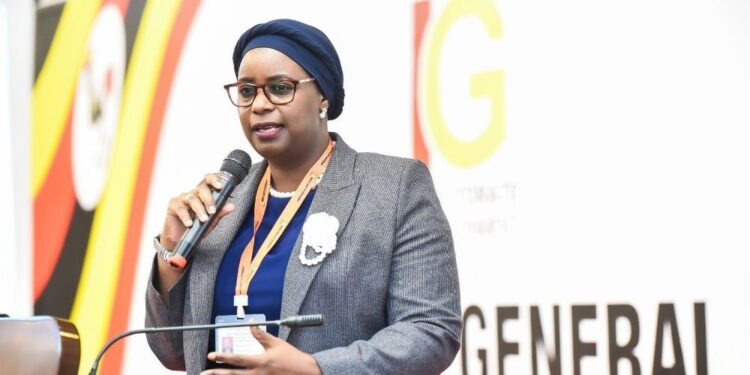
Inspector General of Government Aisha Naluzze Batala presents the inspectorate’s January -June 2026 report to Parliament.
By Joseph Kiggundu
KAMPALA — Uganda’s Inspectorate of Government issued orders for the recovery of Shs41.6 billion in public funds during the first six months of 2026, a sharp increase from the Shs2.2 billion recorded in the corresponding period last year, even as the amount actually recovered declined.
The figures are contained in the inspectorate’s 55th Bi-Annual Performance Report for January to June 2026, presented to Parliament by Inspector General of Government Aisha Naluzze Batala. The report indicates that the agency recovered Shs5.72 billion in cash and assets, compared with Shs8.09 billion in the first half of 2025.
The report does not provide a detailed explanation for the difference between the recovery orders issued and the amounts collected. However, recovery orders do not necessarily result in immediate payment, as enforcement and collection can take considerable time.
The inspectorate also reported a rise in complaints, receiving 1,909 cases during the six-month period against 1,595 in the same period last year. Of these, 630 involved allegations of corruption.
Regional offices accounted for a substantial share of the complaints, registering 954 cases compared with 514 a year earlier. The head office received the remaining 955 complaints.
The agency attributed the increase partly to public awareness activities, including radio and television programmes, community meetings, sensitisation campaigns during the March 2026 asset declaration period and an anti-corruption caravan conducted in partnership with ActionAid Uganda. It noted that increased reporting does not automatically indicate a corresponding rise in corruption.
Convictions increase as MPs question high-profile arrests
The inspectorate took 29 cases before the Anti-Corruption Division of the High Court and the Leadership Code Tribunal, securing 26 convictions. In the first half of 2025, it had obtained 15 convictions from 18 cases.
According to the report, the Leadership Code Tribunal recorded convictions in all the cases it concluded, while the Anti-Corruption Court registered a conviction rate of 57.1%.
However, Leader of the Opposition Joel Ssenyonyi challenged the effectiveness of some high-profile anti-corruption operations, questioning whether arrests were translating into meaningful legal outcomes.
Ssenyonyi cautioned that public displays of suspects in handcuffs followed by their quiet release could undermine confidence in the campaign, making it appear to be “showbiz just for the media”.
Naluzze maintained that the inspectorate would investigate and prosecute suspected offenders without favouritism. She said no individual was beyond scrutiny, while emphasising that suspects must be accorded due process and presumed innocent until proven guilty.
Abuse of office remained the leading offence among the high-profile cases concluded by the inspectorate in ministries, departments and agencies. It accounted for 69 of the 88 cases reported in that category.
In local governments, the inspectorate recorded 526 corruption investigation outcomes, with abuse of office featuring in 159 cases.
Unpaid salaries top complaints against government
Beyond investigating corruption, the inspectorate resolved 681 complaints involving maladministration through its ombudsman function.
Disputes over unpaid salaries and benefits accounted for 230 cases, making them the most common grievance. Employment-related disputes followed with 123 cases. Local governments contributed 584 of the complaints resolved.
Deputy Inspector General of Government Anne Muhairwe said the ombudsman function enables citizens to seek redress against administrative failures without necessarily resorting to court proceedings.
She said the inspectorate uses mediation, negotiation, mobile clinics and systemic investigations to address complaints and resolve disputes between citizens and public institutions.
MPs push for changes to whistleblower rewards
Parliament also raised concerns about delays or failures in rewarding whistleblowers whose information has helped the government recover public funds.
Muwada Nkunyingyi, chairperson of Parliament’s Committee on Commissions, Statutory Authorities and State Enterprises, said lawmakers had received five petitions from informants complaining that they had not received their promised rewards.
Muhairwe said the current legal framework limits the reward to 5% of the money recovered under the Whistleblowers Protection Act. This means informants who help authorities prevent a loss before public money is stolen may receive no financial reward because there is no recovered sum on which to calculate their entitlement.
She said the inspectorate supports amending the law to address the gap and improve incentives for people who provide information about corruption.
Meanwhile, John Teira, chairperson of Parliament’s Legal Committee, welcomed an increase in the inspectorate’s budget from approximately Shs88 billion to Shs97 billion. He said investigators increasingly face cases involving financial transactions and suspected proceeds of corruption that cross national borders.
Amos Kankunda, the Rwampara County MP and chairperson of Parliament’s Budget Committee, also commended the community outreach meetings, saying they had helped bring the inspectorate closer to residents in his constituency.
Asset declaration compliance stands at 80%
The report further showed that 241,230 of the 302,800 public officers registered on the inspectorate’s online asset declaration system submitted their returns during the April 2026 filing period, representing compliance of about 80%.
The inspectorate also recommended 22 leaders for prosecution before the Leadership Code Tribunal over matters relating to compliance with the leadership code.
The figures place the agency’s performance against two competing measures: a substantial increase in the value of public funds it has ordered recovered and a decline in the money and assets it has actually retrieved. Parliament’s scrutiny is expected to keep attention on enforcement, accountability and the effectiveness of the country’s anti-corruption framework.