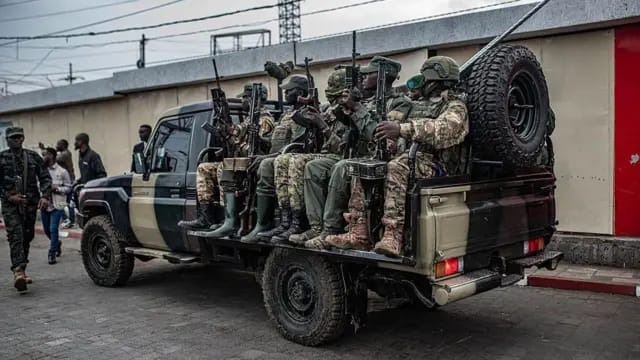
The United States has imposed sanctions on Rwanda’s Ministry of Defence and a financial institution linked to the country’s security services, accusing them of supporting the M23 rebel group operating in eastern Democratic Republic of Congo (DRC).
The sanctions, announced on October 28 by the US Department of the Treasury, also target Zigama Credit and Savings Society, a Rwandan financial institution that Washington accuses of facilitating military payments and financial transactions benefiting the rebels and their political allies.
“Today, the United States makes good on President Trump’s promise to hold Rwanda accountable for its commitments under the Washington Accords for Peace and Prosperity,” US Treasury Secretary Scott Bessent said.
“Rwanda must halt its support for M23 and withdraw its troops from eastern DRC,” he added.
The Treasury Department alleges that Rwanda’s security apparatus has deployed thousands of troops into North and South Kivu provinces, where they operate alongside M23 and provide military equipment, logistical assistance and training.
Washington also accuses Rwandan forces of introducing advanced weapons, including surface to air missile systems and electronic jamming equipment, into the conflict.
According to the US government, M23 has committed human rights abuses in areas under its control, including unlawful detentions, torture and forced labour. It also alleges that minerals extracted from mining areas controlled by the rebels, including gold and coltan, enter supply chains through Rwanda, raising concerns about the financing of the conflict.
Zigama Credit and Savings Society is accused by the U.S of facilitating payments for weapons, ammunition and other military equipment for the Rwanda Defence Force (RDF), as well as financing travel and accommodation for military training activities.
The US Treasury further alleges that the institution helped transport gold originating from M23 controlled territory to Kigali and facilitated transactions worth tens of millions of dollars for M23 and its political wing, the Congo River Alliance.
The sanctions follow the signing of the Washington Accords for Peace and Prosperity by the Congolese and Rwandan presidents on December 4, 2025.
The agreement was intended to advance a peaceful resolution to the conflict while promoting regional trade, investment and transparency in critical mineral supply chains. Washington says the latest measures are intended to press Rwanda to honour its commitments under the agreement.
However, Kigali has consistently rejected accusations that it provides military or material support to M23.
Rwandan officials have argued that the conflict is rooted in the political and social marginalisation of Congolese Tutsis and should be addressed through negotiations between the parties involved.
Rwanda has also defended its security posture along the Congolese border, citing the presence of the Democratic Forces for the Liberation of Rwanda (FDLR), an armed group linked to perpetrators of the 1994 genocide against the Tutsi, as a threat to its national security. Kigali maintains that addressing this threat is central to resolving tensions with the DRC.
The sanctions block the designated entities’ property and financial interests within the United States or under the control of US persons. They also generally prohibit US persons from conducting transactions involving the sanctioned entities, while companies and individuals outside the United States could face exposure if their dealings violate or evade US sanctions rules.
The measures come as the Great Lakes region continues to pursue diplomatic solutions to the conflict, which has displaced civilians and disrupted economic activity across eastern DRC. Their impact will depend partly on how Rwanda responds and whether the pressure helps advance the commitments made under the Washington Accords.