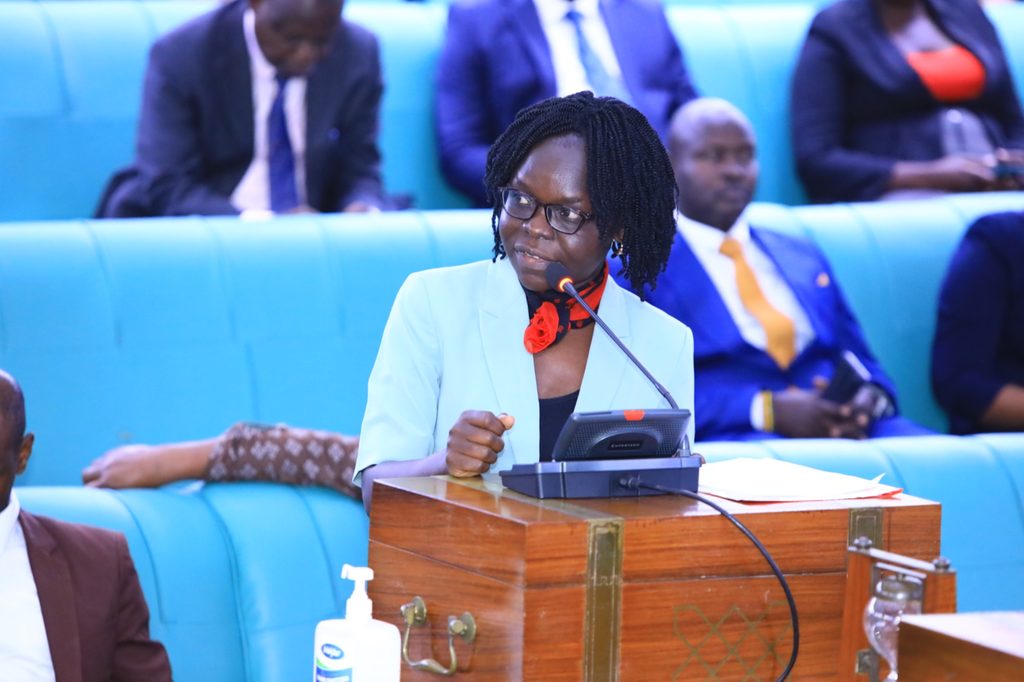
Dr. Eunice Apio speaking in Parliament on Tuesday, 3 November 2026
By Sulaiman Kauki
A parliamentary committee has proposed that Parliament purchase locally manufactured buses from Kiira Motors Corporation for use during its oversight activities, as legislators push for greater government support for Uganda’s homegrown innovations.
The proposal emerged during debate on the report of Parliament’s Committee on Science, Technology and Innovation, presented by its chairperson, Samuel Opio, during Tuesday’s plenary sitting on November 3, 2026, chaired by Speaker Jacob Oboth.
Opio said many locally developed technologies continue to struggle to reach the market because government institutions, which could provide an initial customer base, have been slow to embrace locally manufactured products.
He argued that Parliament should lead by example by incorporating Kiira Motors buses into its transport fleet, particularly for field visits and oversight activities.
Kitgum Municipality MP Denis Oneka Lit backed the proposal, describing Kiira Motors’ development as evidence of Uganda’s growing capacity to produce its own vehicles.
Oneka Lit recalled the early stages of vehicle innovation at Makerere University, where he served as Guild President in 2011, noting that the initiative had since evolved into the production of electric and other buses now operating on Kampala’s roads.
He called for increased investment and institutional support to enable the company to expand its operations and contribute to economic growth.
However, the committee’s report raised concerns about the financial sustainability of some government-supported innovation projects.
Kiira Motors Corporation has reportedly received Sh223 billion in public funding over 12 years but continues to rely heavily on government support. Its manufacturing facility in Jinja has an annual production capacity of 2,500 vehicles, with potential to expand to 10,000 units.
The report also highlighted challenges facing the Presidential Initiative on Banana Industrial Development, which has received Sh311 billion over two decades but generated only Sh15.55 billion in revenue.
Kole South MP Boniface Okot questioned the continued funding of projects that have yet to demonstrate sufficient commercial returns. He proposed temporarily suspending the introduction of new science and technology initiatives until existing programmes are better supervised.
His concerns were partly informed by staffing gaps within the sector, with only 24 of the 151 approved positions in the Science, Technology and Innovation Secretariat filled, despite the institution being responsible for overseeing 141 funded projects.
The committee further established that only five out of 84 startups supported through the Uganda Industrial Research Institute’s business incubation programme had successfully graduated from incubation.
Koboko County MP Emmanuel Banya called for the establishment of a competitive fund to help universities and young innovators transform research ideas into marketable products.
He cited innovations developed by Muni University students, including a temperature-regulating cold storage facility and a GPS-enabled livestock monitoring system designed to alert farmers when their animals move beyond designated grazing areas.
Banya argued that many promising innovations across universities could generate economic value if researchers received financial support to develop them into commercial enterprises.
Shadow Minister for Science and Technology Dr Eunice Otuko also called for greater accountability in the management of public resources allocated to research and innovation.
She questioned the limited visibility of patents, employment opportunities and commercially successful products arising from government investment, urging the sector to provide regular performance reports demonstrating measurable outcomes.
Meanwhile, Opposition Whip Paul Mwiru raised concerns about institutional restrictions that prevent some research organisations from commercialising their innovations.
Bugangaizi East MP Onesimus Twinamasiko called for the expansion of the sericulture initiative in Kween District to other parts of the country, arguing that the programme could create additional economic opportunities.
Responding on behalf of the Minister responsible for Science, Technology and Innovation, Health Minister Chris Baryomunsi acknowledged the need to strengthen the transition from research to commercial production.
He said universities and research institutions should not limit their work to developing innovations but should also ensure that successful projects progress to the marketplace and generate economic benefits.
The debate highlighted Parliament’s growing concern over the need to make public investment in science, technology and innovation deliver tangible returns through industrial development, employment creation and locally manufactured products.