By Joseph Mary Buwule
Makerere University Professor of Law Christopher Mbazira has challenged Uganda’s judiciary to play a more proactive role in advancing constitutional transformation, strengthening democratic governance and holding public institutions accountable, saying courts have a critical responsibility in ensuring that constitutional principles translate into meaningful change in society.
Mbazira said the judiciary must remain central to the promotion of the rule of law, protection of human rights, transparency and political accountability, arguing that public interest litigation provides an important avenue through which citizens can challenge injustices and demand accountability from those exercising public power.
He made the remarks while delivering his inaugural professorial lecture at Makerere University under the theme, “Uganda at 64 and the Exercise of Judicial Power for Constitutional Transformation: Examining the Gains and Lost Opportunities.”
The lecture examined the contribution of the courts to Uganda’s constitutional development, reflecting on the achievements registered through judicial interventions, the opportunities that have been missed and the continuing challenges surrounding the exercise of judicial authority.
Mbazira’s presentation was informed by more than two decades of professional engagement in public interest lawyering, particularly public interest litigation, an area he said has been driven by his conviction that litigation can contribute to transforming society.
He explained that his work over the years has focused on understanding how courts can influence constitutional development and promote a society in which government institutions operate within the law, human rights are respected and public officials are held accountable for their actions.
“I have committed two decades of my professional life to promoting public interest lawyering and, in particular, public interest litigation. This is motivated by the belief that litigation can contribute to transforming society,” Mbazira said.
He identified constitutional transformation as a process that should lead to greater adherence to the rule of law, respect for human rights, relief for victims of violations, transparency and political accountability.
The professor noted that his research draws from extensive engagement with judicial institutions, legal academics, practising lawyers and public interest litigators, whose experiences have helped shape his understanding of the opportunities and limitations of judicial power in Uganda.
He also observed that developments over the past four years had provided numerous illustrations relevant to his lecture, demonstrating the continuing importance of examining the relationship between judicial institutions, political authority and constitutional governance.
Judicial power and constitutional accountability
At the centre of Mbazira’s lecture was the question of how judicial power can be exercised to advance constitutional transformation in Uganda.
His argument places the courts within the broader national effort to strengthen constitutionalism and democratic governance, recognising that the judiciary is not merely an institution for resolving disputes but also a critical guardian of constitutional principles.
Through constitutional interpretation and the determination of cases involving public authority, courts have an opportunity to influence how government institutions exercise their powers and how citizens enjoy their constitutional rights.
Public interest litigation, in particular, provides a mechanism through which individuals and organisations can bring matters affecting the wider public before courts, including questions of human rights, legality and the accountability of public institutions.
However, the theme of Mbazira’s lecture also invited reflection on the gains and lost opportunities in Uganda’s constitutional journey, raising questions about how effectively judicial power has been used to advance the country’s constitutional aspirations.
His book, which was launched during the ceremony, further explores these issues by examining the relationship between judicial power, politics and constitutional transformation.

Tibatemwa-Ekirikubinza commends Mbazira’s scholarship
Supreme Court Justice Hon. Lady Justice Prof. Lillian Tibatemwa-Ekirikubinza, who presided over the professorial lecture and book launch, commended Mbazira for his contribution to legal scholarship and his commitment to interrogating the work of the judiciary.
Justice Tibatemwa-Ekirikubinza, a former Deputy Vice Chancellor for Academic Affairs at Makerere University and former member of the School of Law faculty, described her relationship with Mbazira as one that had developed from an academic connection to a professional association.
She recalled first knowing him as a student whose intellectual abilities in law stood out, before later interacting with him as a colleague.
She expressed satisfaction at seeing him attain professorial status, describing the achievement as a reflection of his commitment to academic excellence and the advancement of legal knowledge.
The Supreme Court Justice particularly appreciated Mbazira’s willingness to critically examine the judiciary, noting that constructive criticism and scholarly reflection are important in strengthening judicial institutions.
As the author of the book’s foreword, she said the publication provides an important opportunity for judicial officers and other stakeholders in the justice system to reflect on their work and consider areas where improvements can be made.
She emphasised the importance of authorship and scholarship in stimulating intellectual development, drawing on the work of Albert Schweitzer to explain how authors inspire others by lighting an intellectual flame.
She observed that Mbazira’s publication was particularly important because it challenges those within the judiciary to reflect on their responsibilities, assess their performance and consider how they can improve the administration of justice.
The book, titled “Judicial Power, Politics and Constitutional Transformation in Uganda: Walking in and Outside the Constitution,” explores the complex interaction between legal institutions, political processes and the constitutional framework.
Makerere celebrates academic excellence
Makerere University Acting Vice Chancellor Prof. Sarah Ssali described Mbazira’s achievement as not merely a personal accomplishment but also an institutional milestone and a source of pride for the university.
She said the professorial lecture reflected Makerere’s longstanding commitment to nurturing intellectual excellence, research and scholarship that responds to society’s challenges.
According to Ssali, inaugural professorial lectures provide an opportunity to reflect on an academic’s professional journey, particularly their contribution through research, teaching, university service and engagement with society.
She expressed confidence that Mbazira’s examination of judicial power and constitutional transformation would contribute to discussions on Uganda’s constitutional development and democratic future.
Ssali also highlighted the significance of the accompanying book, saying academic publications play an important role in interrogating institutions, challenging established thinking and contributing to national and international debates.
She particularly commended Mbazira for his mentorship and contribution to legal education through Makerere University School of Law.
Through teaching, research and mentorship, she said, the professor has contributed to developing a generation of lawyers and legal scholars capable of critically engaging with the law as an instrument of justice and social transformation.
A milestone in legal scholarship
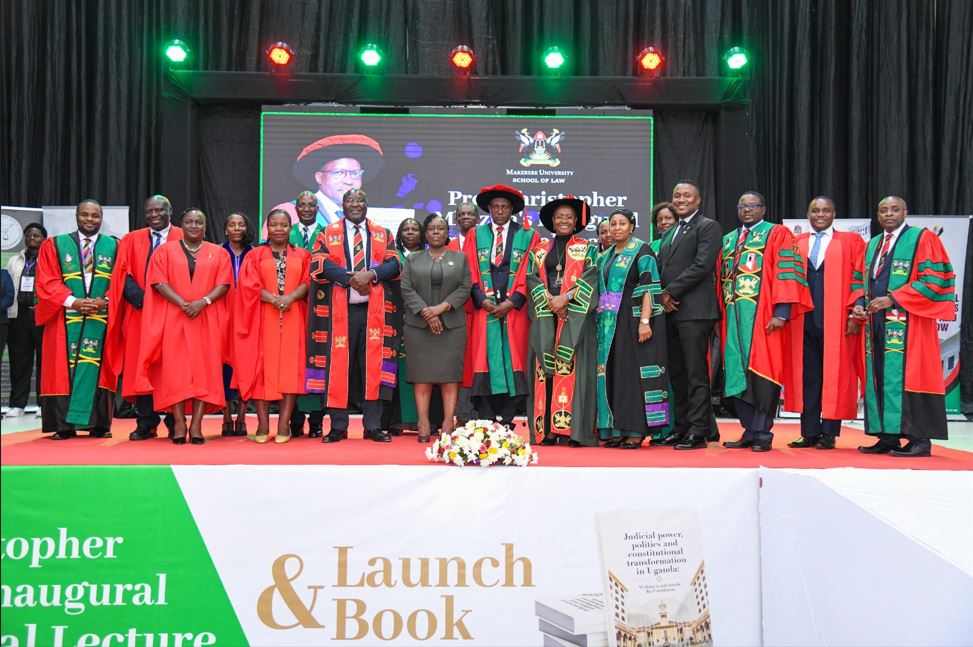
Mbazira’s inaugural professorial lecture and book launch attracted members of the Judiciary, Makerere University management, the legal fraternity, academic staff, students and members of the general public.
The event provided an opportunity for the university and the wider legal community to celebrate his academic journey, which spans more than two decades of scholarship and contribution to legal education.
It also brought together judicial officers, academics and legal practitioners to reflect on the relationship between the courts, constitutional governance and the country’s democratic development.
The launch of the book adds to the body of legal scholarship examining the role of judicial institutions in shaping Uganda’s constitutional order.
As Uganda reflects on 64 years of independence, Mbazira’s lecture places the exercise of judicial power at the centre of conversations about constitutionalism, the protection of fundamental rights and the accountability of public institutions.
His central message is that constitutional transformation requires more than the existence of constitutional provisions and institutions. It also depends on how those institutions exercise their authority and how effectively the law is used to protect citizens, promote justice and hold those in power accountable.
The lecture therefore presents an opportunity for the judiciary, legal scholars, government institutions and citizens to reflect on the country’s constitutional journey, the progress made and the opportunities that remain to be realised.