
Mawokota County North MP Amelia Anne Kyambadde (NRM) celebrating for her victory
By Joseph Kiggundu
MPIGI. The High Court in Mpigi has ruled that alterations to election documents do not automatically amount to electoral fraud, dismissing a petition seeking to overturn the election of Mawokota County North MP Amelia Anne Kyambadde (NRM).
In a judgment delivered on November 13, 2026, Justice Jamson Karemani Karemera observed that although alteration of election documents is a serious offence under Section 95(a) of the Parliamentary Elections Act, the mere presence of alterations on declaration of results (DR) forms is not sufficient proof of fraud.
The judge held that a petitioner must demonstrate that the alterations were deliberate and intended to manipulate election results, a burden that Hillary Innocent Kiyaga, Kyambadde’s National Unity Platform (NUP) rival, had failed to discharge.
Kiyaga had petitioned the High Court, alleging that declaration of results forms from 24 polling stations had been fraudulently altered to inflate Kyambadde’s votes and reduce his own tally.
He argued that discrepancies between copies of the results forms obtained from the Electoral Commission and those allegedly issued to his polling agents on Election Day amounted to thousands of votes, exceeding Kyambadde’s winning margin of 2,274 votes.
However, Justice Karemani found that although the certified results forms contained alterations, there was insufficient evidence to establish that they had been made fraudulently or with an ulterior motive.
The court relied partly on the testimony of Mpigi District Returning Officer Everest Twinomujuni, who explained that some of the changes could have resulted from corrections made by presiding officers while completing the forms.
Twinomujuni told court that he received the forms in the condition in which they were presented during tallying and that the results were displayed and announced in the presence of candidates and their agents.
The judge also noted that Kiyaga had admitted during cross-examination that he did not raise any complaint during the display, tallying and announcement of the results.
Justice Karemani consequently accepted that the discrepancies could have arisen from corrections of errors rather than deliberate manipulation of the election results.
In the November 13 judgment, the court dismissed the entire petition, confirming Kyambadde as the duly elected Member of Parliament for Mawokota County North.
Kyambadde was declared winner of the January 15 parliamentary election with 27,075 votes against Kiyaga’s 24,801, giving her a majority of 2,274 votes.
Kiyaga had challenged the election on several grounds, including alleged fraudulent alterations of results forms, irregularities in the signing of declaration forms and Kyambadde’s eligibility to contest while reportedly serving as a Senior Presidential Advisor on Industry.
On the question of eligibility, Kiyaga argued that Kyambadde was a public officer who was required to resign within the statutory period before contesting for Parliament. He also questioned the validity of her resignation, arguing that her letter had not been addressed directly to the President.
Kyambadde maintained that she had resigned before her nomination and that her position as Senior Presidential Advisor on Industry did not constitute public service employment requiring resignation under the Parliamentary Elections Act.
Justice Karemani first held that the eligibility complaint was a pre-election dispute that ought to have been raised before the Electoral Commission during the nomination period.
He noted that Kiyaga had an opportunity to inspect Kyambadde’s nomination documents but failed to raise any objection before polling day. The judge held that he could not wait until after the election to challenge an issue that ought to have been addressed during nominations.
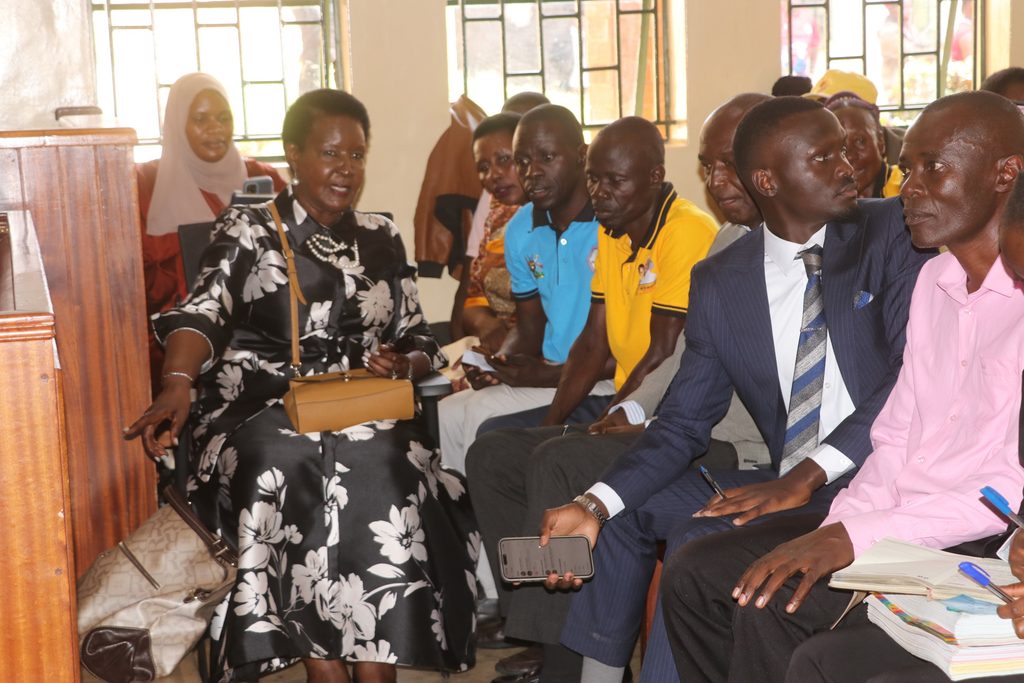
Mawokota North MP Amelia Kyambadde (L) in court together with her supporters on September 21,2026
Nevertheless, the court examined the substance of the complaint and found that the evidence did not establish that Kyambadde’s position fell within the category of public offices requiring resignation under the Constitution and the Public Service Act.
The judge further noted that Kyambadde had submitted a resignation letter dated May 23, 2025, addressed to the Secretary, Office of the President, followed by a letter dated June 10, 2025, accepting her resignation.
The court also dismissed Kiyaga’s complaint over declaration of results forms that allegedly lacked signatures of candidates’ polling agents.
Justice Karemani held that the presiding officer is the principal and mandatory signatory of a declaration of results form, adding that the absence of signatures by candidates or their agents does not, on its own, invalidate election results where the presiding officer has signed.
In another significant aspect of the judgment, the court struck out 22 affidavits filed in support of Kiyaga’s petition for failure to comply with the Illiterates Protection Act.
The judge found that the affidavits, prepared in English for witnesses who required explanations in Luganda, did not disclose the full names and addresses of the people who had prepared and translated the documents.
He ruled that the omission rendered the affidavits incurably defective, explaining that commissioning an affidavit and preparing or translating its contents are separate legal responsibilities.
However, the court spared the affidavits of two witnesses, Peter Kafuuma and Noordin Mutyaba, who appeared for cross-examination and personally explained the circumstances surrounding their evidence.
The judge also struck out a supplementary affidavit filed by Kiyaga in September 2026, ruling that it had been introduced without the court’s permission and after the closure of pleadings.
Having found no proven electoral malpractice or non-compliance with electoral laws capable of affecting the election outcome, Justice Karemani dismissed the petition and upheld Kyambadde’s victory.
On costs, the judge observed that election petitions are matters of public interest and not merely disputes between competing candidates. He cautioned that courts should exercise restraint when awarding costs to avoid discouraging voters and aggrieved parties from seeking judicial redress.
He therefore ordered each party to bear its own costs