By Ruth Nanyonga
The Minister for Local Government, Hon. Balaam Barugahara, has ordered investigations and immediate action against suspected cases of corruption, financial mismanagement and abuse of public resources in Amolatar District, warning public officials that those implicated will be held accountable.
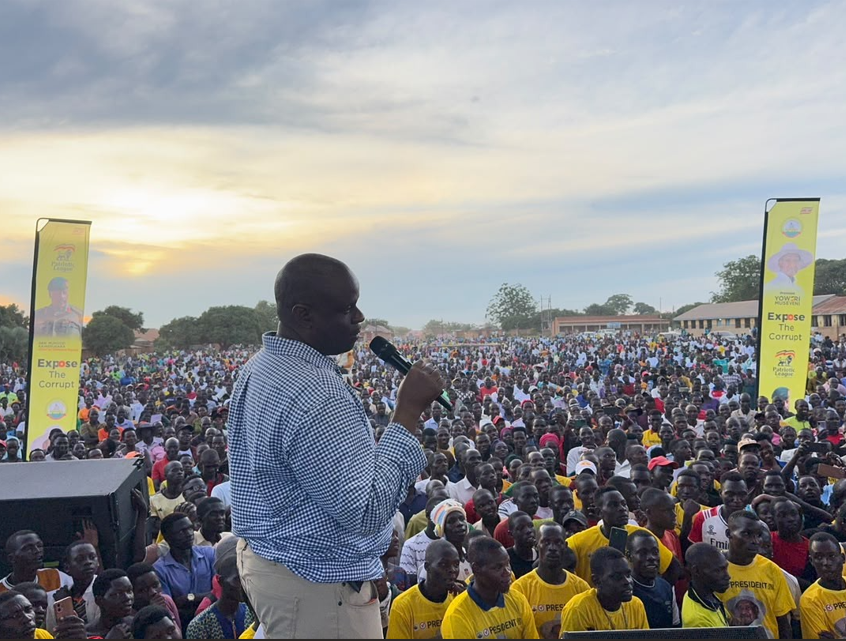
Hon. Barugahara made the remarks on Monday during an accountability meeting with district leaders and stakeholders at Amolatar District Headquarters, where he reviewed challenges affecting service delivery, examined reports of alleged financial impropriety and directed action on several cases involving public institutions and government programmes.
The meeting was held under the ongoing Expose the Corrupt nationwide campaign, through which the Ministry of Local Government is working with the State House Anti-Corruption Unit (SHACU), other anti-corruption agencies and security institutions to fight corruption and strengthen accountability in local governments.
“The time for stealing public funds is over,” Hon. Barugahara warned, urging leaders and residents to expose corruption and work with Members of Parliament, ministers and other stakeholders to improve service delivery.
The meeting brought together the Member of Parliament for Kioga County, Angwech Colline; LC V Chairperson Morris Ogwal Omara; Chief Administrative Officer Rhoda Oroma; councillors, representatives from the district’s 16 sub-counties and other local government officials.
Several concerns emerged, including alleged extortion under the Parish Development Model (PDM), incomplete government projects, staffing shortages, questionable management of road funds, missing district vehicles and poor infrastructure.
PDM extortion cases under investigation:
On the Parish Development Model, officials reported multiple cases of alleged extortion involving beneficiaries, with police confirming that 27 cases had been registered and 19 people summoned in connection with the allegations.
Some residents told the meeting that beneficiaries had been denied access to PDM funds. They also alleged that a Town Agent had been arrested over the matter but was later released.
The Minister’s team directed that the Town Agent be re-arrested as investigations into the allegations continue.
The meeting also heard allegations that elderly women vetted for cattle restocking funds had been asked to pay Shs100,000 to access the money. An elderly woman living with a disability was also reportedly excluded from the programme.
The Minister’s team directed that those implicated in receiving the money be arrested and brought to the rally ground.
Hon. Barugahara also raised concerns about the occupation of government health facilities by individuals not entitled to institutional accommodation.
At Amolatar Health Centre IV, he directed the immediate arrest of a person accused of encroaching on the facility’s premises and continuing to construct additional structures despite being required to vacate.
He further directed the CAO to vacate the doctor’s house at the health centre within two weeks, emphasising that institutional accommodation should be reserved for health personnel.
The CAO explained that she had been allocated the house by the former LC V Chairperson on security grounds and was staying with a police officer assigned to protect her.
The Minister consequently directed the District Police Commander to ensure that she receives appropriate security after securing alternative accommodation.
Seven key positions remain vacant:
The meeting also exposed significant staffing gaps in Amolatar District Local Government, with the CAO reporting that only six Head of Department positions were substantively filled, while seven remained vacant and were being managed in acting capacities.
The vacant positions included Engineering, Water, Finance, Education, Audit and Planning, among others.
Oroma attributed the gaps to inadequate wage provision and said she had written to the Permanent Secretary requesting Shs1.8 billion to facilitate the provision and recruitment.
However, the Permanent Secretary in the Ministry of Public Service clarified that the district had failed to submit its wage requirements within the stipulated period, noting that the request was only made in October, midway through the financial year.
The district was advised to submit its wage requirements for the 2027/2028 financial year in good time to facilitate funding and recruitment.
Incomplete projects, ghost learners raise concern:
On education infrastructure, the meeting examined several incomplete projects, including a laboratory at Namasale Seed Secondary School, whose contract was awarded to Mobitex at Shs239 million, with completion scheduled for March 2025.
The District Education Officer informed the meeting that the project had not been fully completed and that the former DEO, who had been supervising it, had since resigned.
Other projects flagged included a laboratory and teachers’ house at Awero Secondary School, works at Akwon Seed School and two classroom blocks, each comprising three classrooms, at Aputi Primary School.
Concerns were also raised over alleged mismanagement of funds at Abidak Secondary School and reports of ghost learners in some government schools, including Acegere Primary School and Amolatar Primary School.
The management of district road funds also came under scrutiny following allegations that money had been channelled into personal accounts of district staff.
The meeting further examined claims of double budgeting, with roads reportedly fully funded in the 2023/2024 financial year allegedly reappearing in subsequent budgets.
Councillors also raised concerns over the district vehicle fleet, reporting that eight vehicles were missing, with some reportedly having been away from the district for as long as five years.
The meeting heard that garages were still demanding payment for maintenance work on some vehicles that were reportedly not physically available.
Questions were also raised about a request for Shs96 million to maintain a vehicle reportedly grounded at a health facility.
The District Engineer also came under scrutiny over three charges under SHACU, with the Ministry advising that the officer remain interdicted until investigations are concluded.
Health centre seeks hospital status:
On health service delivery, LC V Chairperson Morris Ogwal Omara reported that Amolatar Health Centre IV serves approximately 20,000 patients monthly and appealed for its upgrade to hospital status.
He also highlighted staffing challenges at the facility, with staffing levels reportedly standing at 22.9 per cent, calling for additional government support to improve service delivery.
The district’s water ambulance also attracted scrutiny after councillors questioned why it had remained grounded despite an allocation of Shs5 million for fuel.
They demanded accountability for funds allocated to its operations over the past three years.
The CAO explained that the ambulance was intended to support supervision and immunisation activities, although councillors maintained that they had not seen it operating.
Leaders seek investment in fishing, roads and water:
On the district’s economic potential, LC V Chairperson Omara highlighted the importance of Namasale Fishing Market, constructed by the Ministry of Agriculture, Animal Industry and Fisheries in 2010 at a cost of Shs2.45 billion to facilitate fish supplies to the Democratic Republic of Congo.
He noted that fishing remains one of the district’s major economic activities because of its geographical location but called for greater exposure of local fishing communities to export markets to enable them to benefit from better economic opportunities.
He also appealed for improvements to the road leading to Namasale Port, saying the issue had repeatedly been raised by area legislators without visible action.
The district’s road network was another major concern, with leaders citing its low-lying and swampy terrain, which makes road construction and maintenance particularly challenging.
Amolatar Town Council Mayor Etum Geoffrey Gregod reported that the town council has approximately 182 kilometres of roads but receives funding sufficient to work on only about 35 kilometres annually.
He also raised concerns about the absence of a physical development plan and disputes over public land.
He proposed increasing the district’s road fund allocation from Shs1 billion to Shs2 billion and called for new road equipment, noting that the district last received equipment approximately ten years ago.
Kioga County MP Angwech Colline welcomed the expose the Corrupt campaign, describing it as an important intervention in identifying weaknesses within local governments and exposing corruption.
She highlighted shortages of classrooms, inadequate sanitation facilities in schools and health centres, poor infrastructure and staffing gaps in government institutions.
Hon. Angwech cited Namasale Technical School, which reportedly has more than 2,000 students but only 17 teachers, and called for urgent government intervention.
She also raised concerns about water access, explaining that the salty nature of underground water makes borehole drilling difficult and appealed for the extension of piped water to communities.
The MP pledged continued support for the accountability drive, saying it was necessary to ensure that public resources are used for their intended purposes.
Government vows to strengthen accountability:
The discussions highlighted the need to strengthen Amolatar District’s institutional capacity, address staffing shortages, improve public infrastructure and ensure that government programmes reach their intended beneficiaries.
Hon. Barugahara reiterated his call for leaders and residents to report corruption, emphasising that public resources must be protected and utilised for the benefit of communities.
The engagement formed part of the government’s ongoing efforts under the Expose the Corrupt campaign to strengthen accountability, expose weaknesses in local government administration and ensure that government programmes and public investments translate into tangible services for Ugandans.