By Joseph Kiggundu
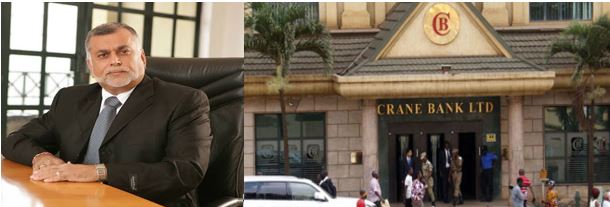
A high profile High Court business case has commenced at London’s Royal Courts of Justice in one of Uganda’s most significant banking disputes, as former Crane Bank shareholders, led by businessman Dr Sudhir Ruparelia, seek £200m (about Shs1 trillion) in damages over the bank’s transfer to dfcu Bank in 2017.
The hearing is expected to run for 16 weeks. Judges will examine claims that Crane Bank’s assets were transferred through an unlawful and corrupt process at a gross undervalue. The claimants argue the bank was sold far below market value and expect the claim amount to increase as proceedings progress.
The defendants—including dfcu Bank, holding entity dfcu Ltd, current and former directors, and international investment partners—deny all allegations of wrongdoing.
At the heart of the dispute is the downfall of Crane Bank, which was once Uganda’s largest indigenous commercial bank and the country’s fourth-largest lender overall.
The takeover and allegations
The Bank of Uganda (BoU) placed Crane Bank under statutory management on October 20, 2016, citing capital inadequacy and liquidity concerns following a bank run. Three months later, in January 2017, BoU transferred selected assets and liabilities to dfcu Bank under a Purchase of Assets and Assumption of Liabilities Agreement.
Mr Ruparelia and his co-claimants contend that discussions regarding a possible acquisition began covertly before the central bank officially intervened. They argue dfcu acquired the business without a proper independent valuation, asserting that the transaction was conducted at a fraction of the bank’s true worth.
Court filings show the lawsuit targets multiple entities and individuals, including Norwegian investment company Norfund, Rabobank subsidiary Rabo Partnerships, and two former Rabobank bankers who sat on dfcu’s board—Albert Jonkergouw and Willem Cramer.
According to court filings, the claimants allege that some defendants ignored clear red flags. These include an alleged $27.5m (about Shs99b) arrangement connected to the disposal of a portfolio of Crane Bank loans, which the claimants characterise as bribery after an internal 2016 email indicated funds would go to the central bank unrecorded. The claimants also cite the US conviction of Hong Kong intermediary Patrick Ho—who was found guilty of bribing Ugandan officials—alleging that the central bank had initially offered Crane Bank to a Chinese conglomerate before concluding the deal with dfcu.
The claimants’ position is further bolstered by findings from a 2019 Ugandan Parliamentary inquiry conducted by the Committee on Commissions, Statutory Authorities and State Enterprises (COSASE), which concluded that the central bank breached several legal provisions during the takeover and resolution process.
dfcu and Central Bank’s defence
The defendants have strongly rejected all allegations. In court filings, dfcu maintains that the transaction was entirely lawful, negotiated in good faith, and executed to preserve financial sector stability after BoU intervened due to severe capital erosion at Crane Bank.
dfcu clarifies that it did not purchase Crane Bank as a corporate entity, but rather acquired selected assets and assumed specified liabilities through a process conducted by the central bank.
Regarding the disputed $27.5m payment, dfcu argues that the funds served a legitimate purpose: repaying emergency financial support provided directly by BoU. The bank states that global auditing firm KPMG and other valuation experts were involved in key aspects of the transaction.
dfcu also points out that extensive document disclosure has yielded no evidence of corruption or conspiracy among the defendants, emphasizing that the claimants never formally challenged the statutory administration of Crane Bank in Ugandan courts.
The central bank’s position on the intervention was previously detailed by former BoU Governor, the late Prof. Emmanuel Tumusiime-Mutebile. Prof. Mutebile stated that an independent inventory conducted after the takeover revealed Crane Bank was “massively insolvent” with a negative core capital of Shs240b. He argued that emergency liquidity support alone could not salvage the institution, making the transfer of assets and liabilities to dfcu necessary under the Financial Institutions Act to protect depositors.
The Auditor General’s inquiry
The London court proceedings coincide with scrutiny over BoU’s management of the bailout funds in Uganda. A special audit report by Auditor General John Muwanga revealed that central bank officials withdrew over Shs478.8b from an undisclosed account and injected it into Crane Bank under the guise of “liquidity support” during statutory management.
In his report to Parliament, Mr Muwanga noted that he was unable to verify or justify the expenditure due to a lack of supporting documentation and statutory revival plans from BoU officials:
“I was unable to review and verify the approved requests for liquidity support together with supporting schedules… In absence of the valuation, I could not establish how the terms for the transfer of assets and liabilities in the Purchase of Assets and Assumption of Liabilities were determined.”
The Auditor General’s report also raised questions over Shs12.2b spent on external service providers. This included billions paid to auditing firms KPMG and PwC for technical support and inventory checks, alongside Shs3.9b paid to law firm MMAKs Advocates for legal advice and commission fees—prior to the firm’s disqualification over conflict of interest.
In response to audit queries, BoU Communications Director Charity Mugumya maintained that the central bank acts transparently:
“The Bank of Uganda is audited by the Auditor General’s Office on an annual basis in line with the Bank of Uganda Act and the National Audit Act 2008. Bank of Uganda has fully cooperated with the Auditor General’s office ever since the Parliamentary Committee instituted a special audit.”