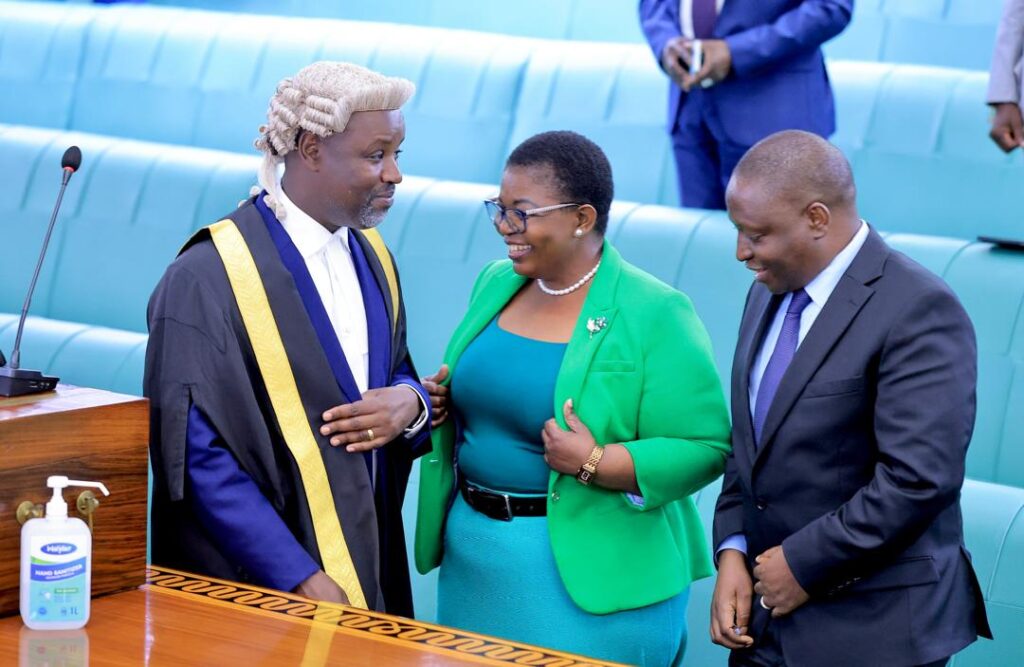
Deputy Speaker Thomas Tayebwa (L), Minister of ICT and National Guidance, Hon. Justine Kasule Lumumba (C) and Hon. David Bahati (R) share a moment at the start of the House sitting on Wednesday, 25 November 2026
By Joseph Kiggundu
The Ministry of ICT and National Guidance, in partnership with the Uganda Communications Commission (UCC), has launched a verification exercise to investigate how telecommunications companies calculate and deduct internet data usage, as well as the expiry of purchased bundles.
The exercise aims to establish whether Internet Service Providers (ISPs) are complying with existing legal requirements, with possible sanctions against companies found violating the regulations.
The Minister of ICT and National Guidance, Hon. Justine Kasule Lumumba, disclosed this while presenting a statement to Parliament on Wednesday, November 25, 2026, following concerns raised over the rapid depletion of internet data bundles.
Lumumba noted that telecom companies had progressively reduced data prices over the years, with the cost of 1GB dropping from approximately Shs5,200 in 2020 to about Shs2,000 currently.
She said UCC would also consult stakeholders on reviewing bundle expiry and rollover policies, including clearer purchase terms, timely notifications to consumers and possible options for carrying forward unused data.
“To review bundle expiry and rollover, UCC will consult on clearer purchase terms, timely alerts and options for carrying unused data forward while preserving affordable short-duration bundles. While Uganda already has bundles marketed as non-expiry, we are benchmarking international best practices to strengthen our local regulations,” Lumumba said.
The Minister also highlighted government efforts to expand access to free public Wi-Fi, particularly in Kampala, Entebbe International Airport and surrounding urban centres.
However, she noted that the initiative had been affected by vandalism of infrastructure and theft of telecommunications equipment.
Lumumba said government was undertaking rehabilitation, upgrading and restoration of the affected public Wi-Fi facilities through two major interventions: the Uganda Digital Acceleration Project and the National Data Transmission Backbone Infrastructure Phase Five Project.
She urged Ugandans to report vandalism and expose individuals involved in trafficking stolen telecommunications equipment to protect public ICT infrastructure.
During the debate, Hon. Sheilah Amaniyo, the NUP Woman Representative for Mukono District, called on government to strengthen consumer protection measures, arguing that internet users have limited ability to independently verify their data consumption or challenge telecom billing systems.
Amaniyo cautioned against attributing rapid data depletion solely to technological advancement, urging government to address concerns surrounding the accuracy and transparency of data billing.
She also called for a review of taxes imposed on internet services, particularly the 12 per cent excise duty, saying affordable smartphones would have limited value if citizens could not afford internet connectivity.
Hon. Marshall Alenyo, Independent MP for Jonam County, cited South Africa’s regulatory approach, particularly measures aimed at protecting consumers from the expiry of purchased data and voice bundles.
He argued that unused bundles should remain available to consumers after purchase and called for telecommunications companies to publicly display their billing methods so that customers can understand how they are charged.
Hon. Samuel Opio, the NRM MP for Kole North County, also called for the removal of taxes on internet data and smartphones to improve affordability.
Similarly, Hon. Remigio Achia, the NRM MP for Pian County, said government efforts to promote ICT development should be aligned with the country’s broader taxation policy.
In response, Lumumba revealed that government planned to extend the national telecommunications backbone network by 5,600 kilometres by August 2027 under the Uganda Digital Acceleration Project.
She also disclosed that discussions were underway to return Uganda Telecom Limited (UTL) to government ownership.
The Minister argued that government ownership of UTL would help extend telecommunications services to underserved areas, including communities around mountains and lakes, where private operators may have limited network coverage.
“Most of these mobile telecoms are foreign-owned, so bringing UTL back to government will support extension of the network to areas like those around mountains and lakes. Government will invest in UTL to reach such areas,” Lumumba said.