By Sulaiman Kauki
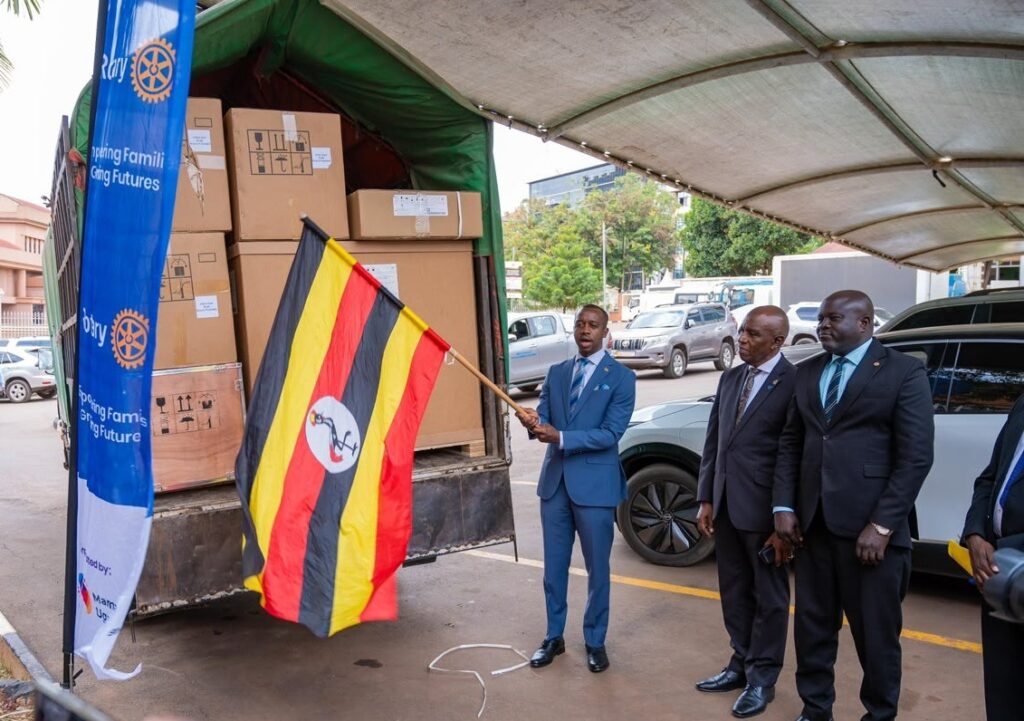
KAMPALA. The Ministry of Health has flagged off a consignment of maternal and newborn care equipment worth approximately Shs2.1 billion, marking a significant step in strengthening emergency obstetric and newborn care services across Uganda’s high-volume public health facilities.
The equipment, procured under the “Empowering Families, Growing Futures” initiative of a Rotarian Program called Mama Toto will be distributed to 31 health facilities comprising 16 Health Centre IVs and 15 Health Centre IIIs in 14 districts, with the aim of improving the quality of care for mothers and newborns.
Presiding over the flag-off at the Ministry headquarters on Wednesday, the State Minister of Health for Primary Health Care, Dr. Charles Ayume, said the investment demonstrates the Ministry’s continued commitment to reducing preventable maternal and newborn deaths by ensuring frontline facilities have the equipment and skills required to save lives.
“Every mother deserves a safe pregnancy and delivery, and every newborn deserves the best possible start to life. This equipment will strengthen the capacity of our health facilities to provide timely, quality care where it is needed most. As a Ministry, we remain committed to working with our partners to ensure these investments translate into better health outcomes for Ugandan families,” Dr. Ayume said.
While appreciating Rotary’s relentless efforts, he emphasized that the Ministry’s focus extends beyond supplying equipment to ensuring it is properly utilized through continuous training, supervision and maintenance.
The consignment includes delivery beds, radiant warmers, patient monitors, baby cots, phototherapy machines, newborn resuscitation units, Kangaroo Mother Care chairs and other essential equipment needed to improve maternal and newborn survival.
The Commissioner for Reproductive and Child Health, Dr. Richard Mugahi, said the equipment complements ongoing investments in building the capacity of health workers to manage complications affecting mothers and newborns.
“Equipment alone is not enough. It must go hand in hand with competent health workers and strong systems of care. That is why the Ministry continues to support comprehensive training, mentorship and quality improvement initiatives to ensure that mothers and newborns receive the right care at the right time,” Dr. Mugahi said.
He noted that health workers under the programme are already undergoing specialized training in Essential Newborn Care, with additional training on Helping Mothers Survive expected to further improve the management of obstetric emergencies such as postpartum haemorrhage, pre-eclampsia, eclampsia and obstructed labour.