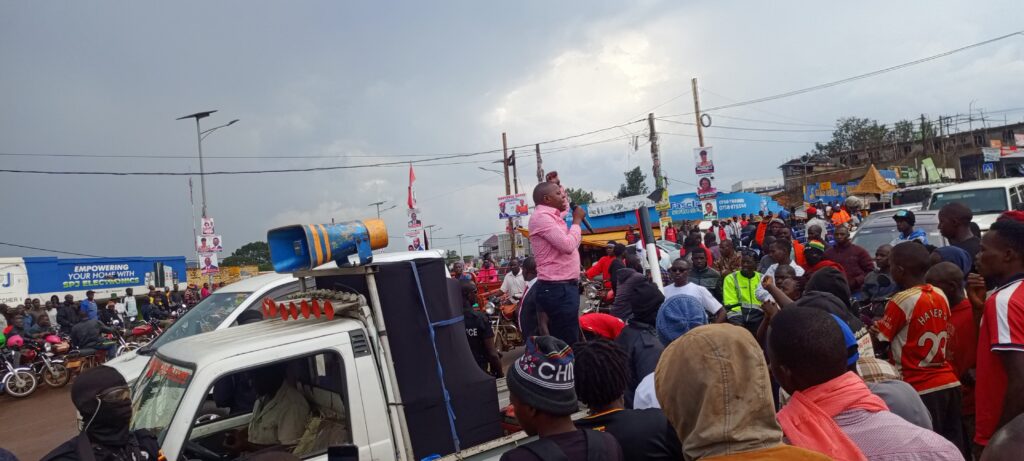
Former presidential candidate on National Peasants Party (NPP) ticket, Robert Kasibante has applied to the Supreme Court seeking leave to withdraw his petition challenging President Yoweri Museveni’s victory in the January 15, 2026 presidential election.
In a Notice of Motion filed before the court, Kasibante asks to withdraw the Presidential Election Petition, as well as a related miscellaneous application in which he sought an audit of all election returns, biometric voter verification (BVV) records, scanners, and servers used in the conduct of the poll.
The application is brought under Section 63 of the Presidential Elections Act, Rule 20 of the Presidential Election (Election Petitions) Rules, and the inherent powers of the court. Kasibante further prays that each party bears its own costs and that the court issues any other orders it deems just.
According to the grounds set out in the application and elaborated in his supporting affidavit, the decision to withdraw is largely informed by the financial and technical demands associated with the proposed audit.
“The application for discovery would involve the processing of a vast quantity of data,” Kasibante states, adding that the estimated cost of executing the audit and processing the data required to substantiate the grounds of the petition is “exponentially high and prohibitive.”
He contends that the scale and complexity of the electronic data sought, encompassing election returns, BVV records, scanners, and servers across the entire country, would require the engagement of highly specialized and independent forensic experts.
“These experts would be required to collect, process, and analyze nationwide electoral data,” the affidavit reads, noting that the financial burden is beyond the petitioner’s means.
The withdrawal application comes days after the Supreme Court sitting, as a nine-justice panel led by Chief Justice Flavian Zeija, framed four key issues for determination in the election petition and adopted submissions from all parties.
At that earlier hearing, Kasibante, who was present in court, was represented by lawyers led by Dr. Julius Galisonga, alongside John Isabirye and Ivan Bwowe. President Museveni, the first respondent, was represented by Ebert Byenkya and Edwin Karugire, while the Electoral Commission (EC) was represented by Mwesigwa Rukutana, Eric Sabiiti, and Ayebazibwe Edgar. Attorney General Kiryowa Kiwanuka appeared with the Solicitor General’s team.
Court had been informed that Kasibante had lined up eight witnesses, President Museveni six witnesses, and the Electoral Commission twelve witnesses, including EC chairperson Justice Simon Byabakama Mugenyi and Secretary Richard Baabo Kamugisha.
The petitioner’s case on non-compliance had largely rested on allegations relating to ungazetted polling stations, the tallying and transmission of results, and the use of biometric voter verification machines. His lawyers argued that an audit of election materials was necessary to access and verify the disputed data.
However, during submissions, the petitioner’s legal team acknowledged difficulties in identifying specific polling stations or electoral irregularities without access to the Electoral Commission’s internal records. Responding at the time, President Museveni’s lawyers described the allegations as broad and non-specific, while the EC denied the existence of any ungazetted polling stations.
“The Electoral Commission denies having any ungazetted polling stations,” Rukutana told court.
The Supreme Court is yet to fix a date for the hearing of Kasibante’s application to withdraw the petition. If granted, the withdrawal would bring to an end the challenge to Museveni’s re-election, in which he was declared winner by the Electoral Commission.
Under the law, a presidential election petition may be withdrawn only with leave of court.
