By Joseph Mary Buwule
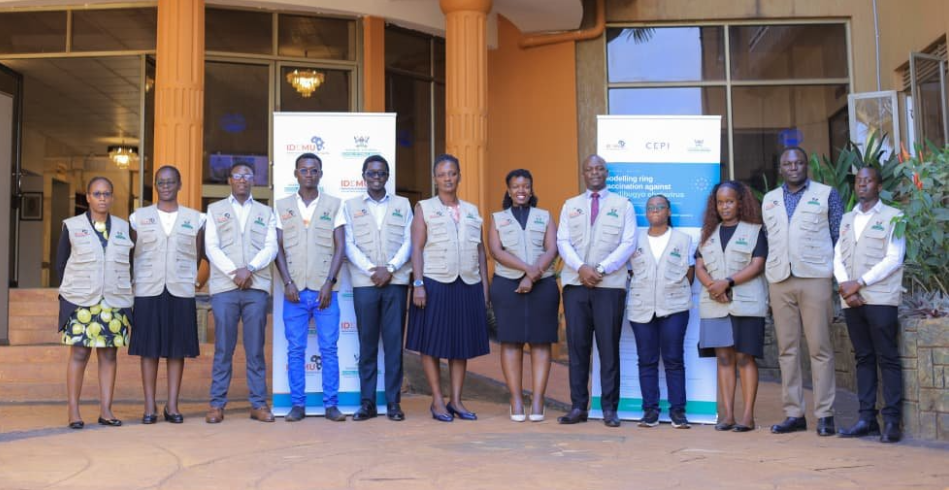
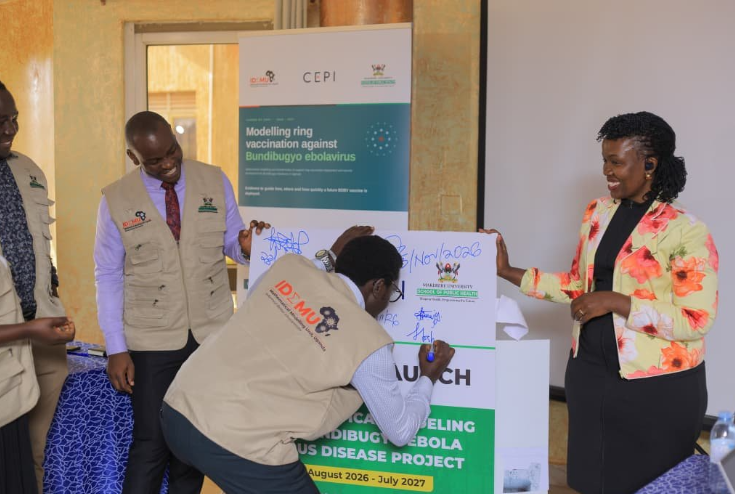
Makerere University School of Public Health (MakSPH) has launched a 12-month research project aimed at strengthening Uganda’s preparedness for future outbreaks of Bundibugyo ebolavirus through mathematical modelling, bioinformatics and vaccine research.
The project, funded by the Coalition for Epidemic Preparedness Innovations (CEPI), seeks to generate scientific evidence to support vaccine planning, clinical trial design, laboratory validation and national preparedness for future outbreaks of filoviruses, a family of viruses that includes Ebola.
The initiative is led by Abel Walekhwa of Makerere University and brings together seven institutions from Uganda, South Africa, the United States and the Democratic Republic of Congo to strengthen research collaboration and local scientific capacity.
The participating institutions include Makerere University School of Public Health, the Ministry of Health, Uganda Virus Research Institute (UVRI), the African Centre of Excellence in Bioinformatics and Data-Intensive Sciences, the University of Cape Town, the University of California, Berkeley, and ESP Kinshasa.
Bundibugyo ebolavirus was first identified in Uganda’s Bundibugyo District in 2007, when the country experienced an outbreak of the disease. Another outbreak was reported in 2012, highlighting the need for sustained research and preparedness against the virus.
Unlike the Zaire ebolavirus, for which vaccines and other medical countermeasures have been developed, there is currently no licensed vaccine or specific licensed countermeasure against Bundibugyo ebolavirus.
The new project therefore seeks to address critical scientific gaps that could affect Uganda’s ability to respond effectively to future outbreaks.
The research will be implemented through three work packages, focusing on ring vaccination modelling, training and capacity development, as well as laboratory and bioinformatics research.
Under the ring vaccination modelling component, researchers will use a mathematical transmission model calibrated with data from previous Ugandan outbreaks to estimate vaccine dose requirements and assess the feasibility of conducting vaccine trials.
The modelling will also help guide clinical study designs, particularly strategies targeting contacts of confirmed Ebola cases and their contacts, an approach known as ring vaccination.
The project is expected to provide evidence on how vaccination could be organised during an outbreak, including the number of doses required and the feasibility of implementing vaccination studies under different outbreak scenarios.
Under the training and capacity development component, nine Ugandan public health fellows will receive specialised training in mathematical modelling, bioinformatics and data analytics.
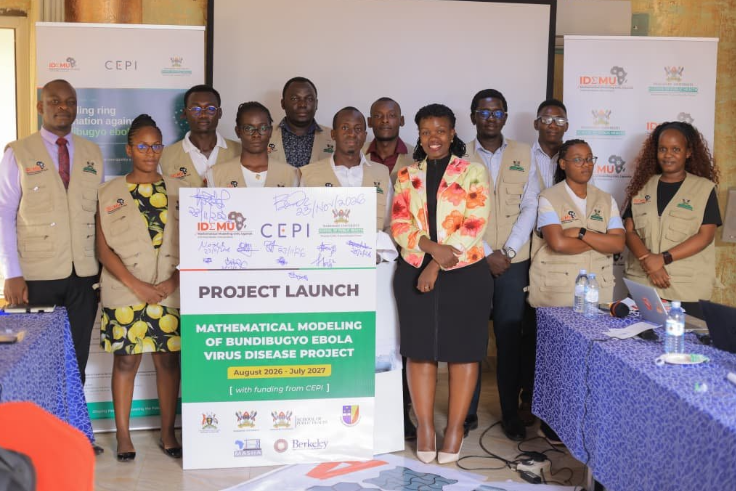
The fellows will participate in a residential training programme that will combine theoretical instruction with supervised practical research projects to strengthen their ability to apply scientific methods in public health emergencies.
The initiative is also expected to strengthen collaboration between Ugandan research institutions and international partners, while building local expertise in the analysis of emerging infectious diseases.
By combining mathematical modelling, bioinformatics and vaccine research, the project aims to position Uganda to make better-informed decisions on vaccine deployment, clinical trials and responses to future Bundibugyo ebolavirus outbreaks.
The initiative comes as Uganda continues to strengthen its disease surveillance, research and emergency response systems against emerging and re-emerging infectious diseases.