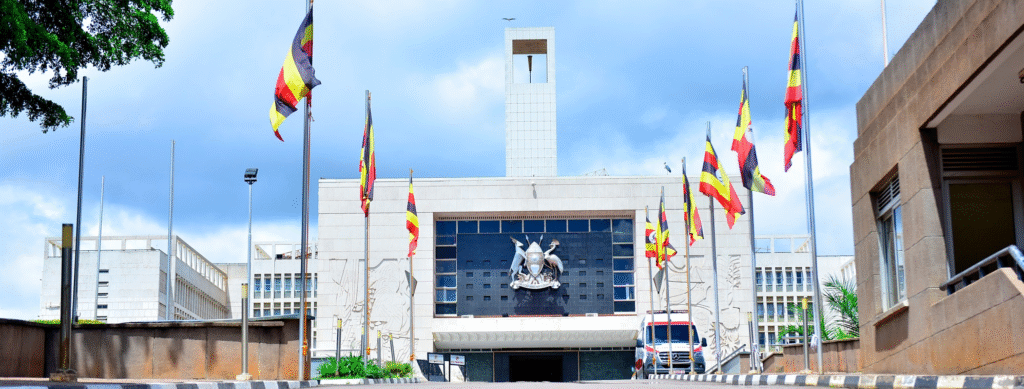
PARLIAMENT .Some lawmakers have called on the Ministry of Justice and Constitutional Affairs to set up a Constitutional Review Commission to look at the increasing size of Parliament and the declining representation of special interest groups.
The call was made during a plenary sitting on Monday, October 20, 2025, as MPs debated a motion tabled by Justice and Constitutional Affairs Minister, Mr Norbert Mao, under Article 78(2) of the Constitution and Section 8(3) of the Parliamentary Elections Act. The motion sought Parliament’s approval to review representation created under Article 78(1) (b) and (c), covering district women MPs, the army, youth, workers, and persons with disabilities (PWDs).
Article 78 (1) of the Constitution prescribes the composition of Parliament as follows: Parliament shall consist of: Members directly elected to represent constituencies; One woman representative for every district; Such numbers of representatives of the army, youth, workers, persons with disabilities and other groups as Parliament may determine.
The 11th Parliament as of 26 March 2025, had 556 members. The composition by categories includes: Constituency Representatives – 353; Women Representatives – 146; Uganda Peoples’ Defence Forces’ Representatives – 10; Youth Representatives – 5; Persons with Disabilities’ Representatives – 5; Workers’ Representatives – 5; Older Persons’ Representatives – 5; Ex Officio Members – 27.
Some have observed that with the current number of MPs, Uganda’s Parliament is unnecessarily big if compared to India that has a population of 1.38 billion people with a total of 552 MPs.
The ruling NRM and opposition MPs supported the motion, which passed with a two-thirds majority.
This decision could change who is represented in Uganda’s next Parliament and may affect the 2026 General Election, party balance, and special interest group representation.
Mr Mao moved that Parliament retain one woman representative for every district and city and maintain the current representation for special interest groups.
The House retained 10 UPDF representatives in Parliament and ring-fenced two positions for the female soldiers. It also retained five workers’ representatives and ring-fenced one position for females. There will still be five youth representatives (at least one woman), five representatives for Persons With Disabilities, and five representatives for older persons.
Ms Sarah Opendi, the Tororo District Woman MP, who seconded the motion, supported the review but cautioned that Uganda remains a “parochial society” that still sidelines women in politics.
“Only 15 women won directly elected seats out of 356 constituencies in the 11th Parliament. There’s still a stereotype that politics is not for women, and decision-making remains a male domain.”
Ms Opendi also cited poor gender representation on public boards, noting that the NIRA Board, which by law should include one-third women, currently has only one female member. She urged the Executive to “wear a gender lens” when approving such boards.
Mr Alex Ndeezi, a PWD representative, decried the declining representation of persons with disabilities across Ministries, Departments, and Agencies, calling it a violation of Article 35 of the Constitution.
“Parliament has doubled from 290 MPs in 1996 to 556 today, but PWD representation has dropped from 2 percent to 0.8 percent. If this continues unchecked, our representation will vanish entirely,” Mr Ndeezi proposed that each special interest group, including PWDs, Youth, Women, and Older Persons, should be allowed 10 representatives, reflecting Uganda’s demographic growth.
Erute South MP, Jonathan Odur said the ballooning size of Parliament must be confronted, citing its heavy burden on taxpayers.
“The Constitution ties our hands. We can only retain, increase, or abolish special interest representation, and abolishing would require a Bill. But we must address the imbalance,” Mr Odur said.
The Shadow Justice Minister, urged the government to meet the one-third gender requirement for UPDF and Workers’ seats and to ensure regional equity among workers’ representatives.
Budama West MP, Mr Fox Odoi echoed these concerns, warning that the percentage of special interest groups shrinks as Parliament grows.
“We should fix their representation at a constant percentage, say three to five percent, so that every increase in MPs doesn’t marginalize these groups further,” Mr Odoi advised.
Attorney General, Mr Kiryowa Kiwanuka, acknowledged MPs’ concerns ,but said any immediate changes would be constrained by Article 93 of the Constitution, which restricts amendments that increase public expenditure.
Presiding over the session, Deputy Speaker, Thomas Tayebwa put the motion to a vote, where the “ayes” carried the day.
Mr Tayebwa emphasized that passing the motion was necessary to facilitate the nomination of special interest group candidates scheduled for Wednesday, October 22, 2025, ahead of the January 2026 general elections. The current push for a fresh Constitutional Review Commission has been driven publicly by Mao during 2023–2025.
He has repeatedly signaled the need for a formal review and told Parliament and the public that President Yoweri Museveni will decide the Commission’s fate. Uganda previously ran a major constitutional review process (the Constitutional Commission that produced the 1995 Constitution). That earlier process (Ssempebwa-led and others) established the modern framework for Uganda’s post-1995 constitutional order.
Over the years several actors, civil society, MPs and some ministers, have periodically urged constitutional reform on discrete issues (term limits, age limits, devolution, and electoral rules).
