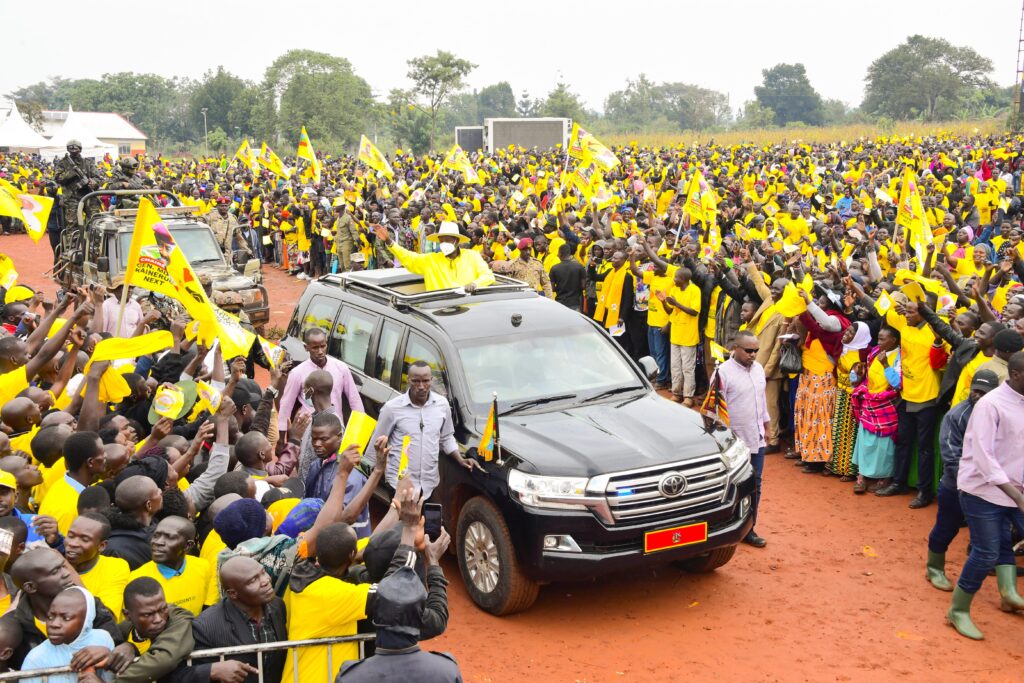
KYANKWANZI .President Yoweri Museveni on Tuesday, December 16, 2025, addressed a rally in Kyankwanzi district amid heavy rainfall where he unveiled the National Resistance Movement (NRM) manifesto for 2026–2031, anchored on peace, infrastructure development, wealth creation, and job generation.
Thousands of supporters braved a relentless downpour to fill Butemba College School Playground, a turnout the President described as symbolic of loyalty, resilience, and the historical revolutionary spirit of the region.
“I want to thank you for showing the world that you are children and grandchildren of freedom fighters — that when we decide to do something, we do it wholeheartedly and with love,” President Museveni said.
“I have not been around, but I was told that when it rained heavily, you remained. And indeed, I found you here. Thank you so much,” he added, drawing cheers from supporters who waved NRM flags and umbrellas alike.
The NRM candidate unveiled the NRM manifesto for 2026–31, while highlighting the party’s “seven historic contributions” to Uganda, beginning with peace.
“We, the people of Greater Luwero, know what it means to lack peace,” President Museveni said, referencing the region’s turbulent history. “We fought several wars here — in 1971, 1979, and 1986. Today, many children have grown up without seeing war or instability.”
He argued that the peace ushered in since 1986 enabled the establishment of strong national institutions, including the Uganda People’s Defence Forces (UPDF), the police, prisons, and the judiciary.
“These institutions were built because the NRM does not look at tribe or religion, but at what you can do as a person,” he said, reiterating his long-held emphasis on meritocracy over sectarian politics.
Roads, Water, and Electricity:
The President identified economic and social infrastructure as the second major contribution of the NRM, highlighting road construction as a transformative intervention in Kyankwanzi and the greater Buganda sub-region.
“When the NRM came, the tarmac road stopped at Busunju,” President Museveni recalled. “We extended it to Kiboga, Kafu, and Hoima. On the other side, it ended in Mityana, but we pushed it to Mubende, Fort Portal, and Bundibugyo.”
He pledged continued road upgrades to enhance connectivity, trade, and market access.
On water access, President Museveni presented district-specific statistics, noting that out of 486 rural villages in Kyankwanzi District, 420 have access to safe water sources — an 86 percent coverage rate, while 66 villages (14 percent) remain unserved.
“This is good progress,” he said, “but now we must go beyond domestic water. We need water for irrigation to increase production.”
To drive home the point, President Museveni showcased a video of Dr. Florence Muranga’s banana plantation in Bushenyi District, where irrigation has enabled yields of up to 53 tonnes of matooke per acre annually, compared to the national average of five tonnes.
“That difference is water,” President Museveni said. “But water also means protecting wetlands. You cannot destroy the source of your wealth.”
He warned against encroachment on wetlands for crops such as rice and yams, while assuring Kyankwanzi residents that government plans for large-scale irrigation would prioritise swamp-rich areas.
On electricity, President Museveni reaffirmed the government’s phased expansion strategy — from district headquarters to sub-counties and eventually villages.
Health Sector:
Turning to health services, President Museveni acknowledged existing gaps in Kyankwanzi District. Of the district’s 21 sub-counties, only one has a Health Centre IV, while 11 have Health Centre IIIs. Nine sub-counties lack facilities at the HCIII level or above.
To address this, he announced a series of planned upgrades which include Bananywa HCII to HCIII, Kisala HCII to HCIII, Byelima HCII to HCIII, Nakitembe HCII to HCIII in Watubba Sub-County, and Kikubya HCII to HCIII in Watubba Town Council.
He also revealed that new Health Centre IIIs would be constructed in Masodde Kalagi Town Council, Nkandwa, Kilyanongo, and Kigando sub-counties.
Development vs Wealth Creation:
President Museveni urged the people of Kyankwanzi to make a distinction between development and wealth creation, a message he said he has consistently delivered since the 1990s.
“Development benefits all of us but wealth creation is personal. It is at the household and individual level.”
Quoting a Lusoga proverb Akange kakira akaife (“What is mine is better than what is ours”), President Museveni stressed that while public infrastructure is essential, families must actively engage in income-generating activities.
“Since 1986, we have been telling you not to work only for the stomach, but also for the pocket,” he said.
To illustrate his point, President Museveni revisited the four-acre model introduced in the NRM’s 1996 manifesto, designed for households with small land holdings.
The model proposes one acre for coffee, food crops, fruits, and pasture under zero-grazing, and also proposes backyard enterprises such as poultry, piggery, and fish farming.
Large screens displayed videos of successful farmers who adopted the model. One was George Matongo, a livestock farmer from Ngoma Sub-County in Nakaseke District, who collects over 900 litres of milk daily. Despite having no formal education and living more than 70 miles from a tarmac road, Matongo earns about Shs29 million per month — roughly Shs 250 million annually.
“He built a good house and educated his children. That is wealth creation,” President Museveni noted.
Another featured farm was the Kamanyire Demonstration Farm in Kakumiro District, owned by State Minister for Transport Fred Byamukama. On four acres, the farm integrates coffee, bananas, pineapples, poultry, dairy, and piggery. Hon. Byamukama’s farm keeps more than 200 pigs, over 25,000 layers producing about 300 trays of eggs daily, and eight dairy cows yielding approximately 120 litres of milk each day.
President Museveni also cited Korea Dick Ogira, a farmer from Abim District in the Karamoja sub-region, to challenge assumptions linking wealth strictly to infrastructure. Ogira received 200 mango seedlings from Operation Wealth Creation and Shs1 million under the Parish Development Model (PDM). By intercropping mangoes with cassava, he earned Shs12 million in his first year, selling mangoes at Shs1,000 each.
“Next year I expect to earn Shs18 million, and then Shs32 million after two harvests,” Ogira said in the video.
“That man is in Abim, where there is no tarmac road. Development is not there, but wealth is there,” President Museveni said.
The President further cited his own Baralege model farm in Lira District, where integrated agriculture yields significant returns. From a single fish pond measuring 20 by 50 metres, President Museveni said he earns about Shs100 million annually, with profits of around Shs70 million after costs.
Job Creation:
Regarding job creation, President Museveni dismissed the notion that government employment could absorb Uganda’s growing population.
“There are only about 480,000 government jobs,” he said. “Yet we are 50 million Ugandans.”
He argued that jobs must come from commercial agriculture, manufacturing, artisanship, services, and ICT.
To illustrate this, President Museveni cited Johnson Basangwa, a large-scale poultry farmer whose business employs more than 300 workers and earns an estimated Shs20 million per day from egg sales.
“That wealth has produced jobs. That is the difference between politics and economics.”
He also highlighted industrial parks such as Namanve, with over 273 factories employing more than 24,000 workers, and Sino-Mbale, which employs about 12,000 people.
NRM Second National Vice Chairperson and Speaker of Parliament, Rt. Hon. Annet Anita Among, praised residents for enduring the rain and raised several local concerns.
She highlighted the issue of absentee landlords, commending President Museveni for consistently funding the land purchase programme to secure tenants’ rights.
She also informed the President that 12 sub-counties are settled on National Forestry Authority (NFA) land, where residents have faced evictions since 1973.
“As the father of these people, we ask you to relocate them or gazette that land for settlement,” Rt. Hon. Among said.
President Museveni pledged to handle the matter and ensure a peaceful settlement.
Rt Hon. Among further requested the tarmacking of the Kyankwanzi–NALI road and reiterated calls to upgrade the Bukomero–Kyankwanzi–Bukuya road corridor.
NRM Vice Chairperson for central region, Hon. Haruna Kyeyune Kasolo, said the party had deployed 30 mobilisers per village, complemented by district teams.
“The Buganda of 2021 and the Buganda of 2026 are different,” Hon. Kasolo said. “The youth have decided to rally behind you.”
He urged President Museveni to address land disputes in Kyankwanzi, warning that land insecurity undermines development.
Kyankwanzi District NRM Chairperson, Ms. Wekembe Mary thanked President Museveni for granting Kyankwanzi district status and expanding government programmes such as PDM, Emyooga, SAGE, and youth funds.
She appealed for a district technical institute, citing the need to equip young people with employable skills, and reminded President Museveni of earlier pledges to upgrade Ntwetwe Health Centre IV to a district hospital.
Kyankwanzi District currently has 21 sub-counties and town councils, 119 parishes, and 486 villages, with a population of 278,432, according to the 2024 census.
In the 2021 elections, President Museveni polled 39,859 votes (61.6 percent) in the district. By 2025, registered voters had increased to 133,655, up from 108,311 — a rise of 25,344 voters, with polling stations increasing from 255 to 338.
The Kyankwanzi rally was also attended by NRM secretariat officials, ministers, MPs, party flag bearers, and veterans.
