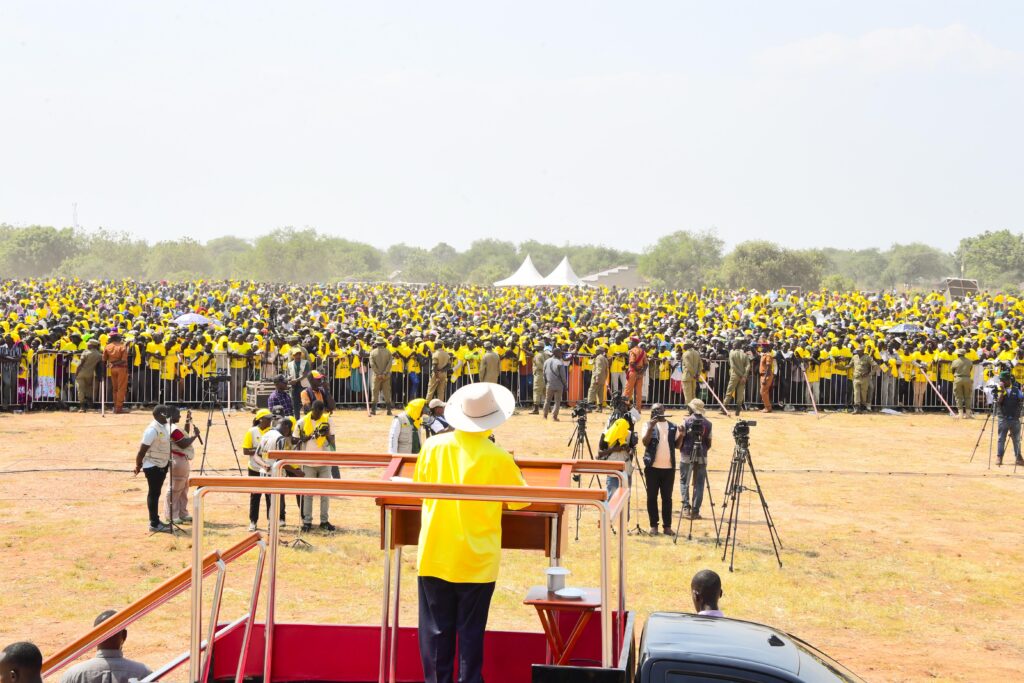
BULIISA.President Yoweri Museveni has urged Ugandans to treat the country’s oil resources as a temporary economic booster rather than a permanent source of income, warning that petroleum wealth must be carefully managed to create “durable wealth” for present and future generations.
Speaking to enthusiastic supporters in Buliisa Town Council on Thursday, December 11, 2025, during his campaign trail in the Bunyoro sub-region, President Museveni, the National Resistance Movement (NRM) National Chairman and Presidential flagbearer for the 2026 elections, emphasized that the new petroleum discoveries must not lure citizens into complacency or consumption-driven expenditure.
“There is new wealth in petroleum. Some people just shout ‘oil this, oil that.’ I am the one who discovered the oil, and I know more about it,” said President Museveni who was accompanied by the First Daughter, Mrs. Natasha Museveni Karugire.
“The issue about petroleum is that it is exhaustible. We have 6.5 billion barrels that we can mine for about 25 years,” the President added, stressing that countries that treat oil as a consumable income source eventually face economic decline.
“You must use it to create durable wealth. We can’t keep eating the money from oil while importing items like perfumes and whiskey.”
President Museveni cited countries such as Norway and Saudi Arabia as examples of prudent oil management, in which revenues are put in sustainable wealth funds and nations rely primarily on the interest generated rather than spending the principal oil revenues at once.
Buliisa District in Uganda is a central location for the country’s oil and gas development, particularly within the massive Tilenga Project, operated by TotalEnergies, which aims for up to 190,000 barrels per day, while Kingfisher, operated by the Chinese company CNOOC, aims at 40,000 barrels per day.
Addressing the fishing crisis around Lake Albert:
Fishing remains the backbone of livelihoods in Buliisa District, particularly around Lake Albert, but the sector has been hit by depletion caused by overfishing, illegal gear, and enforcement challenges.
President Museveni promised to meet leaders and traditional fishing families to discuss a sustainable path forward, assuring fishermen that the government would support the revival of the industry.
He directed the UPDF Fisheries Protection Unit (FPU) to return motorcycles, boats, and engines that were confiscated from fishermen during operations. However, he insisted that illegal and destructive fishing nets should not be returned.
“The bad fishing gear should be shown publicly and recorded, but not given back,” he said.
The President called on the people of Buliisa to continue supporting the NRM, which he said has delivered peace, development, and job creation — the core pillars upon which the ruling party seeks a new mandate.
“Regarding peace, you, the people of Buliisa, are the best witnesses because you know what is happening in Congo. When there is no peace, there is nothing we can do,” he noted.
He praised the government’s infrastructure achievements in the region, including tarmac roads from Hoima to Buliisa and within Buliisa Town Council, which have facilitated trade and movement.
Wealth Creation:
The President’s message in Buliisa was anchored on the third pillar of the NRM’s 2026–2031 manifesto: Wealth Creation, with a specific focus on household income enhancement through commercial agriculture, manufacturing/ artisanship, services, and ICT.
President Museveni reiterated his long-standing advocacy for the 4-acre model, designed for families with small pieces of land seeking to generate consistent income through intensive agriculture.
“For families with limited land, I propose one acre for coffee, one acre for fruits, one acre for pasture for dairy, and the fourth acre for food for the family,” he said.
For those near water bodies, he recommended adding poultry, piggery, and fish farming for additional income streams.
The President showcased the highly successful Kamanyire Demonstration Farm in Kakumiro District, run by Minister Fred Byamukama, as proof that the model can transform rural livelihoods. According to Byamukama, the farm currently operates coffee, bananas, pineapples, poultry, dairy, and piggery enterprises- with over 200 pigs, more than 25,000 layers producing 300 trays of eggs daily, and eight dairy cows giving about 120 liters of milk every day.
“Byamukama is a good witness that what we are saying is true,” President Museveni said.
“But if you have big land, you can do other things such as maize, tea, cotton, sugar cane, but I’m concerned about those with small land.”
The NRM candidate further emphasized that he practices what he preaches, referencing his Barlege 4-acre model farm in the Lira–Lango sub-region, where he raises dairy cattle under zero-grazing, practices fish farming, and grows coffee, fruits, bananas, and other food crops.
“That is my testimony,” President Museveni told the supporters.
“From my fishpond of 50 meters by 100, I get 100 million shillings per year. After removing costs, I remain with 70 million shillings. You can have two such ponds on one acre.”
He said similar opportunities await communities in Teso, Busoga, Lango, Buliisa, and Madi-Okollo, especially in wetland areas suitable for profitable fish farming. Using the example of Limoto wetland, he said farmers there earn up to Shs 60 million per acre from properly managed fishponds.
On job creation, President Museveni emphasized that most jobs come from the private sector, not the government. He highlighted success stories like Jeka Poultry Farm in Kamuli, owned by Johnson Basangwa, which employs 300 workers, as well as the Sino-Mbale Industrial Park, which now employs 12,000 people.
He also cited Namanve Industrial Park, which hosts 273 factories employing 24,000 people, as evidence of NRM’s sustained investments in industrialization as a path to mass employment.
Earlier, Rt. Hon. Anita Among, the NRM’s 2nd National Vice Chairperson and Speaker of Parliament, thanked the President for approving funding for the Masindi–Biso–Buliisa road.
The Prime Minister, Rt. Hon. Robinah Nabbanja and the NRM Vice Chairperson for Western Uganda, Eng. Asiimwe Jonard also addressed supporters and pledged overwhelming support for President Museveni in Buliisa and the wider Bunyoro region in the 2026 polls.
Buliisa District currently has 10 sub-counties and town councils, 39 parishes, and 131 villages. According to the 2024 census, the district’s population stands at 167,894.
In the 2021 presidential election, Buliisa had 44,869 registered voters, of whom 28,326 cast ballots. President Museveni garnered 19,316 votes (72.5%), while the opposition National Unity Platform secured 6,152 votes (23.1%). Other candidates shared 1,162 votes (4.36%).
Ahead of the 2026 elections, the district’s voter register has significantly expanded. Buliisa now has 61,122 registered voters, an increase of 16,253 from the 2021 cycle, and 148 polling stations, up from 96.
President Museveni continues his campaigns in the Bunyoro sub-region, where oil development, agriculture, and job creation remain central issues shaping voter expectations.
