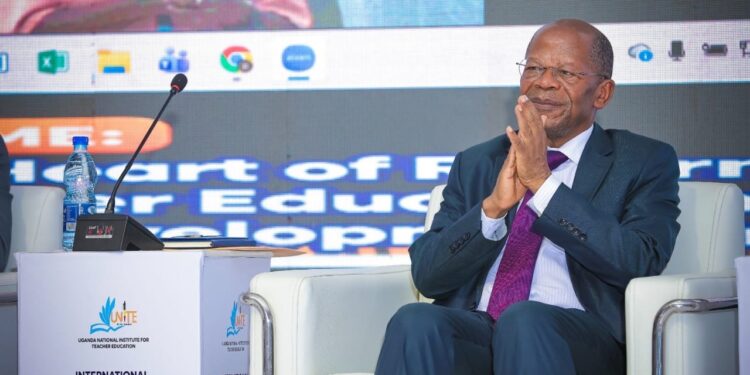
The Acting Minister of Education and Sports, Hon. John Chrysestom Muyingo.
By Joseph Kiggundu
KAMPALA — Government has pledged to maintain funding and implementation of ongoing teacher education reforms, saying sustained investment is necessary if the changes are to improve teaching standards and learning outcomes.
The Acting Minister of Education and Sports, Hon. John Chrysestom Muyingo, said government would continue supporting the reforms despite the challenges that may arise during implementation.
Muyingo made the remarks while opening the inaugural International Teacher Education Conference (ITEC) 2026 in Kampala, held under the theme, “Teachers at the Heart of Reforms: Transforming Teacher Education for Human Capital Development in the 21st Century.”
He said Uganda’s efforts to improve education must begin with strengthening the people responsible for delivering it, arguing that the effectiveness of the education system is closely linked to the quality of teachers.
According to Muyingo, government is pursuing a number of measures aimed at transforming teacher education, including the rationalisation of teacher training institutions, implementation of the competence-based curriculum, establishment of the Uganda National Institute for Teacher Education (UNITE) and the ongoing process to establish the National Teacher Council.
He said the initiatives are intended to strengthen teacher preparation and professional development while ensuring educators receive the support and skills required to respond to changing needs within the education sector.
“Government is not stepping back from this agenda. The funds that have been put in place are not temporary experiments to be abandoned when implementation becomes difficult. They are long-term commitments, and we are committed to seeing them through,” Muyingo said.
The minister, however, cautioned that developing policies and programmes would have limited impact unless they were implemented consistently and translated into improvements in schools and classrooms.
He urged education officials to approach implementation with commitment and ensure that reforms deliver measurable benefits to both teachers and learners.
Muyingo also called for closer cooperation between policymakers, researchers and education practitioners, saying decisions on education policy and public expenditure should be informed by credible evidence.
He said research can help authorities assess the effectiveness of existing interventions, identify gaps and determine where resources and policy adjustments are needed.
“That partnership between Government, research and practice is fundamental to developing, implementing, testing and improving policy,” he said.
The minister identified several areas that require continued attention, including the preparation of teachers, their welfare, the appropriate use of technology in education and the long-term sustainability of reforms.
He said the education sector must continually examine how teachers are trained, how their wellbeing is supported and how technology can be integrated without undermining the core objectives of teaching and learning.
The three-day ITEC 2026 conference has attracted researchers, teacher educators, policymakers and practitioners from Uganda and other countries to discuss research findings, experiences and approaches to improving teacher education.
Muyingo commended UNITE and its development partners for organising the conference, saying the gathering provides an opportunity to strengthen the connection between research, government policy and classroom practice.
He urged participants to use the conference discussions to develop practical solutions that can strengthen teacher education and contribute to Uganda’s broader human capital development agenda.