By Joseph Kiggundu
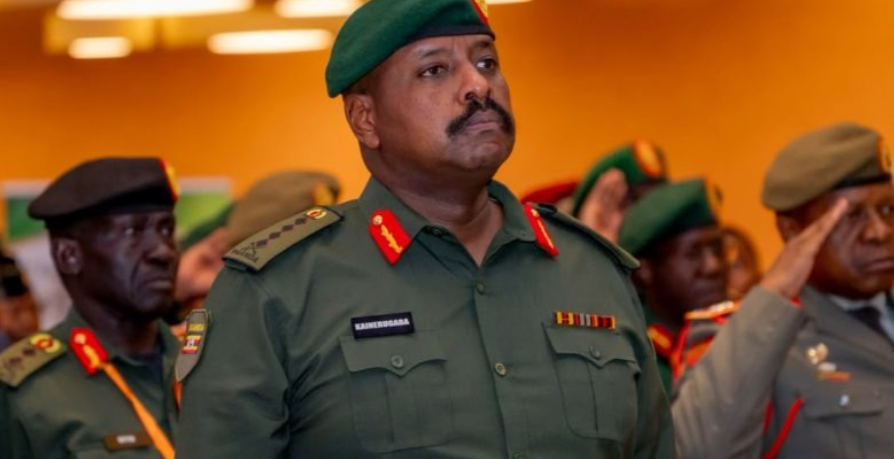
As the country continues to debate a possible political dialogue to ease the current political tensions , powerful First Son and Chief of Defence Forces Gen Muhoozi Kainerugaba has declared that his Patriotic League of Uganda (PLU) will not participate in any proposed government of national unity.
This comes days after Gen Muhoozi rejected political dialogue involving incarcerated veteran opposition figure Dr Kizza Besigye.
In a post on X on Saturday, November 21, Gen Muhoozi,52 who is warming up to replace his 82-year old father Yoweri Museveni who has ruled Uganda for nearly half a century , dismissed the prospect of PLU joining a coalition government, drawing parallels with the National Resistance Army’s position during the final stages of the 1981–1986 bush war.
“PLU will ABSOLUTELY not be part of any ‘National Unity Government’. We like NRA/NRM in 1985 refuse to be part of those who want to prevent the righteous victory of the masses,” Muhoozi wrote.
His remarks follow earlier statements on November 17 opposing Besigye’s inclusion in the proposed national dialogue.
“You cannot have ‘National Dialogue’ with a traitor who was planning to shoot down Mzee’s helicopter. We will not accept that,” Muhoozi said.
Muhoozi’s statements come amid renewed efforts to establish a national reconciliation process and power sharing formula to address Uganda’s political divisions.
On November 13, representatives of the Inter-Party Organisation for Dialogue (IPOD), the National Consultative Forum (NCF) and other stakeholders agreed to integrate the proposed Consociational Democracy Agreement (CDA) into the Uganda National Dialogue framework chaired by former Prime Minister Dr Ruhakana Rugunda.
The initiative seeks to promote political accommodation, power-sharing and national cohesion through structured engagement among political actors.
Challenges of Power-Sharing
Muhoozi’s rejection comes amid renewed debate over power-sharing arrangements, which have helped resolve political crises in several African countries but also exposed weaknesses in government coordination, executive authority and accountability.
In Kenya, the 2008 Grand Coalition Government between President Mwai Kibaki and Prime Minister Raila Odinga helped end post-election violence but subsequently experienced disagreements over ministerial appointments and disciplinary powers.
In 2010, Odinga boycotted Cabinet meetings following a dispute with Kibaki over his authority to suspend ministers implicated in corruption scandals.
The arrangement also produced an expanded Cabinet of 40 ministers, increasing the cost of government while complicating accountability across competing political parties.
In Zimbabwe, the 2009–2013 unity government involving President Robert Mugabe and opposition leader Morgan Tsvangirai experienced repeated disagreements over ministerial appointments, security institutions and political reforms.
Although the coalition helped stabilise the economy after years of crisis, mistrust between its members delayed key reforms and weakened collective decision-making.
South Sudan provides another example. Its transitional unity arrangements, established under the 2018 peace agreement, struggled to implement security reforms, establish a permanent constitution and organise elections amid continuing political disputes.
President Salva Kiir eventually dissolved the transitional unity government in September 2026 following prolonged disagreements and instability.
These experiences highlight the potential weaknesses of coalition governments where executive authority is divided among competing political parties.
In particular, a president’s ability to dismiss ministers implicated in corruption may become politically constrained where Cabinet appointments are protected by a power-sharing agreement.
Coalition partners may also resist investigations targeting their representatives, complicating efforts to enforce accountability and coordinate government policy.
However, some governance experts say power-sharing arrangements can help reduce political violence and facilitate institutional reforms.
Justice and Constitutional Affairs Minister Norbert Mao has also called for national dialogue to address political grievances, electoral reforms and disputes involving opposition leaders.
ICT and National Guidance Minister Justine Lumumba previously told Parliament that ongoing political consultations could be expanded into a broader national reconciliation process following the January 2026 general elections.
Opposition groups, including the Forum for Democratic Change (FDC) and the People’s Front for Freedom (PFF), have rejected participation in the proposed power-sharing discussions.
Muhoozi’s latest declaration sets out PLU’s position on a possible national unity government, although no formal and detailed plan to establish such an administration has been announced.