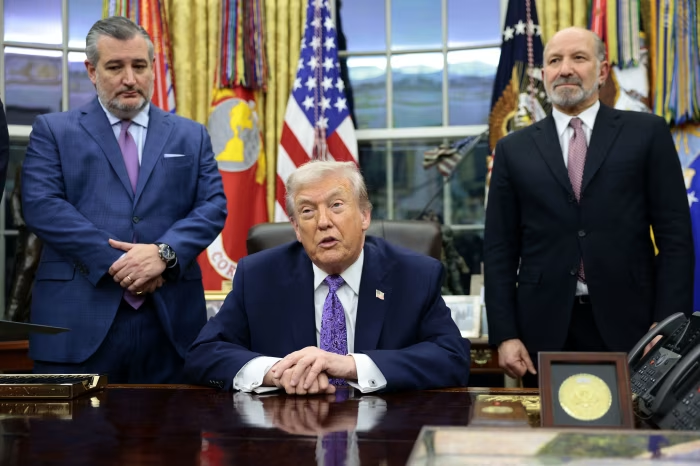
President Donald Trump has signed an executive order aimed at preventing individual states from enforcing their own artificial intelligence regulations a move that has sparked renewed debate over federal authority, innovation and consumer protection in the rapidly expanding AI sector.
The order seeks to establish a single national approach to AI governance by blocking state level laws that the administration considers restrictive or inconsistent with federal priorities. Trump’s move is framed as an effort to reduce regulatory fragmentation, which he argues could discourage investment and slow technological development in the United States.
Addressing the rationale behind the decision, Trump warned that differing rules across states would make it difficult for companies to operate efficiently nationwide.
“If they had to get 50 different approvals from 50 different states, you could forget it because it’s impossible to do,” Trump said.
Under the directive federal agencies are instructed to identify state AI regulations that conflict with national policy and take steps to challenge or override them. The order also opens the door for the federal government to withhold certain funds from states that continue to pursue independent AI rules deemed burdensome to innovation.
Supporters of the move argue that a uniform regulatory framework will make it easier for businesses to develop and deploy AI technologies while keeping the U.S. competitive globally. They contend that inconsistent state laws could create uncertainty for investors and technology firms, particularly as artificial intelligence becomes more deeply integrated into healthcare, finance, transportation and national security.
However, critics have raised concerns that the order undermines states’ rights and weakens protections designed to address risks associated with AI, including data privacy, algorithmic bias and misuse of personal information. Several states have already enacted AI-related laws in response to growing public concern over the technology’s social and ethical impacts.
The executive order is expected to face legal and political scrutiny, with observers predicting challenges over the limits of federal authority and the role of states in regulating emerging technologies. As artificial intelligence continues to evolve rapidly, the decision highlights the ongoing struggle to balance innovation with accountability and public safety.
