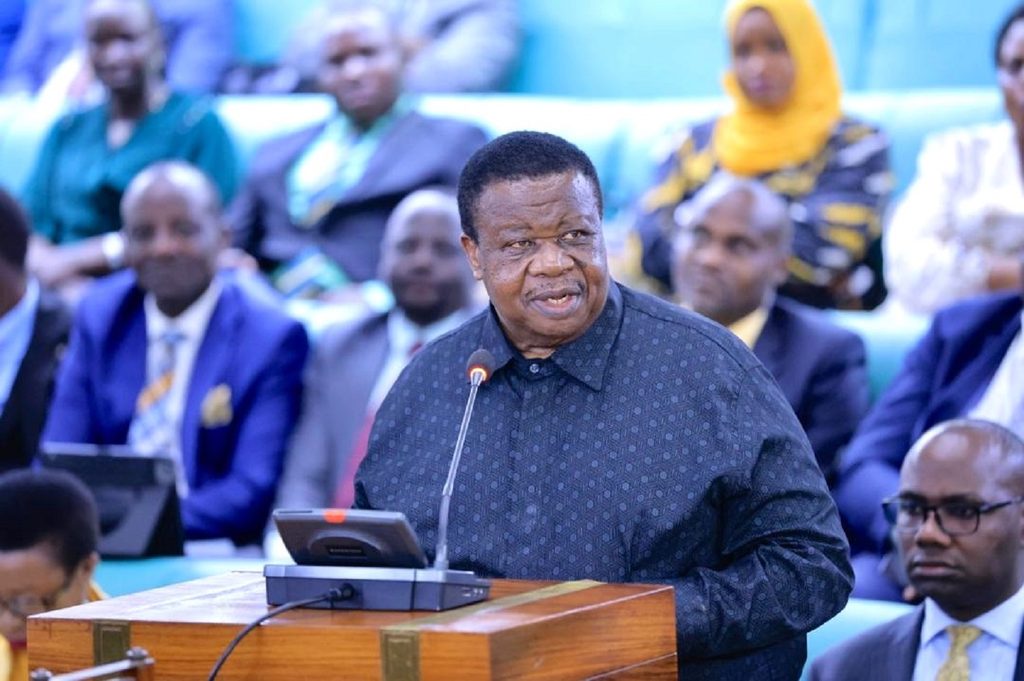
Minister Kahinda Otafiire on the Floor of Parliament on Wednesday, 30 September 2026
By Joseph Kiggundu
KAMPALA — Uganda’s access to safe water has increased to 73.6 per cent, up from 71.2 per cent, surpassing the government’s annual target of 71 per cent, Parliament has been told.
The figures were contained in a performance report presented to legislators by the Minister of Water and Environment, Hon. Kahinda Otafiire, during a plenary sitting chaired by Speaker Jacob Marksons Oboth on Wednesday, September 30, 2026.
According to the report, safe-water coverage in rural areas stands at 72 per cent, while urban coverage has reached 75.2 per cent. Refugee settlements and host communities recorded coverage of 76 per cent.
The ministry also reported functionality rates of 85 per cent in rural areas, 92 per cent in urban areas and 91 per cent among refugee and host communities.
Otafiire said government interventions during the reporting period included the rehabilitation of 27 piped-water systems and 1,238 rural water points, restoring dependable water supplies to an estimated 464,443 people.
Despite the progress, the minister said thousands of communities remain without access to an improved safe-water source.
“Despite these headline gains, 12,339 of Uganda’s 77,225 villages and cells still lacked a single improved safe-water source by June 2026,” Otafiire said.
He explained that many of the areas yet to be served are remote and have small populations, making conventional infrastructure projects expensive to establish and maintain.
Otafiire said government should consider large-scale water transmission projects instead of relying predominantly on boreholes, particularly in water-stressed regions.
He cited Karamoja as an example, arguing that water could be pumped from major lakes and rivers to communities facing persistent shortages.
“It’s a shame that we have people dying of hunger in Karamoja, when major water sources are nearby,” he said.
MPs welcomed the reported improvement in water coverage but called for faster interventions in communities that continue to face shortages.
Mityana Municipality MP Francis Zaake criticised the practice of legislators using personal resources to hire water bowsers for residents during shortages.
“The ministry should provide water bowsers to every district since this is a service they should give,” Zaake said.
Amelia Kyambadde, meanwhile, described Mawokota County North as water-stressed and raised concerns about residents on islands who continue to rely on lake water that may be contaminated.
Other lawmakers focused on the durability of government-funded water projects. Asha Mafabi, the Sironko District Woman Representative, said inadequate supervision and oversight often lead to projects becoming non-functional after completion.
Concerns were also raised over disaster preparedness as the country approaches the October rains.
Bulambuli County MP Emmanuel Biara asked the ministry to demonstrate the measures being taken to protect communities in the Elgon region, which he said has experienced recurring mudslides since 2010.
“I have not clearly seen the actions the minister is proposing for the rains that are going to come, kill people and destroy property,” Biara said.
In response, Otafiire said government was strengthening its capacity to monitor weather conditions and provide early warnings for agriculture and disaster management.
He said 11 automatic weather stations had recently been commissioned, bringing the country’s total to 234 stations covering 104 districts.
The ministry’s next priorities, according to the minister, include connecting the remaining 12,339 unserved villages to safe-water sources, protecting existing infrastructure, expanding water-for-production programmes and rehabilitating degraded ecosystems.
Government also plans to strengthen monitoring of wastewater and air quality as part of wider efforts to improve environmental management and public health.