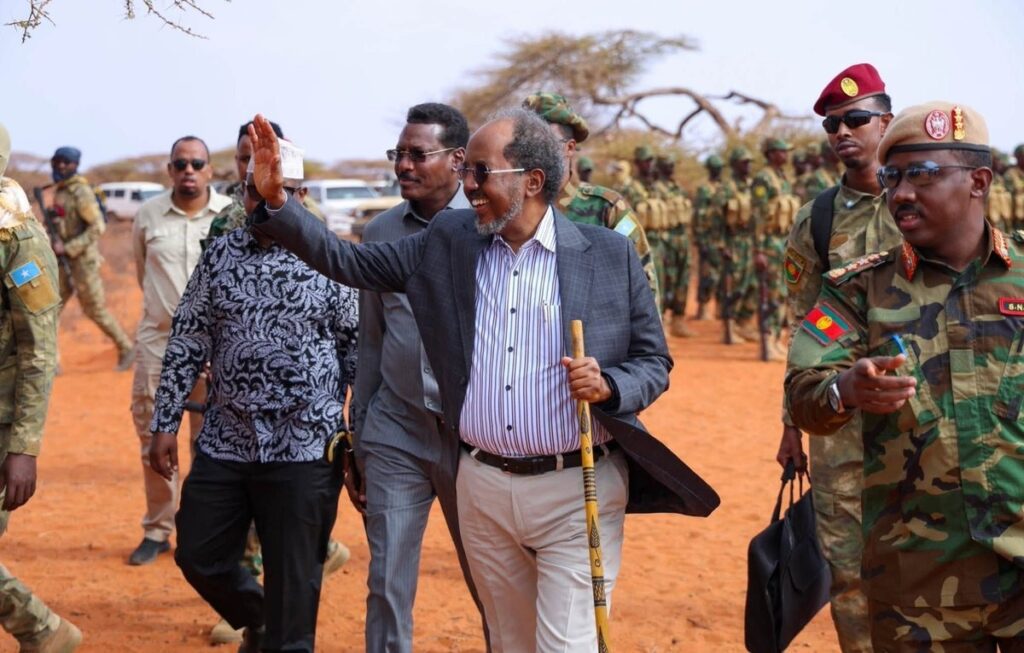
Somali President Hassan Sheikh Mohamud has said his country is now capable of taking full responsibility for its security.
He asked the African Union peacekeepers to leave Somalia after nearly two decades of fighting Al-Shabaab militants.
Speaking in Galmudug on Sunday, Mohamud said Somalia had reached a point where it could manage its own security and thanked the African troops for their contribution.
“We have reached a point where we can now take full charge of our security. Let’s give African peacekeepers a bunch of flowers and send them home,” he said.
The statement comes at a significant moment for Somalia, where the African Union is already transitioning out of its long-running security role while other foreign powers, particularly Turkey and the United States, remain deeply involved in building and supporting the Somali security forces.
Turkey has established one of the most extensive bilateral military relationships with Mogadishu, including a major training base, while the United States continues to provide intelligence, training and air support.
Egypt has also joined the current AU mission with troops, while Uganda and Ethiopia maintain forces in Somalia outside their formal AU deployments.
The result is that Somalia’s security transition is not simply a withdrawal of foreign troops. It is a shift from a predominantly African multinational military presence towards a more fragmented system of bilateral foreign military partnerships.
The African Union Mission in Somalia, AMISOM, was established in 2007, with Uganda becoming the first country to deploy troops. Burundi subsequently joined, followed by Djibouti, Kenya, Sierra Leone and Ethiopia.
The mission became the principal international ground force fighting Al-Shabaab and supporting Somalia’s fragile federal government.
Ugandan and Burundian forces played a particularly important role in the battles that pushed Al-Shabaab out of Mogadishu. The African forces subsequently participated in operations that helped the Somali government regain control of major towns and strategic areas.
AMISOM also protected government institutions, supported humanitarian access and helped create the security conditions for Somalia’s political transition.
The cost was heavy. AMISOM became one of the African Union’s longest-running and deadliest operations, with troops repeatedly targeted by Al-Shabaab. Uganda, which remained the largest contingent for much of the mission’s history, suffered significant casualties during the deployment.
Records from AMISOM’s medical facilities alone documented hundreds of fatalities and injuries during the mission’s early years.
AMISOM was replaced by the African Union Transition Mission in Somalia, ATMIS, in 2022, as the AU began implementing a phased transfer of security responsibility to Somali forces.
ATMIS was itself replaced by the African Union Support and Stabilisation Mission in Somalia, AUSSOM, on January 1, 2025.
The objective remained broadly the same: strengthen Somali forces while progressively reducing the need for foreign troops.
Somalia has since taken control of a number of former AU forward operating bases. By April 2025, the Somali government reported that its forces had assumed control of 23 such bases since January 2023.
But the transition has not been straightforward. AUSSOM has faced serious financing and logistical difficulties, while its future has been complicated by disagreements over troop contributions and funding.
Mohamud’s call therefore comes as the AU mission is already under pressure to reduce its role.
Turkey’s expanding military footprint
While the African mission has been shrinking, Turkey has steadily increased its influence over Somalia’s security forces.
Turkey established Camp TURKSOM in Mogadishu in 2017, its first overseas military base, and has used the facility as the centre of a long-running programme to train and equip the Somali armed forces.
Turkey has trained at least 16,000 Somali soldiers, including members of the Gorgor commando units, according to an April 2026 assessment by the Critical Threats Project.
Turkish military personnel in Somalia also increased from about 400 to roughly 800 in early 2025, while Turkey’s parliament has authorised the deployment of as many as 2,500 troops.
The relationship has expanded beyond basic military training.
In 2024, Turkey and Somalia signed a defence and economic cooperation agreement that gave Ankara a long-term role in developing Somalia’s maritime security capabilities, including rebuilding, equipping and training the Somali navy.
Turkey’s parliament approved another two-year extension of its military deployment in Somalia in July 2026, allowing its forces to continue providing training, advisory and counterterrorism support.
The significance of Turkey’s role is therefore not simply the number of Turkish soldiers in Somalia -Ankara is helping shape the Somali military itself.
Its training programmes have produced thousands of soldiers, including elite Gorgor commandos, who are now among the forces being deployed against Al-Shabaab.
That gives Turkey an influence different from the one exercised by AMISOM. The AU deployed a multinational force to fight alongside Somali forces. Turkey is helping build the Somali forces that are expected to replace that foreign combat role.
The scale of the Turkish partnership is becoming clearer as Mohamud prepares another major offensive against Al-Shabaab.
More than 5,000 newly trained Somali soldiers recently completed almost a year of training at Xananbuure in Galguduud. The training covered combat tactics, weapons handling, communications, battlefield medical skills and other military specialities.
At the same time, 1,521 soldiers from the 21st Gorgor Brigade have completed commando training in Turkey and are returning to Somalia, while another 1,523 soldiers are scheduled to begin training there.
The forces are being prepared for the government’s renewed campaign against Al-Shabaab.
The development gives Ankara a direct stake in the capabilities of the Somali military at a time when Mogadishu is seeking to reduce reliance on the African peacekeeping force.
A different security architecture
Somalia is consequently moving towards a security model that looks very different from the one that existed during the height of AMISOM.
During the AMISOM years, the central foreign military presence was a multinational African force operating under an AU mandate. Uganda and Burundi initially carried much of the fighting, while Kenya, Ethiopia, Djibouti and Sierra Leone later joined the operation.
Today, Somalia’s security architecture is divided among the Somali National Army, AUSSOM, Turkish forces, US military personnel and capabilities, bilateral Ugandan and Ethiopian deployments, Egyptian troops and other foreign partnerships.
This fragmentation could give Mogadishu more flexibility, but it also creates competing foreign interests and different chains of influence.
Turkey’s role is particularly significant because its influence extends into the structure of the Somali armed forces themselves.
The United States has specialised capabilities. Egypt is now part of the AU deployment. Uganda retains a major operational role, both through AUSSOM and bilateral arrangements.
And other regional powers maintain security relationships with Somalia’s federal government or regional administrations.
Somalia is therefore not moving from foreign security involvement to complete military independence. It is moving from one dominant model of foreign involvement to several.
Mohamud’s political challenge
The president’s announcement also comes as he faces a political struggle with Somalia’s federal member states.
His visit to Galmudug has heightened tensions with Puntland, which earlier placed its security forces on alert and accused the federal government of seeking to provoke instability in Galkayo.
The dispute reflects a broader struggle over the balance of power between Mogadishu and Somalia’s semi-autonomous regional administrations.
Galmudug is particularly important because of its strategic location in central Somalia and its position around Galkayo, a divided city on the Puntland-Galmudug frontier.
Greater federal control over security forces in Galmudug would strengthen Mogadishu’s position in its disputes with more autonomous administrations such as Puntland and Jubaland.
That makes the development of a national army more than a military issue. It is also a question of political power.