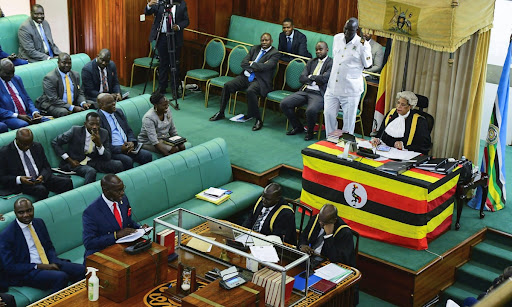
A joint committee of Parliament has raised glaring gaps in the Protection of Sovereignty Bill, 2026, warning that its current form could affect the economy, civil society and key national institutions.
The House committee on defence and internal affairs and the committee on legal and parliamentary affairs reviewed the Bill after consulting more than 200 stakeholders, including government agencies, civil society groups, financial institutions, and the diaspora.
The report ,which has been tabled before Plenary on Tuesday has been signed by several members of the committee. The committee sessions were chaired by Wilson Kajwengye and Stephen Baka Mugabi.
The report that has been widely shared on Tuesday (May 5, 2026), ahead of Parliament, says while the Bill seeks to protect Uganda from foreign interference, several of its provisions are too broad and unclear.
Lawmakers found that definitions of “foreigner” and “agent of a foreigner” could extend to ordinary activities such as business transactions, research partnerships, and diaspora support. The Bill is listed on the Order Paper for consideration during this afternoon’s parliamentary sitting.
The Committee warned that the Bill risks shifting power away from citizens, contrary to the Constitution, which vests sovereignty in the people. It was observed that the proposed law places heavy control in the hands of the minister responsible for internal affairs, raising concerns about unchecked authority.
Stakeholders, including civil society organisations, opposed the bill, cautioning that it could restrict civic space and limit the operations of non-governmental organisations. Financial institutions raised fears that tighter controls on foreign funding could disrupt remittances, investment flows, and banking systems.
The report highlights that the Bill creates a parallel regulatory framework that overlaps with existing institutions such as the Bank of Uganda and other regulators, which could lead to confusion and increased compliance costs.
Lawmakers further pointed to vague offences like “economic sabotage,” warning that a lack of clarity could lead to arbitrary enforcement and discourage lawful activities such as journalism, research, and advocacy.
The committee recommended sweeping amendments to narrow the scope of the Bill. These include limiting its application to individuals acting directly on behalf of foreign interests, exempting legitimate activities like business and academic work, and replacing strict approval requirements with a system of declaring foreign funds.
It proposed reducing penalties, clarifying offences, and removing provisions that grant excessive powers to the Minister.
Despite the concerns, the Committee backed the bill’s objective of safeguarding national sovereignty and recommended that it proceed to Parliament for second reading after the proposed changes are incorporated.
Purpose of the Bill
The Bill seeks to protect Uganda’s sovereignty by regulating foreign influence, including:
• Registration of agents acting for foreign interests
• Control of foreign funding
• Prevention of external interference in governance and policy
Key findings
• Broad and unclear definitions: Terms like “foreigner” and “agent of a foreigner” are too wide and could affect ordinary activities such as business, research, and diaspora support.
• Conflict with the Constitution: Sovereignty belongs to the people under the Constitution, yet the Bill shifts power toward the State.
• Excess powers to the Minister: The Minister of Internal Affairs is given wide authority, raising concerns about abuse and a lack of checks and balances.
• Duplication of regulation: The Bill creates parallel systems that overlap with existing regulators like the Bank of Uganda and others.
• Economic risks: Restrictions on foreign funding could disrupt remittances, investment, banking, and financial systems.
• Vague offences: Crimes such as “economic sabotage” are not clearly defined, creating risk of misuse.
• Impact on key sectors: Academia, health, and innovation systems could suffer due to limits on international collaboration.
Stakeholder concerns
• Civil society groups warned of shrinking civic space
• Private sector raised fears of investment decline
• Financial institutions flagged risks to economic stability
• Researchers and health experts cautioned against disruption of partnerships
Key recommendations
• The Committee proposed major amendments, including:
• Limit the law to agents of foreign influence, not all individuals
• Exempt remittances, business, research, health, and religious activities
• Replace approval systems with a declaration of funds
• Reduce penalties and clearly define offences
• Remove excessive powers from the Minister
• Exclude regulated institutions like banks from the law
• The Committee supports the Bill’s objective but says it must be amended to:
• Align with the Constitution
• Protect economic stability
• Avoid overregulation and abuse
• The Bill is recommended to proceed to Parliament with amendments.