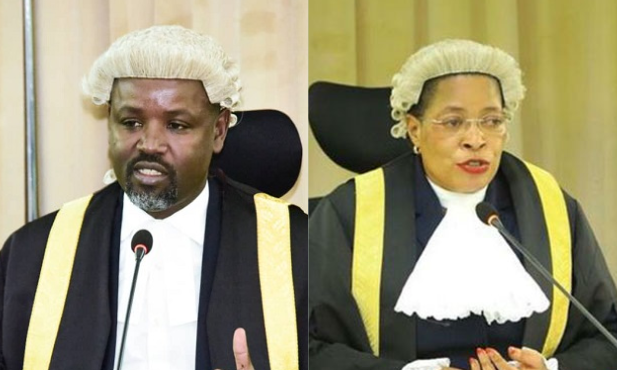
The High Court in Kampala has dismissed an application challenging the National Resistance Movement (NRM) Central Executive Committee (CEC) decision endorsing Ms Anita Annet Among and Mr Thomas Tayebwa as the party’s flag bearers for Speaker and Deputy Speaker of Parliament, respectively, in the 12th Parliament.
In a ruling delivered by Justice Collins Acellam on May 11, 2026, the court held that the application brought by Mr Jack Nsubuga, alias Mandela, was incompetent for lack of standing and failure to exhaust internal party dispute resolution mechanisms.
The case arose from a judicial review application in which the applicant sought orders of certiorari to quash the CEC decision, prohibition to stop its implementation, and mandamus compelling a more participatory internal process.
According to court documents, the contested decision was made on January 29, 2026, during a Central Executive Committee meeting held at State House, Entebbe, where the NRM endorsed Among and Tayebwa as flag bearers.
The applicant challenged the process, arguing that it was exclusionary and inconsistent with internal party democracy, particularly after what he described as a “nationwide digital registration and expansion” of NRM membership.
He further alleged that eligible members of the NRM parliamentary caucus were not given an opportunity to express interest or compete for the positions.
“The endorsement process did not accord an opportunity to other eligible members within the National Resistance Movement Parliamentary Caucus to express interest in the said positions,” the ruling quotes the applicant as arguing.
He also claimed the process violated constitutional principles of fairness, participation, and natural justice.
Court on internal party democracy
The court, however, found that the dispute arose from internal party structures and processes governed by the NRM Constitution and caucus rules.
Quoting the ruling, Justice Acellam stated: “Courts are guardians of legality, not supervisors of political strategy or internal caucus preferences.”
The judge added that judicial review is concerned with legality of process, not the political merits of internal party decisions.
A central ground for dismissal was the applicant’s failure to exhaust internal NRM mechanisms before approaching court.
“I am not satisfied that the Applicant demonstrated exhaustion of the internal dispute resolution mechanisms established within the constitutional framework of the 1st Respondent before instituting these proceedings,” the judge said.
The court emphasized that exhaustion is a mandatory legal requirement under the Judicature (Judicial Review) (Amendment) Rules, 2019.
“The doctrine of exhaustion is neither ornamental nor merely procedural. It is grounded in sound constitutional and institutional principles,” the judge held.
The court also found that the applicant lacked sufficient legal standing, noting that he was neither a Member of Parliament nor part of the NRM Parliamentary Caucus eligible for the positions under challenge.
“The Applicant did not establish sufficient standing to maintain these proceedings,” the court ruled.
Justice Acellam further warned against premature judicial interference in internal political processes.
“To hold otherwise would risk converting this Court into the first forum for resolution of every internal political disagreement arising within political organisations,” he said.
The court ultimately dismissed the application, but declined to award costs, noting that the matter raised broader questions about internal party democracy and the limits of judicial review.
“Each party shall bear its own costs,” the ruling concluded.
The ruling comes at a time when Parliament is setting up for a feisty election of the Speaker, with Democratic Party President Norbert Mao, who has in recent years taken a more cooperative stance with the government through political engagement frameworks, throwing the kitchen sink at Ms Among.
Mao, who is the justice minister under the NRM-DP cooperation agreement, believes he has earned the right to be considered by the insiders of the party ahead for the hot seat.
However, the case helps Ms Among’s push for a second term having taken over in the wake of Jacob Oulanyah’s death in 2022.