By Joseph Mary Buwule
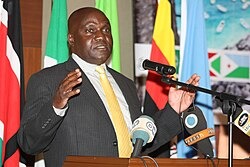
Veteran Ugandan statesman and long-serving legislator Crispus Kiyonga has made a high-profile return to Cabinet after being appointed Second Deputy Prime Minister and Deputy Leader of Government Business in Parliament by President Yoweri Kaguta Museveni.
The appointment follows his political comeback in the recently concluded general elections, where he reclaimed the Bukonzo West seat, marking a return to active parliamentary politics after years of diplomatic and academic service abroad. His re-entry into Cabinet is widely interpreted as a reinforcement of experienced leadership within Uganda’s executive arm.
Kiyonga is regarded as one of Uganda’s most experienced public servants, with a political career spanning several decades and multiple senior government positions that have shaped the country’s governance, security, health, and economic policy direction.
Over the years, he has held several influential ministerial roles, including Minister of Defence, where he oversaw national security and military institutional development during a period of regional stability. He also served as Minister of Finance, Planning and Economic Development, contributing to macroeconomic reforms and fiscal policy management aimed at sustaining Uganda’s growth trajectory.
He previously served as Minister of Health, where he played a central role in strengthening public health systems, improving service delivery, and supporting national responses to disease control and health sector reforms.
Following his 2016 electoral defeat in Bukonzo West, Kiyonga transitioned into diplomacy, serving as Uganda’s Ambassador to China, one of the country’s most strategic international postings. He later took on academic leadership as Chancellor of Makerere University, where he provided strategic oversight in the institution’s ceremonial and governance functions.
His long parliamentary career, which began in 1980, has been marked by consistent participation in national policy debates, constitutional development, and constituency-level development initiatives.
Political analysts say his return to Cabinet signals renewed confidence in his administrative experience, institutional memory, and diplomatic exposure. They argue that his appointment could strengthen coordination between Parliament and the executive, particularly at a time when government is prioritizing economic transformation, infrastructure development, and improved service delivery.
Leaders from Kasese District and the wider Rwenzori sub-region have welcomed the appointment, describing it as recognition of decades of national service and a source of pride for the region.
As Second Deputy Prime Minister and Deputy Leader of Government Business in Parliament, Kiyonga is expected to play a central role in coordinating government legislative priorities, managing parliamentary business, and supporting policy implementation across ministries.
His comeback is being viewed by observers as a reaffirmation of trust in veteran leadership within Uganda’s political establishment, especially at a time when effective coordination between the executive and legislature remains a key governance priority.
With his return to active Cabinet duty, expectations are high that his extensive experience across defence, finance, health, diplomacy, and academia will contribute to strengthening government coordination and legislative efficiency in the 12th Parliament.