By Joseph Kiggundu
KAMPALA.Economists, experts, and business leaders have advised government to exercise a high degree of transparency while formulating predictable policies if Uganda is to achieve its ambitious tenfold growth strategy, which targets expanding the economy from $50 billion in 2023 to $500 billion by 2040.
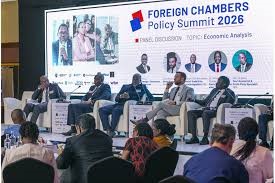
Discussing the impact of the FY2026/27 national budget on employment reforms and sovereignty legislation during the 2026 Foreign Chambers Policy Summit, the experts said Uganda can meet the target if transparency and accountability are upheld.
Ms Eve Zalwango, General Manager at the American Chamber of Commerce of Uganda, said the country holds strong potential as an investment destination driven by its youthful population and expanding regional trade opportunities.
“However, unlocking this potential requires consistent policy implementation. Policies that attract investors into the country are good for us all,” she said.
In a rejoinder, Mr Mark Turyamureba, Head of Legal at AmCham Uganda, said opportunities emerging from the economic transformation agenda will require a supportive policy environment.
“It will require policies that are predictable, transparent, consultative, and practical,” he said. “It will require a regulatory environment that supports innovation while safeguarding national interests, and it will require strong partnerships between government and the private sector.”
Stakeholders said policy certainty will be critical in attracting investment, creating jobs and sustaining long-term economic growth as Uganda pursues industrialization, value addition, export promotion, digital transformation, infrastructure development and regional trade integration.
Uganda in 2023 launched the Tenfold Growth Strategy, a plan to expand GDP from roughly $50 billion to $500 billion by 2040. To realise it, government zeroed its focus on four priority sectors code-named ATMS: Agro-industrialisation, Tourism, Mineral development, and Science/Technology innovation.
Government has been aligning budgets and development plans to these areas. The fourth National Development Plan, launched last year and running from FY2025/26 to FY2029/30, aims at accelerating socio-economic transformation. The Shs84 trillion budget read by the Finance Minister last week is also aimed at advancing this growth agenda.
Mr Turyamureba described the national budget as more than a fiscal document because businesses closely monitor government spending priorities when making decisions on expansion, hiring and long-term investments.
“Uganda has set itself an ambitious vision of transforming into a 10-fold economy, and the timing of this summit could not be more important as stakeholders come together to strengthen the investment climate and build the policy environment needed for sustainable economic growth and development,” he said.
Business leaders noted that employment reforms remain central to Uganda’s growth agenda, adding that creating a more competitive labour market, strengthening workforce development, and fostering an environment where businesses can thrive is key to tackling unemployment that undermines growth.
Economists and bankers emphasised policy predictability and transparency, noting that confidence remains the foundation for investment and long-term development.
Investors, they said, need assurance through clear policies, reliable institutions, respected contracts, and sustained dialogue between public and private sectors to attract and retain them.
The policy and investment summit was organized by AmCham Uganda in collaboration with the British Chamber of Commerce, the French Chamber of Commerce and the Netherlands-Uganda Trade and Investment Platform.
Anna Grodzki, Managing Director of Matooke Tours and a NUTIP board member, said collaboration among chambers over the past 18 months had strengthened private sector advocacy and engagement with government institutions.
“We take our role very seriously in policy engagement and advocacy because we do see that this is one of the main advisors we can give to our membership spaces,” Grodzki said.
She said joint engagements with the Ministry of Finance, Parliament and government agencies had enabled businesses to raise concerns and recommendations on issues affecting investment and operations.
Grodzki noted that policymakers had shown willingness to listen, though more structured engagement and data-sharing were needed.
“We often find that there’s a lack of data or a lack of engagement with the private sector in a very sustainable and substantial way,” she said.