By Joseph Kiggundu
LAMU, KENYA — President Yoweri Museveni has backed plans to establish a 700,000-barrel-per-day oil refinery in Kenya, saying East African countries should develop multiple refining facilities and process their natural resources locally to create jobs and accelerate industrialisation.
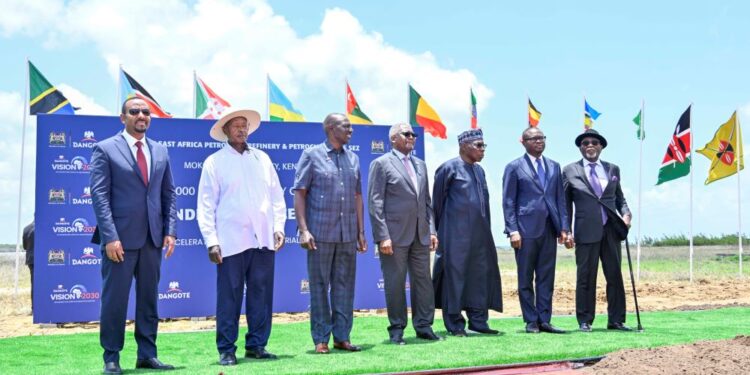
Museveni made the remarks in Lamu County on Wednesday during the groundbreaking of the Dangote East Africa Petroleum Refinery and Petrochemicals Special Economic Zone, a project expected to include a refinery, petrochemical facilities and power-generation infrastructure.
The ceremony brought together Kenyan President William Ruto, Nigerian businessman Aliko Dangote and other African leaders and government representatives.
Museveni said Uganda remained committed to developing its own refinery despite the planned Kenyan facility, arguing that the two projects could serve different markets and complement other refining investments in the region.
“We are going to build a small refinery in Uganda. We had planned this long ago. We can’t change that,” Museveni said, adding that Uganda’s refinery would serve the domestic market and countries in the interior of Africa.
He also said he intended to discuss with Presidents Ruto and Samia Suluhu Hassan the status of a proposed refinery in Tanzania’s Tanga region, which he said had stalled.
Museveni argued that East Africa could accommodate refineries in Kenya, Uganda and Tanzania alongside facilities elsewhere on the continent, provided countries coordinate their investments and markets.
He said Africa has for decades lost economic opportunities by exporting raw materials and importing processed products, arguing that value addition would create employment and increase earnings from commodities.
Using coffee as an example, Museveni said the value of the commodity rises substantially when it is processed, roasted, ground and packaged instead of being exported in raw form.
He said Uganda’s experience with oil had reinforced the need for domestic processing capacity, recalling that some people had previously questioned whether a refinery would be economically viable.
Museveni also linked refinery development to his long-standing call for deeper East African integration, saying regional cooperation would allow countries to share investment, employment and industrial opportunities.
He cited discussions with Ruto over a proposed iron ore processing plant in Mombasa, questioning how Uganda would maximise employment benefits if its raw materials were processed outside the country.
Museveni also welcomed Dangote’s proposal to reserve up to 30 per cent of the refinery’s equity for East African countries, but said regional ownership alone would not resolve concerns about employment opportunities.
President Ruto described the Lamu project as a major investment in Kenya’s industrialisation and energy security, saying it would turn a long-standing proposal into a major industrial venture.
He said local communities should benefit through employment, skills development and opportunities for businesses to supply the project with goods and services.
Ruto called on universities and technical institutions to prepare welders, technicians, engineers, managers and other professionals needed to support the refinery and associated industries.
Dangote, the chairman and chief executive of Dangote Industries Limited, said the investment was aimed at reducing Africa’s dependence on imported petroleum products by increasing local refining and manufacturing capacity.
“Africa cannot build lasting prosperity by exporting what it has and importing what it needs. We must produce more of what we consume; we must process more of what we produce,” Dangote said.
He said the company planned to establish a training school for 1,000 local residents and estimated that the project could create or support about 60,000 jobs during construction.
Dangote said he expected the facility to be commissioned within 40 months and disclosed that the estimated investment in the refinery and associated facilities stood at about $16 billion.
According to the project details presented at the ceremony, the facility will be located along the Lamu Port-South Sudan-Ethiopia Transport (LAPSSET) Corridor and is expected to process crude from Kenya’s Lokichar fields in Turkana and other regional sources.
The refinery is expected to serve markets in Kenya, Uganda, Tanzania, Ethiopia, South Sudan and the Democratic Republic of Congo, while complementing other regional energy infrastructure, including the East African Crude Oil Pipeline linking Uganda’s oil fields in Hoima to Tanga in Tanzania.
Dangote also said his group had earmarked about $50 billion for investments in infrastructure, minerals, ports, power, chemicals and other sectors by 2030.
Other leaders attending the groundbreaking included Togolese President Jean-Lucien Savi de Tové, Ethiopian Prime Minister Abiy Ahmed and former Nigerian President Olusegun Obasanjo. Delegations from Burundi, Rwanda, South Sudan and Tanzania also attended.
Lamu Governor Issa Timami welcomed the investment, saying the project could expand employment, business opportunities and infrastructure development in the county.