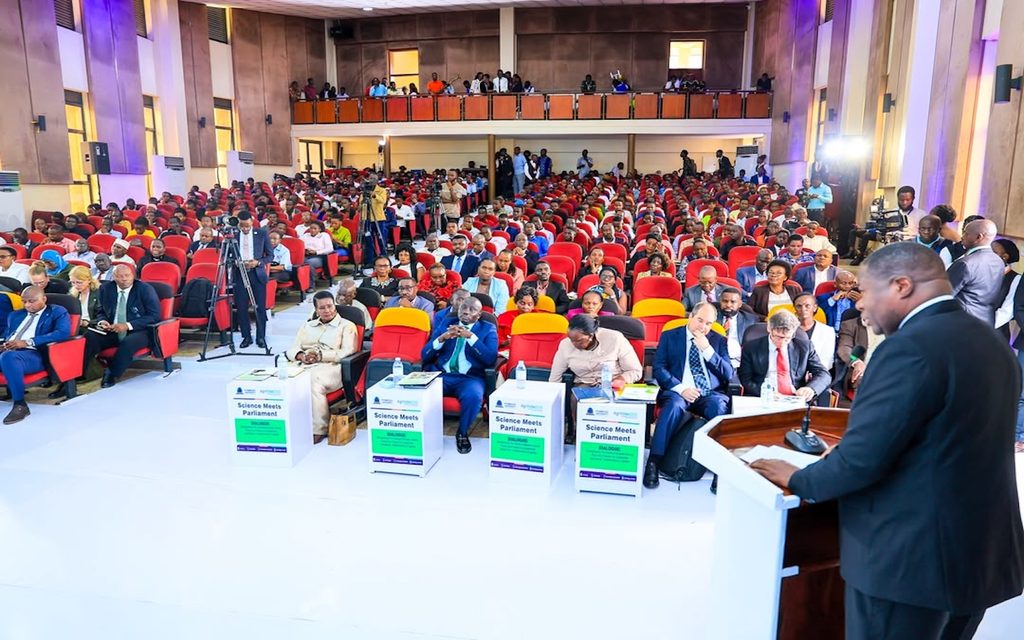
Speaker Oboth addressing the participants at Kyambogo University
By Sulaiman Kauki
Speaker of Parliament Jacob Marksons Oboth has challenged Uganda’s researchers and scientists to present evidence of gaps between scientific research and government policy, pledging parliamentary action to address the challenges.
Oboth said Parliament was ready to investigate cases where scientific findings fail to influence policymaking, resource allocation and implementation, adding that those responsible would be held accountable.
“We would want to be petitioned and shown where the disconnect is, so that we can address it,” Oboth said.
He made the remarks on Thursday, November 12, 2026, while delivering the keynote address at Kyambogo University during the Science Meets Parliament dialogue organised by the AgriFoSe2030 Uganda Hub.
The dialogue was held under the theme, Strengthening the Interface between Science, Policy and Practice for Sustainable Agricultural Transformation in Uganda.
Oboth observed that Uganda has numerous policies, research institutions and qualified experts but continues to struggle to translate scientific knowledge into practical interventions that benefit communities.
He urged researchers to move beyond publishing academic findings and develop practical recommendations that can inform government decisions and improve service delivery.
“We have many think tanks. Perhaps it is time to develop action tanks,” he said.
The Speaker pledged to use Parliament’s legislative, budgetary and oversight responsibilities, particularly through relevant committees, to identify and address institutional and policy barriers affecting the application of research findings.
Kyambogo University Vice-Chancellor Prof. Eli Katunguka highlighted the institution’s efforts to strengthen research through an internal grant scheme introduced around 2018, initially supported with Shs1 billion from the university’s internally generated revenue.
He said government had provided an additional Shs3 billion this year to support research activities.

Oboth (C) being received on arrival at Kyambogo University
However, Katunguka raised concerns about staffing shortages in public universities, revealing that institutions are operating with only 34 to 35 per cent of their required workforce.
He also cited difficulties in retaining highly qualified professionals, particularly engineers with PhDs, who are attracted by better remuneration in the private sector.
The Vice-Chancellor proposed the establishment of a parliamentary science-policy dialogue platform and a Centre of Excellence for Science Translation at Kyambogo University to strengthen collaboration between researchers and policymakers.
Meanwhile, Prof. Elisabeth Rajala, Programme Director of AgriFoSe2030, said the programme was marking 10 years of promoting the use of scientific knowledge in addressing sustainable development challenges.
She explained that the initiative, led by the Swedish University of Agricultural Sciences and funded by the Swedish International Development Cooperation Agency (Sida), operates through three regional hubs in Uganda, Kenya and Zimbabwe.
In Uganda, the programme is jointly managed by Kyambogo and Gulu universities.
Rajala expressed concern that much scientific research remains confined to academic publications instead of reaching policymakers, farmers and local communities who could benefit from it.
She emphasised that research only creates meaningful impact when its findings are communicated effectively, understood and translated into practical action.