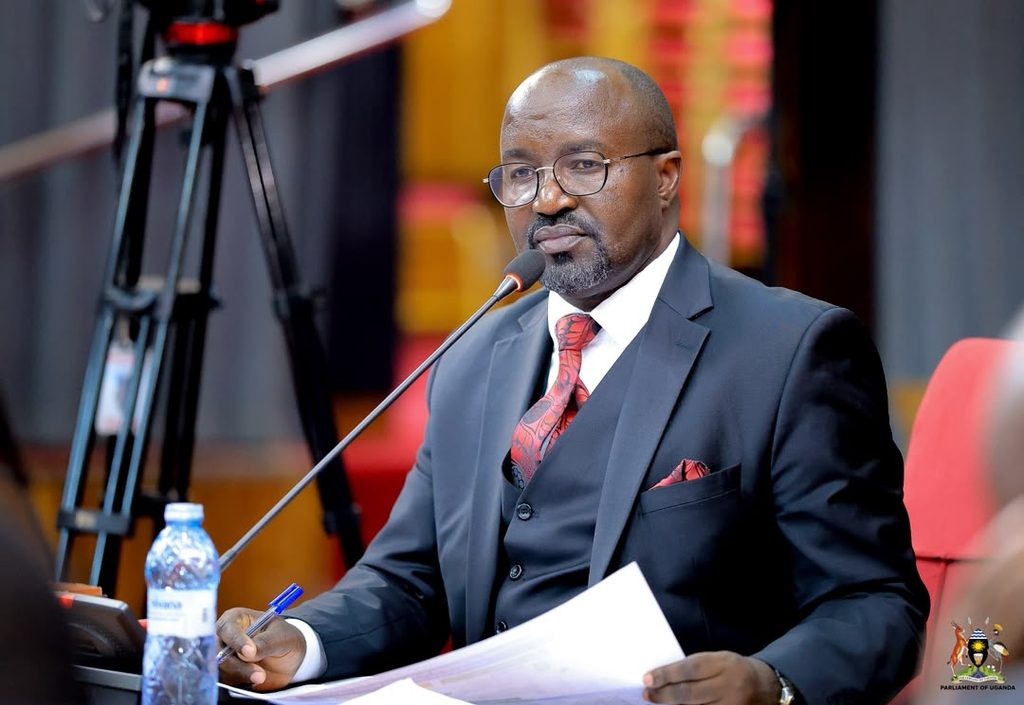
Hon. Patrick Nsamba
By Sulaiman Kauki
KAMPALA — Parliament’s Public Accounts Committee has challenged government project managers to provide evidence that development projects are delivering lasting benefits to citizens, rather than simply counting completed buildings and other physical outputs.
The committee’s Central Government chairperson, Patrick Nsamba, said the success of a public project should ultimately be measured by the changes it creates in people’s lives and the economy.
Nsamba was speaking on Tuesday, October 6, 2026, when the team responsible for implementing the 10-year Competitiveness and Enterprise Development Project (CEDP) appeared before the committee to account for the project’s expenditure, implementation and results.
Funded by the World Bank and implemented in two phases from 2014 to 2024, CEDP supported reforms in areas including land administration, business registration, tourism development and private-sector growth. The project team told MPs that approximately US$202.3 million (about Shs800 billion) had been spent during the implementation period.
Among the achievements presented to the committee were 22 zonal offices for the Ministry of Lands, a National Land Information System and the digitisation of business registration services.
Nsamba, however, said completion of such projects does not automatically demonstrate that the intended objectives had been achieved.
“I think going forward, among the things that we must always do at the end of the project cycle is to evaluate those indicators,” Nsamba said.
He said project managers should be able to link activities completed at the beginning of a project to measurable outcomes at its conclusion, rather than relying primarily on output figures.
“If you set the indicators right in 2014 and now you are in 2024, you are closing the project, you must be able to attribute certain outcomes out of this, other than talking about outputs at the end of the project,” he added.
Nsamba questioned the economic and social benefits arising from some of the infrastructure financed under CEDP, including tourism facilities.
“Yes, you constructed the building. But how did it improve the business environment?” he asked. “Yes, you did the hotel in Jinja. But which contribution did it make?”
CEDP project manager John Marie Kyewalabye told the committee that the programme had contributed to significant institutional and regulatory changes. He said the time required to register a business had fallen from 33 days to about a day, with some services now available online.
The project also supported the Uganda Hotel and Tourism Training Institute, Uganda Tourism Board and Uganda Wildlife Authority, while 312 micro, small and medium enterprises received matching grants amounting to US$2.79 million.
Kyewalabye said the tourism interventions were intended to improve the skills of Ugandans and strengthen the country’s hospitality industry. He said an application hotel was constructed at the Uganda Hotel and Tourism Training Institute to give students practical training, alongside the reconstruction of the institution’s administration block and lecture facilities.
Project officials also linked the reforms to growth in business registrations and non-tax revenue. However, MPs questioned whether the increases could be attributed directly to CEDP, given that the beneficiary institutions continued receiving funding from government.
Ignatius Wamakuyu, the independent MP for Elgon County, also questioned how government would repay the World Bank financing and whether mechanisms had been established to recover project-related investments through fees and charges from land registration, as envisaged under the financing arrangement.
The committee further questioned the project’s claim that its interventions had contributed to more than US$320 million in non-tax revenue. Nsamba said the project team needed to demonstrate, using a clear methodology, how much of the revenue could actually be attributed to CEDP.
Fredrick Angura, the NRM MP for Tororo South County, meanwhile questioned whether some CEDP activities duplicated programmes already being implemented by government ministries, departments and agencies. He asked the project team to explain how its plans were coordinated with the institutions that benefited from the interventions.
Although an independent assessment presented to the committee rated CEDP’s implementation as successful, MPs stressed that completing planned activities and meeting implementation targets should not be confused with demonstrating long-term development impact.
The committee said future assessments of government projects should therefore focus more closely on measurable outcomes, sustainability and the extent to which public and borrowed funds produced the benefits for which they were approved.