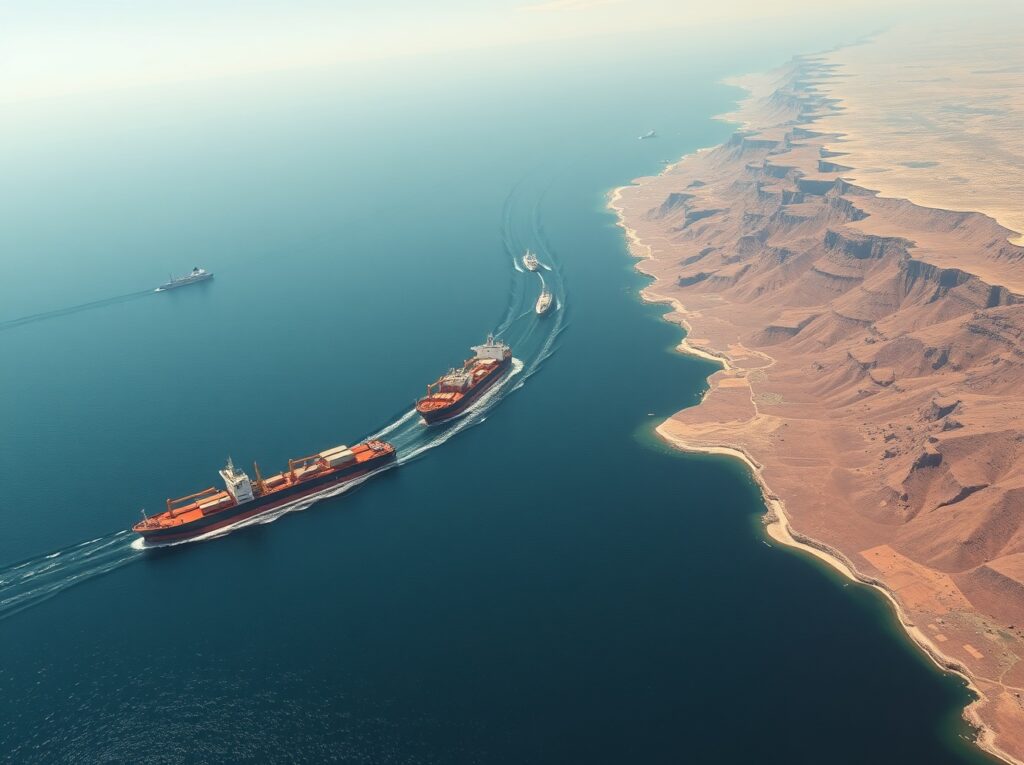
TEHERAN.The reopening of the Strait of Hormuz has excited traders and transporters across the globe giving renewed hope of smooth shipping of goods across Asian continent.
On Friday Iran declared the Strait of Hormuz open to commercial vessels during a ceasefire period, but restrictions, military oversight, and industry caution continue to cast uncertainty over one of the world’s most critical oil transit routes.
Iran has announced the reopening of the Strait of Hormuz to commercial shipping, with Foreign Minister Abbas Araghchi stating in a post on X that “passage for all commercial vessels through [the] Strait of Hormuz is declared completely open for the remaining period of the ceasefire.
”The announcement links the move to a broader ceasefire arrangement in Lebanon, with Iran indicating that shipping would now operate along a “coordinated route” previously outlined by the country’s Ports and Maritime Organisation.
“In line with the ceasefire in Lebanon, the passage for all commercial vessels through Strait of Hormuz is declared completely open for the remaining period of ceasefire, on the coordinated route as already announced by Ports and Maritime Organisation of the Islamic Republic of Iran,” said Iranian foreign minister Abbas Araghchi.
Iranian state media further quoted a senior military official as saying that commercial vessels would be allowed to pass only through a designated route, and under the supervision or permission of the Islamic Revolutionary Guard Corps (IRGC) Navy.
The same official reportedly confirmed that military vessels would remain barred from transiting the strait.Seyyed Mahmoud Nabavian, an Iranian Member of Parliament and part of an Islamabad delegation, was also cited as saying that some commercial ships may be allowed passage “upon payment of tolls,” suggesting that access could still be subject to administrative or financial conditions.
Despite the official declaration of openness, early reactions from the shipping industry indicate continued caution.Several tanker operators told international media that they would not immediately resume transit through the waterway, citing safety concerns and uncertainty over enforcement.
One unnamed oil and gas tanker operator said the Iranian statement “doesn’t change anything” in practical terms, adding that companies were unwilling to be “the first to go through the strait.
”Another major shipping firm, Stena Bulk, said it was “monitoring developments closely” and would only transit when satisfied it was safe for crew and vessels.
The Strait of Hormuz remains one of the most strategically important maritime chokepoints in the world, carrying roughly 20% of global oil and liquefied natural gas trade.
At its narrowest point, the channel is just over 30 kilometres wide, linking the Persian Gulf with the Arabian Sea and serving key energy exporters including Saudi Arabia, Iraq, Kuwait, Qatar, the United Arab Emirates, and Iran itself.
The announcement had immediate economic effects, with global oil prices falling sharply. Brent crude dropped below $90 per barrel after previously trading above $98, reflecting market sensitivity to any disruption or easing of tensions in the region.However, uncertainty remains high due to conflicting signals. Iranian authorities have indicated that passage is conditional and regulated, while shipping companies continue to treat the situation as unstable.
The combination of restricted routing, military oversight, and potential tolls has reinforced doubts about whether the strait is fully normalising operations.US President Donald Trump also weighed in on the development in a post on Truth Social, declaring that the strait was “COMPLETELY OPEN AND READY FOR BUSINESS,” while also stating that a naval blockade would remain in force as it relates to Iran until ongoing negotiations are fully completed.
The mixed messaging underscores the fragile nature of maritime security in the region, where access to the Strait of Hormuz has long been a geopolitical pressure point.Iran has in the past used its strategic position to influence shipping movements and energy markets, and analysts note that even partial restrictions can have significant global economic effects.
For now, while the official declaration signals de-escalation, shipping firms and energy markets appear to be treating the situation with caution rather than certainty, awaiting clearer guarantees on safety and unrestricted passage.