KAMPALA.Uganda’s economy is on course for its fastest growth in decades, with government projecting a dramatic expansion driven by the commencement of commercial oil production later this year.
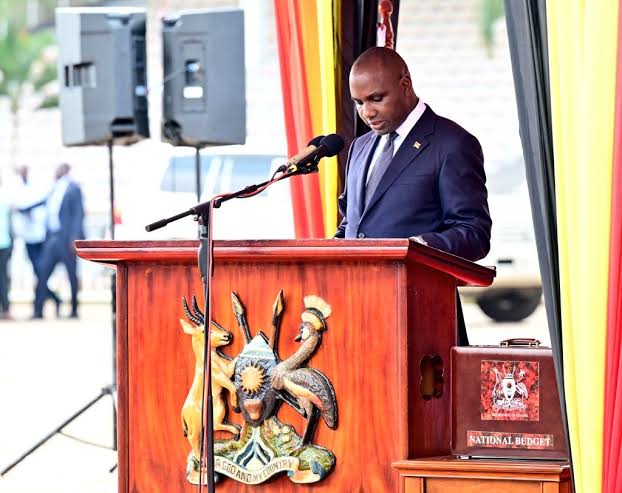
Presenting the National Budget for Financial Year 2026/27 at Kololo Ceremonial Grounds on Thursday, Minister of Finance, Planning and Economic Development Henry Musasizi said growth is expected to accelerate to 10.2% in FY 2026/27. That would mark Uganda’s first return to double-digit growth since the economic reforms of the 1990s.
“Most importantly, a larger economy will create more jobs, raise household incomes, expand opportunities for business, and generate the resources required to invest in quality education, healthcare, infrastructure, security, and other public services that improve the lives of Ugandans,” Musasizi said.
The minister said the projection reflects the success of government’s long-term strategy of investing in security, infrastructure, wealth creation and productive sectors.
Strong economic fundamentals
Despite global trade disruptions and economic uncertainty, Uganda’s outlook remains robust, according to government.
“The economy is stable. Growth is accelerating. Inflation is low. The exchange rate is stable. Exports are rising. Investment is increasing. And confidence in Uganda’s future remains strong,” Musasizi told Parliament and invited guests.
The economy is estimated to have grown by 6.4% in FY 2025/26, up from 6.3% the previous year. By June 2026, GDP is projected at Shs250.4 trillion, or $69.3 billion. GDP in purchasing power parity terms is estimated at $197.1 billion. Per capita GDP is projected to rise to $1,420, about Shs5.1 million per person.
Inflation remains under control
Inflation averaged 3.8% in FY 2025/26, compared to 3.5% the previous year, supported by fiscal-monetary coordination, stable food prices and improved fuel supply.
“Low inflation protects household incomes, supports business planning and strengthens investor confidence. Government remains committed to maintaining price stability as a cornerstone of sustained economic growth,” Musasizi said.
Investor confidence growing
Foreign Direct Investment hit $3.2 billion in the 12 months to March 2026. Start-ups in Kampala attracted about $30 million in 2025, up from $4 million the previous year.
“This surge signals growing confidence in Uganda’s innovation ecosystem and affirms our emergence as a destination for entrepreneurship, technology and investment,” Musasizi said.
Remittances from Ugandans abroad rose from $1.9 billion to $2.8 billion over the same period.
Tourism fully recovers
Tourism earnings rose to $1.86 billion in 2025, surpassing the $1.4 billion recorded before COVID-19 in 2018/19. The sector had dropped to $562 million in 2020.
To sustain momentum, government plans increased investment in tourism infrastructure, security and economic diplomacy through Uganda’s missions abroad.
Stable shilling, rising reserves, record exports
The Uganda shilling remains among Africa’s best-performing freely floating currencies. Foreign exchange reserves increased to $6 billion in the year to March 2026, from $3.6 billion a year earlier.
“We expect the exchange rate to remain broadly stable despite ongoing global uncertainties,” Musasizi said, crediting UNOC’s direct importation of petroleum products for easing FX pressure.
Export earnings reached $18.04 billion in the 12 months to March 2026, up from $5.93 billion four years ago. Coffee alone generated $2.46 billion, up from $1.84 billion. “Exports are the engine of Uganda’s transformation. They generate foreign exchange, create jobs, support enterprise growth and strengthen economic resilience,” he said.
Strong exports, remittances and investment inflows helped Uganda record a Balance of Payments surplus of $2.47 billion, the highest in 15 years.
Employment and revenue
Formal private-sector jobs grew from 672,300 in FY 2016/17 to over 2.3 million in FY 2024/25, a 245% increase. The services sector now accounts for 50.5% of employment, agriculture 37.1%, and industry 12.4%.
Domestic revenue is projected at Shs35.7 trillion in FY 2025/26, up from Shs32.3 trillion. It financed about 80.9% of the discretionary budget.
“Increasing domestic revenue is not merely a fiscal objective. It is a sovereignty objective,” Musasizi said.
Shs84.4 Trillion Budget for FY 2026/27
Total resources for FY 2026/27 are Shs84.39 trillion, funded by domestic revenue of Shs45.96 trillion, domestic borrowing Shs11.97 trillion, refinancing Shs13.97 trillion, external budget support Shs1.22 trillion, and project financing Shs11.27 trillion.
Key allocations: wages Shs9.71 trillion; non-wage recurrent Shs33.28 trillion; development Shs22.05 trillion; debt refinancing Shs13.97 trillion.
With oil production expected later this year and key indicators improving, government says Uganda is entering a new phase of accelerated growth that could transform the economic landscape and livelihoods nationwide.