By Joseph Kiggundu
JINJA.
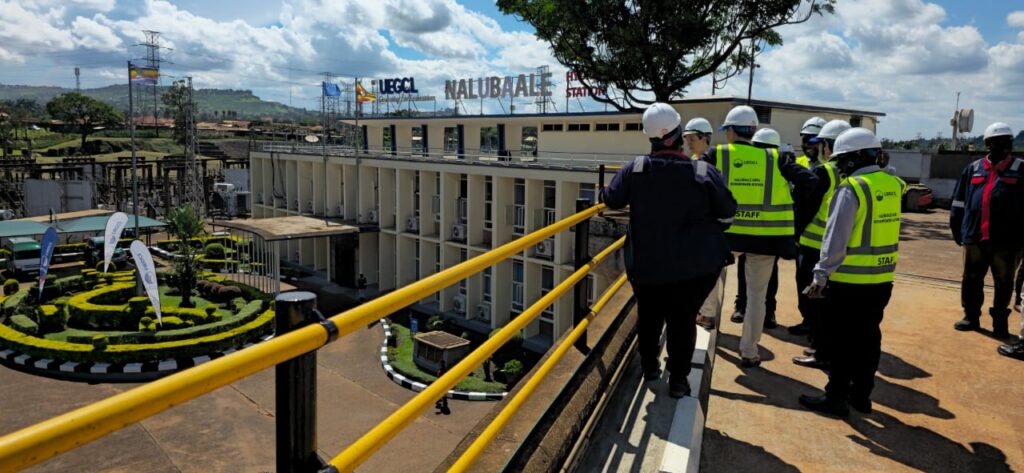
The government of Uganda is expected to spend Shs735billion on rehabilitating Nalubaale and Kiira hydropower stations in Jinja City.
The funds are expected to come from the government of France and the European Union.
The French Ambassador to Uganda, Virginie Leroy, reaffirmed the commitment during a recent visit to the two facilities, accompanied by officials from Agence Française de Développement (AFD).
The visit signals a critical step forward in plans to modernize Uganda’s oldest power generation infrastructure.
Constructed in 1954, Nalubaale is Uganda’s oldest hydropower plant with an installed capacity of 180 megawatts, while Kiira, commissioned in the 1990s, contributes 200 megawatts.
Both facilities are central to the country’s electricity grid but now require extensive upgrades to maintain efficiency, safety, and reliability.
Speaking during the visit, H.E Leroy emphasized that the project goes beyond infrastructure renewal, highlighting its socio-economic impact.
“This project is not only about energy generation but also about improving livelihoods through access to clean and affordable power, boosting businesses, and creating employment opportunities,” she said.
Under the financing arrangement, AFD will provide a €73 million soft loan (Shs315.73 billion) and a €2 million grant (Shs8.65 billion), while the European Union will contribute an additional €10 million grant (Shs43.25 billion).
Ambassador Leroy noted that further funding approvals are expected by the end of the year, following completion of necessary government and institutional processes.
She also revealed that France has invested more than €300 million in Uganda’s energy sector over the past two decades. These investments include flagship projects such as the Bujagali Dam, as well as key transmission and distribution initiatives like the Hoima transmission line and the Masaka–Mbarara grid expansion.
“We pay a lot of attention to ensuring people access affordable energy to improve their livelihoods and create opportunities,” she added.
The ambassador recalled visiting the dams in 2018, when discussions around refurbishment were still in early stages, expressing satisfaction that the initiative has now materialized.
She described the project as a model of strong bilateral cooperation between Uganda, France, and the European Union.
The rehabilitation works will include installation of modern turbines, upgrades to electromechanical systems, and enhanced engineering support to improve water flow management along the River Nile cascade.
This is expected to optimize power generation while safeguarding dam infrastructure.
“These dams are critical for the stability of electricity production, transmission, and distribution in Uganda. Without reliable energy, industrialization and job creation are constrained,” Leroy noted.
The project is also designed to enhance climate resilience, particularly in response to rising water levels on Lake Victoria, which have posed operational challenges in recent years.
According to George Tusingwire, Acting Chief Executive Officer of the Uganda Electricity Generation Company Limited (UEGCL), preparatory processes are already underway.
“We are finalizing the required documentation and approvals from both government and development partners. Once this is completed, we will proceed with procurement of contractors, with works expected to commence next year,” Tusingwire said.
He explained that the project will be implemented in phases. The first phase will include the installation of a modern 33kV substation to replace the aging system dating back to the 1950s, which has become increasingly difficult to maintain due to obsolete components.
Key interventions will also involve upgrading turbines and generators, modernizing control and protection systems, and deploying advanced monitoring technologies such as SCADA systems to improve plant operations and responsiveness.
“At Nalubaale, many internal systems—pumps, motors, switches, and power circulation components—are worn out and need replacement ,” Tusingwire said.