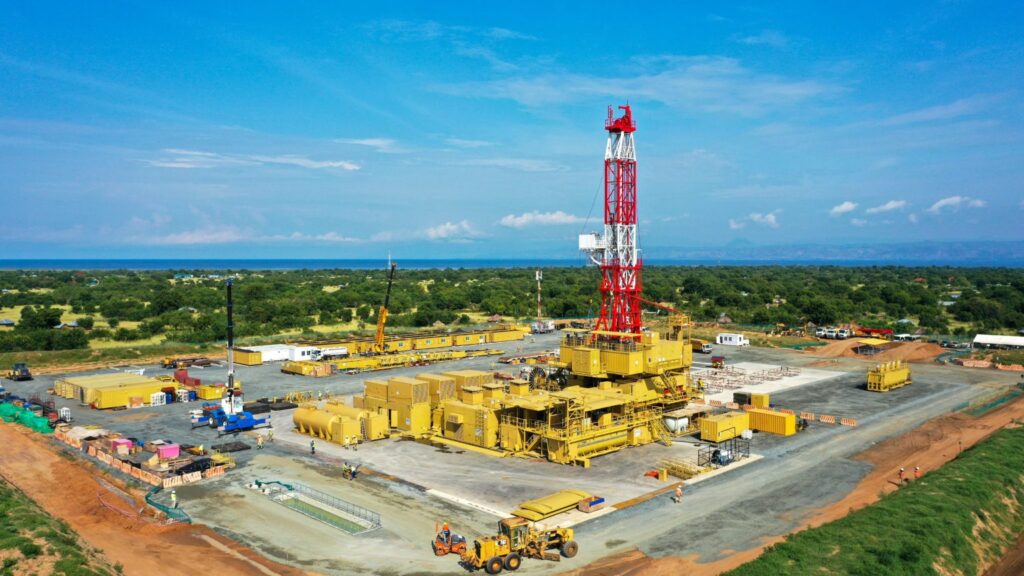
KAMPALA. With just a couple of months to Uganda’s first oil production, the country’s long-awaited entry into the oil-producing league is within touching distance after China National Offshore Oil Corporation (CNOOC) conducted a high-stakes emergency drill to test operational readiness, now pegged at 99 percent.
The government set July this year as the target for first oil production . The Kingfisher Development Area (KFDA) operated by CNOOC, will produce 40,000 barrels of crude oil per day during peak production and so far 18 wells out of the 31 have been drilled.
However, CNOOC said it is currently at the testing stage of equipment as the date approaches, having drilled 18 wells ready for initial production.
In an exclusive interview with Daily Monitor, Mr Andrew Mbigiti, the senior media and publicity supervisor at CNOOC Uganda Limited, said the drills are part of pre-commissioning activities aimed at ensuring operational readiness and safety before production begins.
“We are here for an emergency well control drill. The purpose of this drill is to help us prepare for an emergency and to test the equipment. We have invested in equipment that can be deployed in the event of any well control incident,” Mr Mbigiti said.
He added: “This drill helps to train Ugandans who operate this equipment while also testing whether it is fit for purpose. We have seen firefighting equipment capable of reaching up to 140 metres, which ensures operators can control fires from a safe distance.”
Mr Mbigiti said the exercise not only tests machinery but also equips national staff with hands-on experience in handling emergencies.
The exercise involved testing a range of specialised equipment, including fire pumps, cooling and protection systems, remote hydraulic sandblasting cutting devices, and high-temperature penetration cutting tools designed to handle extreme emergency scenarios such as well blow-outs.
During the drill, engineers demonstrated how fires can be extinguished before proceeding to more complex operations such as cutting through obstructing pipes to access a damaged wellhead.
The company showcased both hot cutting, which operates at temperatures of about 4,000 degrees Celsius, and cold cutting, which uses high-pressure water and sand.
“These methods allow us to safely remove damaged equipment and install a new wellhead. In an actual emergency, we do not need to repair components; we can replace the entire wellhead quickly to restore control,” Mr Mbigiti said.
He added that the timing of the drill is critical as Uganda transitions from the development phase to production. “You cannot wait for an incident to occur before preparing. Both equipment and personnel must be ready. We are currently in the pre-commissioning phase, where installed equipment is being tested to confirm that it functions properly,” he said.
Mr Adolf Karubanga, a senior petroleum officer, said emergency preparedness reflects the overall maturity of the sector. “A project is not ready merely because wells can be drilled or facilities constructed. It is ready when operators can demonstrate that they can prevent incidents, detect abnormalities early, and respond effectively to protect life and the environment,” he said.
Mr Mbigiti explained that Uganda’s oil sector, comprising Kingfisher, Tilenga and the East African Crude Oil Pipeline, requires a high level of coordination, as an incident in one segment could affect the entire value chain.
“What happens at one facility has implications for production systems, export infrastructure, environmental protection, and national confidence. That is why preparedness at Kingfisher must match standards across the entire sector,” he said.
Progress at the Kingfisher project is in its final stages, with officials reporting that the central processing facility is more than 99 percent complete. Mr Mbigiti said the company has drilled 18 new wells, in addition to four existing ones, which are sufficient to support initial production targets.
“We are now carrying out completions, which involve preparing the wells for production or injection. Once testing is done and systems perform as expected, we will be ready for production,” he said.
Ms Jane Byaruhanga from Petroleum Authority of Uganda (PAU) said they are updating operational oil spill contingency plans to align with the transition to the production phase, adding that drills are essential for identifying weaknesses and strengthening response systems.
“If drills go smoothly, it shows systems are working. If they do not, they help us identify gaps and fix them within a specified timeframe,” Ms Byaruhanga said.
UNOC, as the government nominee, holds 15 percent participating interest in the project. CNOOC Uganda Limited (operator) and TotalEnergies EP Uganda hold 28.33 percent and 56.67 percent respectively.